
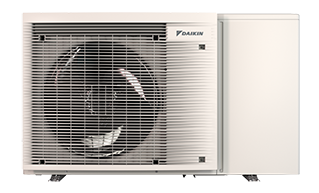
The Daikin Altherma 3 doesn't shout about itself, and Daikin doesn't shout about it either. It's the one premium heat pump on this list whose UK site publishes no headline COP or SCOP at all. What it does publish is the thing that actually matters if you live somewhere cold: an operating range down to -28°C on the high-temperature models. If you're in northern England, Scotland or anywhere elevated and exposed, that deserves your attention more than a brochure efficiency number does.
Cold weather is where it earns its money
Every heat pump loses efficiency as the outside temperature drops below zero. That's physics, not engineering: there's simply less heat in cold air to move. What separates the good ones is how far down they'll keep going at all. Daikin publishes operation down to -28°C for the Altherma 3 H HT (both the F and W variants) and the H MT F, and down to -25°C for the Altherma 3 R F. Those are not marketing numbers, they're on the product spec block for each model.
One correction first, because we had this wrong and so does most of the internet. "Flash injection" is Mitsubishi's term, the branding on its Zubadan compressors. It is not Daikin's. We searched every page on daikin.co.uk and the phrase appears nowhere on the site; the only vapour-injection language Daikin UK uses is on commercial chillers, not on any Altherma. Daikin names no low-ambient technology on its consumer heat pump pages at all. It just publishes the operating envelope and lets you draw your own conclusion, which is arguably the more honest approach.
In practical terms, for most of England and Wales this rarely decides anything. UK winters are far milder than the test conditions. For Scotland, northern England or anywhere elevated and exposed, it's a genuine advantage and worth paying for.
The specs
| Spec | Detail |
|---|---|
| Refrigerant | R32 (Altherma 4 R290 now available) |
| Efficiency | Energy label up to A+++. Daikin UK publishes no per-model COP or SCOP |
| Operating range | Down to -28°C (Altherma 3 H HT and H MT F); -25°C (Altherma 3 R F) |
| Noise level | 43–48 dB(A) sound pressure (H HT), 41–47.1 (H MT F), 44–50 (R F), measurement distance not stated on Daikin's UK pages. No sound power figure published |
| Capacities | 4–16kW |
| Installed price | £9,000–£14,000 |
| Warranty | 2yr standard, 5yr free with Stand By Me registration, 7yr via a Sustainable Home Expert |
You'll see "SCOP up to 5.0" attached to the Altherma 3 all over the internet, including on this page until today. We couldn't find it on daikin.co.uk. Daikin's UK product pages give an energy label and nothing else, and the one efficiency number the site does put in writing is on a blog post: "Daikin's standard heat pumps run at 3.6 SCOP". That's a brand-wide seasonal figure with no flow temperature attached, and it's a great deal closer to what you'll actually experience than 5.0 is. Credit to Daikin for publishing the realistic number rather than the flattering one.
The capacity range of 4–16kW is one of the widest available, which helps at both ends: small well-insulated homes where most heat pumps are oversized, and large properties with high heat loss.
The outdoor unit is notably compact for its output range. If space is tight (a narrow side passage, a small courtyard, a busy utility area), the Altherma 3's footprint works in its favour.
The number to actually ask for
Forget the headline SCOP for a moment. If cold-weather performance is why you're looking at Daikin, the figure that matters is capacity and COP at A-7/W35: what the unit delivers with the outside air at -7°C and a 35°C flow temperature. That's the condition where your house is coldest and your heat pump is working hardest, and it's where the differences between machines are widest.
Daikin's UK consumer pages give the operating envelope but not the A-7/W35 performance, so you'll need the technical data sheet. Ask your installer for it for the exact unit on your quote and read that line. It tells you more about how the system behaves in February than everything else in the brochure put together, and an installer who can't produce it is telling you something as well.
The honest downsides
The base warranty is only 2 years, shorter than you'd expect at this price. Registering on Daikin's Stand By Me platform adds six months on its own, and gets you to 5 years free. Seven years needs a Daikin Sustainable Home Expert installer. Worth knowing before you rely on it: Daikin's own warranty page contradicts itself about whether that seventh year is free or chargeable, and about whether 7 years applies to all heat pumps or only hybrids. Get your installer to put the term you're being sold in writing.
The Altherma 3 is also less familiar to UK consumers than the Mitsubishi Ecodan. It's well-known among installers, but if you're doing your own research and asking around, you'll find less peer-to-peer feedback than you will for Mitsubishi. That's changing as the installer base grows, but it's worth knowing.
R32 refrigerant: same caveat as the Ecodan. It's serviceable and widely available now, but it's not where the industry is heading long term. Daikin has launched the Altherma 4 with R290 refrigerant, which is the natural successor. If you're buying new, ask your installer about the Altherma 4 availability.
Who should buy this
- Anyone in Scotland, northern England, or exposed locations where cold-weather performance matters.
- Homes needing a wide capacity range: the 4–16kW span covers a lot of ground.
- Space-constrained installations where the compact outdoor unit is a practical benefit.
- Anyone who'd rather buy on published operating data than on a headline number. Daikin gives you the envelope and the data sheet instead of a marketing COP, which suits some buyers and frustrates others.
Who should look elsewhere
- If warranty length matters, compare the conditions rather than the headline, because every one of these starts at 2 years. Daikin's goes to 5 free with Stand By Me registration, or 7 via a Sustainable Home Expert. Vaillant's goes to 7 only with a Vaillant cylinder and a myREWARDS installer. Grant's goes to 7 with a G1 Installer.
- If installer familiarity in your area is a priority, Mitsubishi's larger UK network is an advantage.
- If you want natural refrigerant today, ask specifically for the R290 Altherma 4 rather than the Altherma 3, or look at the Vaillant aroTHERM plus and the Mitsubishi PUZ-WZ, which are R290 as standard.
The Altherma 3 is a quiet achiever in the best sense, and unusually honest about what it is. If cold-weather capability is what you're buying, the -28°C envelope on the HT models puts it at the top of the shortlist. For the full brand-by-brand comparison, see our best heat pumps UK guide. For costs after the £7,500 BUS grant, see our heat pump costs guide.