Solar Panels: The Complete UK Guide
Solar panel costs, savings, battery storage, and everything you need to go solar in the UK.
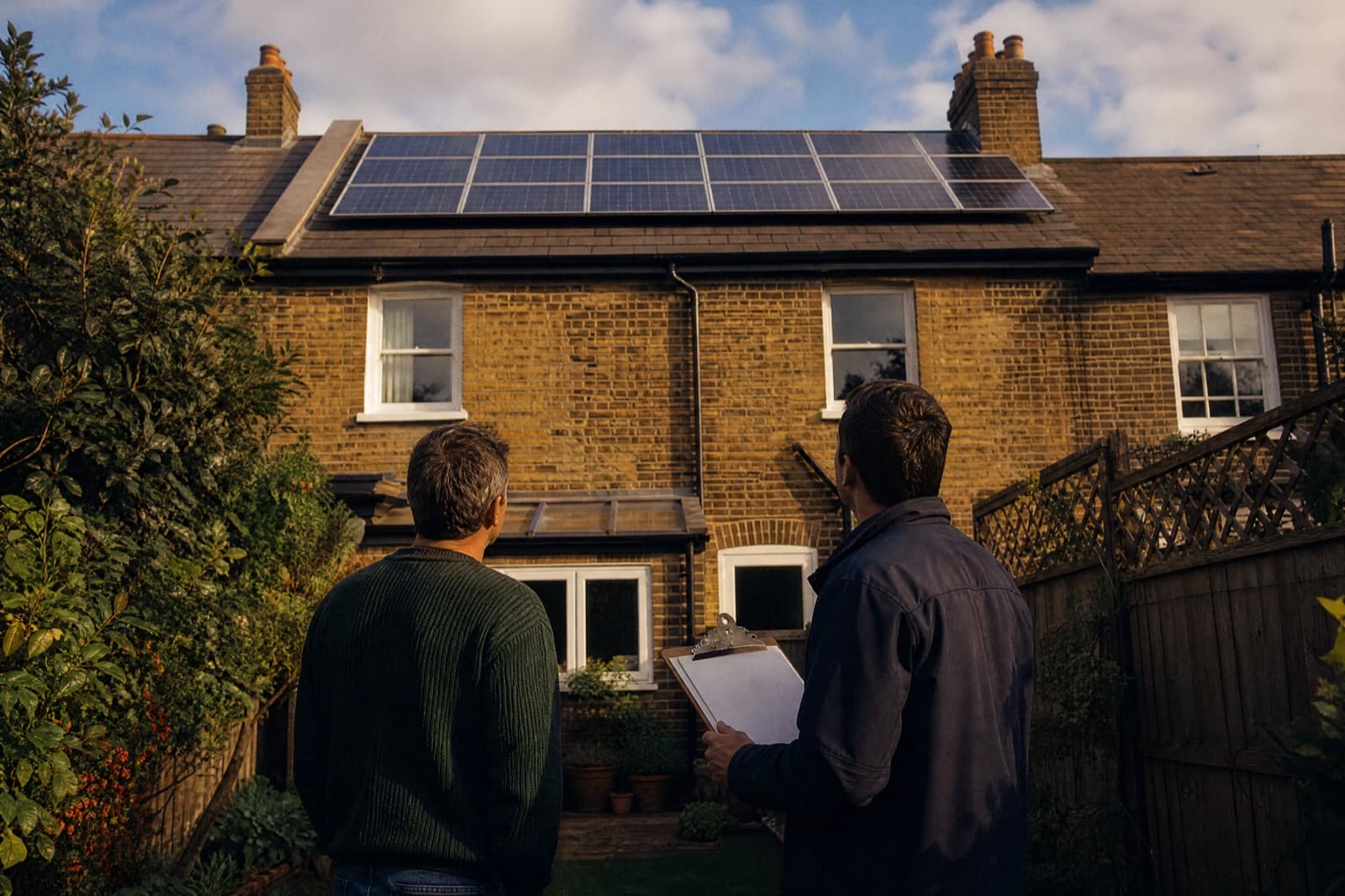
Solar panels turn sunlight into free electricity for your home, and the Energy Saving Trust says they work even on cloudy days. A typical 4kW system costs about £6,200 to £6,600 fitted, going by what households actually paid in 2025/26 (DESNZ). There's 0% VAT on residential solar until 31 March 2027, then it goes to 5% from 1 April 2027 (HMRC VAT Notice 708/6), so a quote you sit on into next spring gets more expensive.
MCS certified 267,032 solar installations across the UK in 2025, beating the record set in 2011 by 31%. On our model a 4kW system is worth about £599 a year and pays back in about 10 to 11 years. The Energy Saving Trust puts paybacks at 9 to 12 years depending on where you live, and says panels should last 25 years or more.
Answer it for your own roof
Check whether you could get panels free, work out how many you need for your region and roof direction, price a system, and see whether a battery would ever pay for itself.
Solar panel calculator
How many solar panels do you need?
Uses the European Commission's PVGIS solar model for your region and roof direction, not a single UK average.
On your bill or annual statement. Ofgem's typical home uses 2,500kWh.
Planning to add
Car: 7,100 miles a year at 3.3 miles per kWh (EV Database). Heat pump: 9,500kWh of heat at a SCOP of 3.5.
Which way does the roof face?
East and west roofs often split the panels across both sides, which suits a home that uses power morning and evening.
Panel size
Each panel is about 1.72m by 1.13m.
You need
6 panels
A 2.58kWp system, about 12 square metres of roof, making around 2,500kWh a year, enough to match your yearly use of 2,500kWh.
969
kWh per kWp a year here
£5,000
typical cost, 0% VAT
£421/yr
bill saving plus export
12 years
to pay for itself
Making as much as you use isn't the same as not buying any. Without a battery, on the government's SAP 10.2 self-use formula this home would use about 34% of its solar as it's made; the rest goes to the grid at the export rate and you still buy power after dark.
Yield: PVGIS v5.2, 35 degree pitch, 14% system losses, unshaded. Value: 34% used at home (the government's SAP 10.2 self-use formula for this system and your yearly use) at 26.32p, the rest exported at 12p (Outgoing Octopus, for Octopus supply customers on eligible tariffs). Cost at DESNZ's 2025/26 mean for home installs: £1,955 per kWp under 4kW, £1,645 from 4kW. Shading, pitch and your own tariff will move these numbers.
1. What size system?
The Energy Saving Trust says the average home system is around 4.5 kWp, on 20 to 30 square metres of roof. Bigger systems need more roof area.
2. Panel type
Solar tiles look tidier but cost more: the Energy Saving Trust says they normally cost about 1.5 times as much as panels, which is what we use.
3. Battery storage
A battery stores spare daytime solar to use later, lifting the share you use at home from 26% to 42% with 5 kWh or 56% with 10 kWh, for this size in a home using Ofgem's typical 2,500 kWh a year.
Estimated installed cost
£6,200 to £6,600
Panels from DESNZ's figures for 2025/26 MCS installs: the median of all installs to the mean for homes, covering the equipment, fitting, connection and VAT (0% on solar until 31 March 2027).
Cost breakdown
- Solar panels + installation
- £6,200 to £6,600
- Battery storage
- None
- Total (0% VAT)
- £6,200 to £6,600
Bill savings
£263 / year
999 kWh self-used at 26.32p
SEG export income
£336 / year
2,801 kWh exported at 12p
Total annual benefit
£599 / year
Payback period
10.4-11.0 years
25-year net profit
+£7,776
Want a real quote for your home?
These are estimates. Get free quotes from MCS-certified installers to see exact costs for your roof. Takes about 60 seconds, no obligation.
Based on the Ofgem price cap for 1 October to 31 December 2026 (26.32p/kWh) and Octopus Outgoing SEG rate (12p/kWh), on our estimate of 950 kWh a year per kW for a south-facing roof in central England, with the share used at home from BRE's SAP 10.2 self-use formula for this size in a home using Ofgem's typical 2,500 kWh a year (26% without a battery, 56% with 10 kWh, taking 80% of a battery as usable, our assumption). For the 10 kWh battery we use the Energy Saving Trust's £5,000 to £8,000 for battery storage, which gives no size; solar tiles at about 1.5 times the panel price are its ratio too, and the 5 kWh battery's price is our estimate. The 25-year figure holds prices flat, uses the middle of the cost range and deducts one replacement inverter at £800, the Energy Saving Trust's figure (it says inverters typically need replacing every 10 to 15 years, so you may need two). For a region- and orientation-aware estimate, use our full solar ROI calculator.
Free solar eligibility checker
Could you get solar panels for free?
Every UK scheme that can fit solar for free, checked against its own published rules on 11 October 2026. Takes about 30 seconds.
Question 1 of 6
Where do you live?
Battery payback calculator
Would a solar battery pay for itself?
The honest version: on solar alone, a battery only earns the gap between what you pay for power and what you'd be paid to export it.
Battery size
Makes about 3,800kWh a year, south-facing in central England
Intelligent Octopus Go needs an electric car or charger that Octopus can control.
Payback
40 years
Earns about £163 a year. That's longer than many battery warranties (Tesla's Powerwall 3, for example, is 10 years), so check the one you're quoted.
Working: it moves about 1,139kWh of solar a year from export to your own use (self-use rises from 26% to 56% on the government's SAP 10.2 self-use formula, in a home using Ofgem's typical 2,500 kWh a year), each worth 14.32p, the gap between your import and export rates.
The thing that changes it most is a time-of-use tariff you charge it on. Try the overnight option above, and check your export rate: if you're on 5p, look at a 12p export tariff (Octopus pays it to its own supply customers on certain tariffs) before relying on a battery.
Our view: buy one for the tariff it lets you use or for backup power, not on a payback promise you can't check.
Bottom line
Our view: if your roof faces anywhere from east through south to west and you're staying a while, fitting solar is a yes.
Solar systems at a glance
Costs are DESNZ's 2025/26 figures; generation is our estimate of 950 kWh a year per kW for a south-facing roof in central England; panel counts are at 430W a panel, as in the panel calculator and cost estimator; roof area is scaled from the Energy Saving Trust's average 4.5kWp system on 20 to 30 square metres.
| 3 kW | 4 kW | 6 kW | |
|---|---|---|---|
| Panels | about 7 | about 10 | about 14 |
| Roof space | 13 to 20 sq m | 18 to 27 sq m | 27 to 40 sq m |
| Cost (0% VAT) | £4,800 to £5,900 | £6,200 to £6,600 | £9,300 to £9,900 |
| Generation a year | 2,850 kWh | 3,800 kWh | 5,700 kWh |
| Worth a year (our model) | £471 | £599 | £843 |
Work out what your roof can do
Start here. Size the system from your usage and roof space, then run the calculator to get a payback estimate for your specific home. These are the two answers we'd want first.
 Guide

Cost it and decide what to add
What a system actually costs to fit in 2026, whether to bolt on a battery, plus the format choice (tiles or standard panels) and pairing solar with a heat pump if you're already going down that road.
 Guide
 Guide
 Solar tiles vs solar panelsWhen tiles are worth about 1.5 times the cost
 Pairing solar with a heat pumpWhat the two save together, on our model
 Plug-in solar (renter-friendly, 800W cap)Lawful in Great Britain since 27 August 2026: the new option for flats and balconiesCharging an electric car from solarWhen it pays, and when exporting beats itHow many EPC points solar addsOur EPC calculator, with solar as one of the upgrades
Pick panels and the kit around them
Compare panels, inverters and the monitoring that comes with them, and check the warranties and who stands behind them.
 Guide
 Guide
 Solar inverter types explainedString vs micro vs optimiser vs hybrid, with a free recommender toolPortable panels and 12V kitsFor power stations, caravans and sheds
 Accessories worth addingDiverters, monitoring, EV chargers that pay for themselves
Battery reviews and comparisons
Get the savings, then keep them
There's no dedicated solar grant, and the free schemes are for lower incomes, so unless you qualify, 0% VAT and an export tariff are the help on offer. Then a bit of upkeep keeps it generating.
 Guide
 Guide