
The Short Answer
On the merits, the Pro Breeze 9000 BTU Smart is still the best all-rounder for most UK rooms: a Which? Best Buy award, Alexa and Google Home support, and sensible cooling for the money.
The awkward bit, in September 2026: almost everything on this page is out of stock. Portable AC is a seasonal product and the shelves empty out by autumn. Right now the Belaco 9000 BTU is the one you can actually buy, and out-of-season pricing has pushed it well above where it sat in the spring. If you're not desperate, wait until March. That's when these are cheapest and fully stocked.
- Cheapest to run on this list: the Pro Breeze 7000 BTU at 19p/hr, ideal for a bedroom, and currently out of stock.
- Quietest by a distance: the De'Longhi Pinguino PAC EL112 at 47 dB on low. Also the most expensive by a distance.
And if you only get 10 hot days a year, honestly just buy a decent fan.
Stock note: portable AC stock swings hard with the weather, and a unit that's available in May can be gone by August and back again the following spring. We check every product on this page against Amazon's live listing, so if something you click has sold out we'll tell you there and then and show you the nearest thing we'd actually buy. It's also worth checking the "Used, Like New" price on anything here (see the box below).
Last reviewed: 18 September 2026
Prices and stock on this page come straight from Amazon and refresh through the day, so what you see is what's current rather than what was true when we wrote it. Portable AC stock is seasonal, and when a model we rate has sold out we keep it here rather than quietly dropping it, because it tells you where it sits against the rest. Click one that's gone and we'll say so and point you at the nearest alternative.
Tip: check the "Used, Like New" price. Several of these (including some that are out of stock new) show a cheaper "Used, Like New" or Amazon Warehouse price, usually customer returns Amazon has inspected and graded, often 20 to 40% off. For a simple bit of kit like a portable AC it's a low-risk way to save: you get the same cooling, and Amazon's 30-day returns cover you either way. Just pick a "Like New" or "Very Good" grade and check the window kit and hose are included.
Do You Actually Need a Portable Air Conditioner?
Before you spend £200 to 900, be honest about how often you'll use it. A portable AC is a big, heavy appliance that lives in a corner for most of the year. Here's a quick decision guide:
- Hot for under 10 days a year? A good tower fan (£40 to 250 depending on how quiet you want it) and closing curtains during the day will get you through. Don't buy a portable AC.
- Hot for 10 to 30 days, renting, or budget under £500? A portable AC makes sense, and this guide is for you.
- Hot for 30+ days, own your home, and can install an outdoor unit? Consider a split system (£1,500 to 3,500 installed). It's half the running cost, a third of the noise, lasts twice as long, and heats in winter too. A portable AC is fighting physics; a split system isn't.
Still here? Good. Let's find you the right portable AC.
What Size Do You Need?
BTU (British Thermal Units) measures cooling power. Too small and the room never cools properly. Too big and the unit short-cycles, cooling too fast, shutting off before dehumidifying, leaving you in a cold but clammy room.
The rule of thumb is 500 to 600 BTU per square metre for a standard UK room with 2.4m ceilings. But your room isn't standard: floor level, window orientation, and insulation quality all matter. Use our calculator:
What Size Portable AC Do You Need?
Enter your room details for a BTU recommendation and running cost estimate.
Room area
14.0 sq m
BTU needed
9,317
Cost per hour
30p
Cost per night (8hrs)
£2.38
We recommend: a 9,000 BTU unit: Pro Breeze 9000 BTU Smart (~£360)
Based on the Ofgem price cap electricity rate of 26.32p/kWh (1 October to 31 December 2026). Actual running costs are typically 60 to 80% of the maximum as the compressor cycles on and off.
Running Costs: What You'll Actually Pay
At the current Ofgem rate of 26.32p/kWh, the units on this page cost between 19p and 39p an hour to run. That sounds manageable until you run one overnight: 8 hours of a typical 9,000 BTU unit at 25p/hr is £2 a night. Use it 20 to 40 nights and that's £40 to £80 for the season. The chart below runs the same sums over 60 nights, which is a properly hot summer, and lands between £91 for the 7,000 BTU Pro Breeze and £187 for the 14,000 BTU one.
But here's what most guides don't mention: portable ACs don't run at full power constantly. Once the room hits your target temperature, the compressor cycles off and the fan keeps running. Real-world costs are typically 20 to 40% lower than the headline figures.
Running Cost per Hour (Ofgem cap 1 Oct-31 Dec 2026: 26.32p/kWh)
Costed at the Ofgem price cap rate of 26.32p/kWh (1 October to 31 December 2026).
As an Amazon Associate we earn from qualifying purchases.
Compare any two units side by side with our calculator:
Running Cost Calculator
Compare two units side by side. Costs assume the compressor runs continuously (real costs are typically 20 to 40% lower).
Pro Breeze 9000 Smart (9,000 BTU)
Per hour
30p
Per day
£2.38
Per month
£47.59
Per summer (~60 days)
£142.76
De'Longhi PAC EL112 (11,000 BTU)
Per hour
25p
Per day
£2.00
Per month
£40.01
Per summer (~60 days)
£120.02
Difference: £7.58/month: £22.74/summer. The De'Longhi PAC EL112 is cheaper to run.
Based on the Ofgem price cap electricity rate of 26.32p/kWh (1 October to 31 December 2026). Actual costs depend on thermostat cycling, room temperature, and insulation.
Our Picks
All 9 Products Compared
As an Amazon Associate we earn from qualifying purchases. Prices correct as of 12 October 2026, checked against Amazon every few hours.
Budget (Under £350)
Best Value
HOMCOM 10000 BTU
£240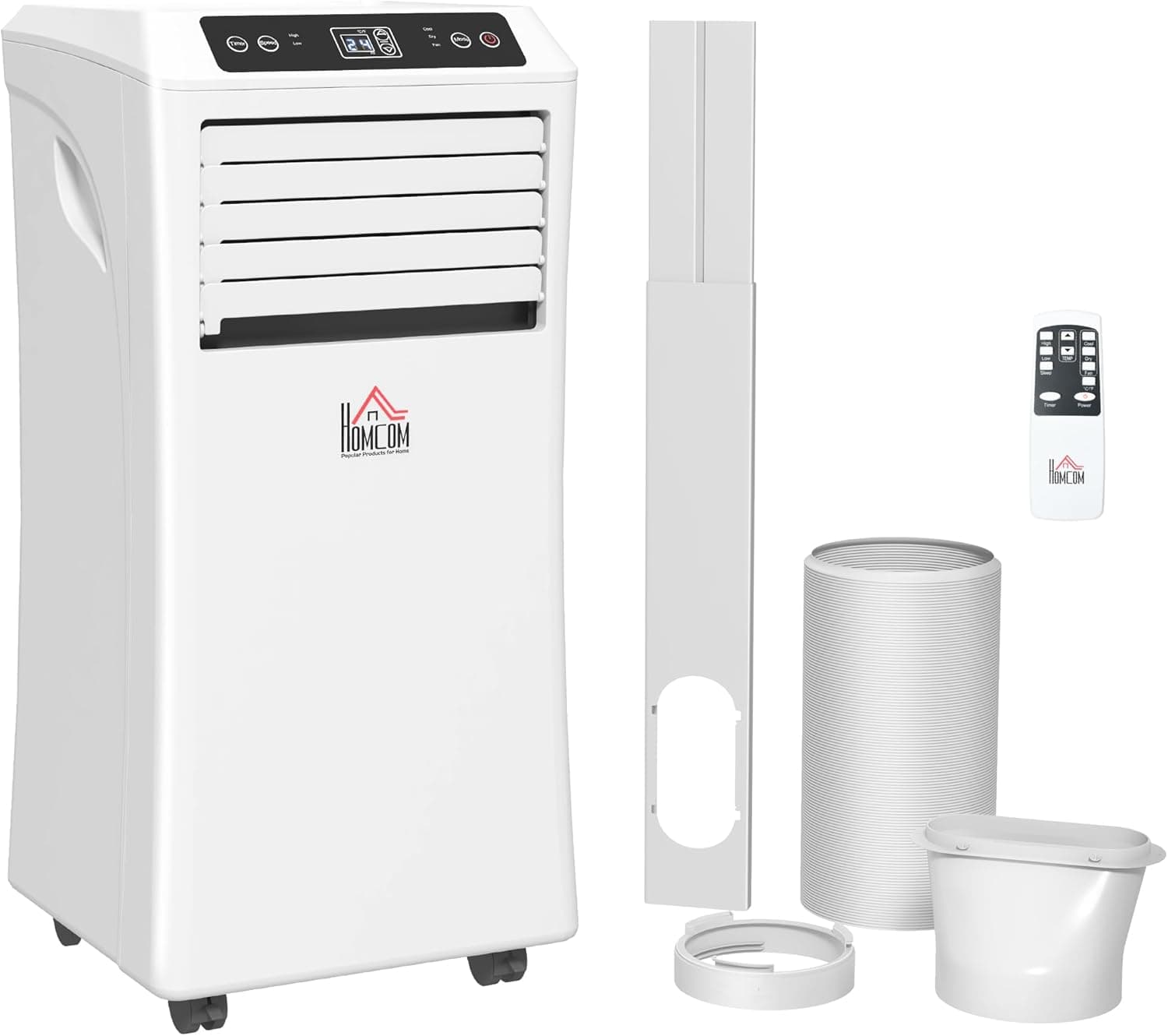
While it's out of stock, consider


10,000 BTU at this price is the most cooling power per pound on this list, and it's got enough reviews behind it to be well proven (the spec box above carries the current count and rating, pulled straight from Amazon). It's a no-frills 4-in-1 unit with cooling, dehumidifier, fan, and sleep mode. The 24-hour timer is useful for overnight running.
The trade-offs are predictable at this price: 65 dB means it's loud, there's no Wi-Fi or app, and the 6-month warranty is the shortest on this list. But if you just need a room cooled and don't care about smart features, this is hard to beat for the money.
Buy this if: you want the most BTU for the least money and can live without an app.
Best Small Room
Pro Breeze 7000 BTU
£296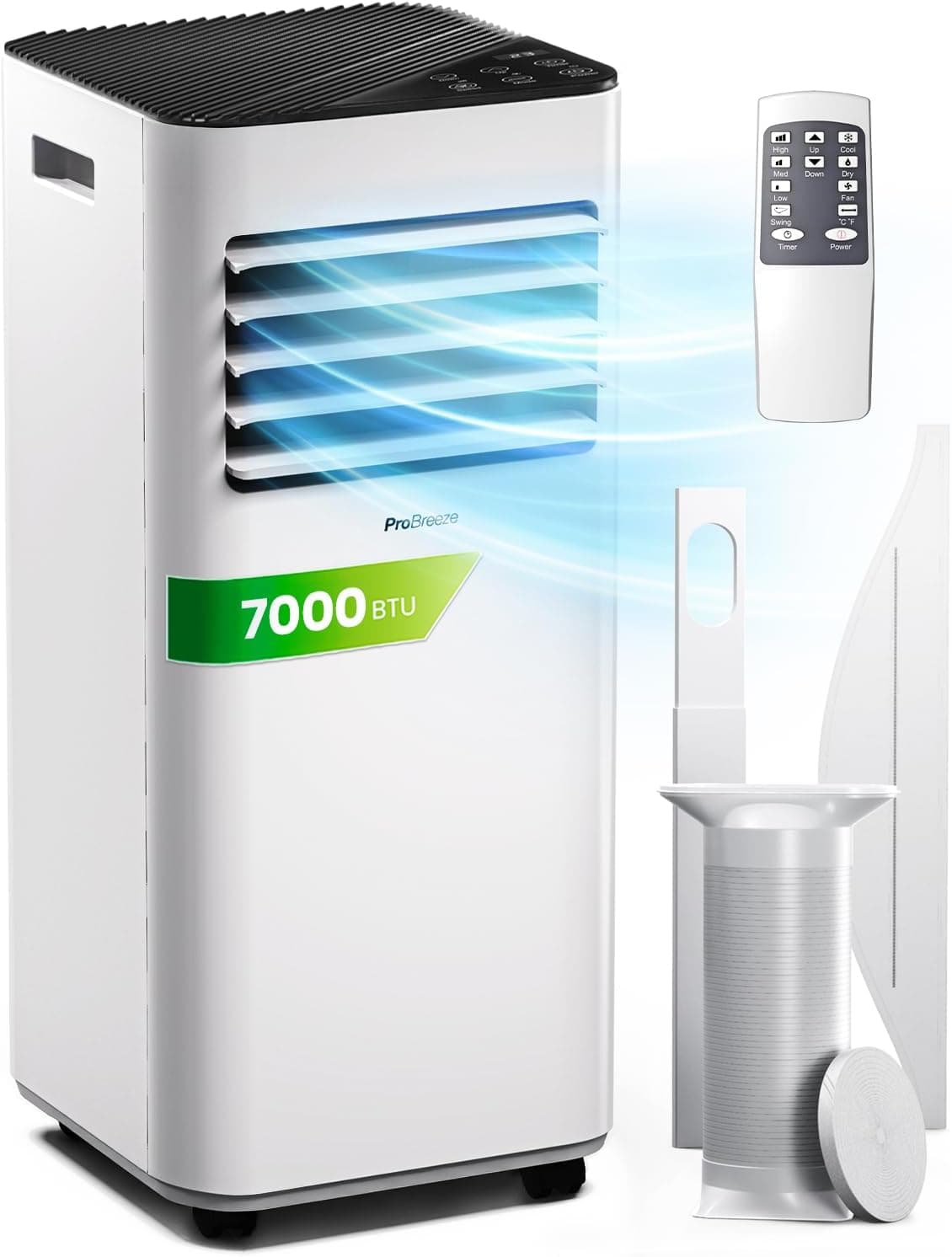
While it's out of stock, consider
If you're cooling a bedroom or small home office (under 15 sq m), you don't need 9,000 BTU. The Pro Breeze 7000 is the cheapest to run on this list at 19p/hr, and at 53 dB it's quieter than the 65 dB budget units. It's also one of the most-reviewed portable ACs on Amazon UK.
Don't trust Amazon's claimed 42 sq m room coverage: at 7,000 BTU, it's realistically effective up to 15 sq m on genuinely hot days. But for the right-sized room, it's the sweet spot: quieter, lighter on the electricity bill, and well proven.
Buy this if: you're cooling a small room and want the lowest running cost.
Best Budget
Belaco 9000 BTU
£449.99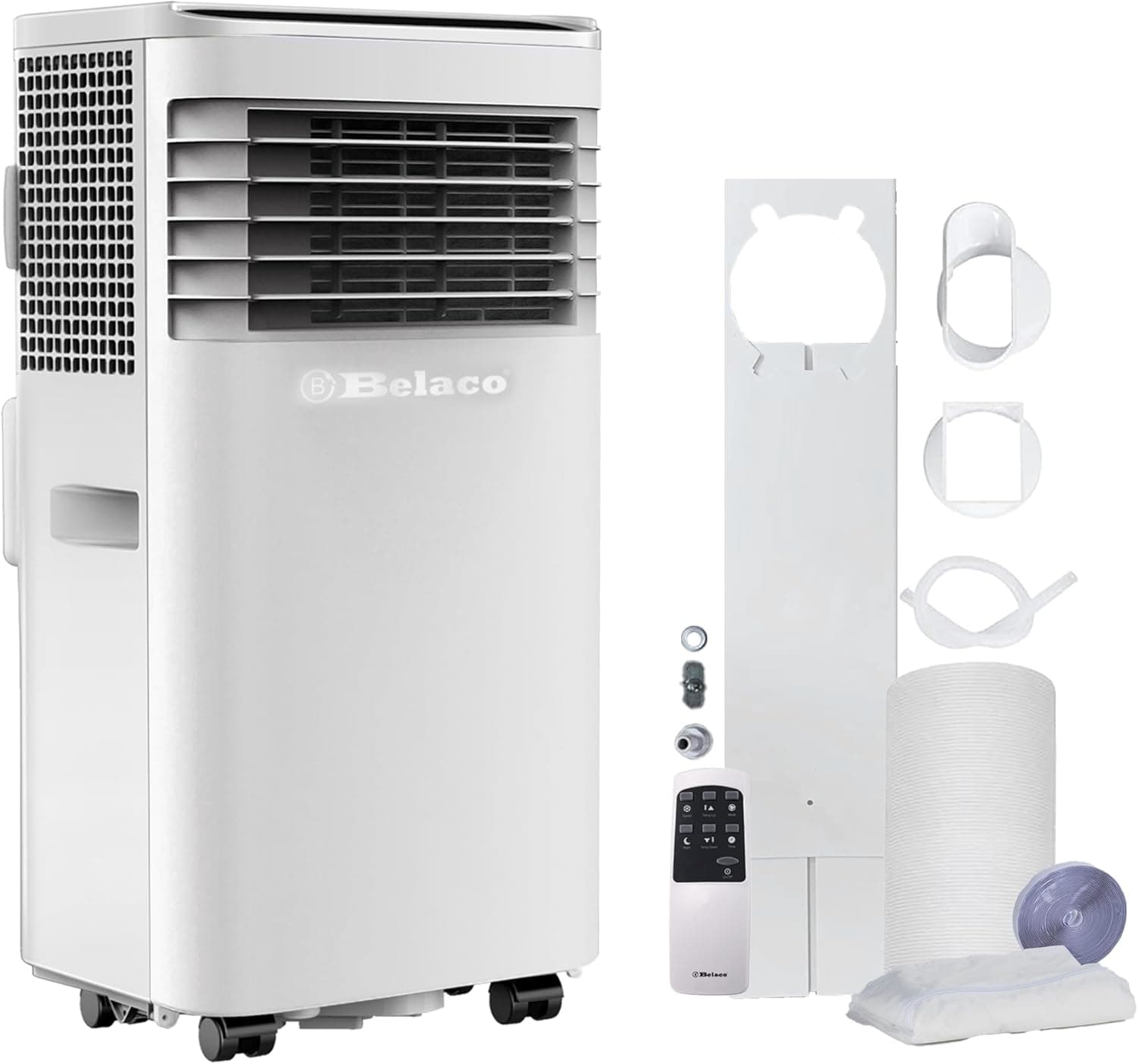
The most-reviewed budget portable AC on Amazon UK. At 20.5 kg it's lighter than most competitors, and it comes with a dual window kit in the box. The 24-hour timer and remote control cover the basics.
Like most budget units, it's 65 dB: you'll hear it. No Wi-Fi or app, and the 1-year warranty is shorter than Meaco or Pro Breeze (both offer 2 years). Build quality is basic, but reviewers consistently say it does the job.
The honest caveat as of September 2026: this is the only unit on the page still in stock, and it's priced accordingly. It was a genuine budget pick in spring. At today's price it isn't, and the only reason to pay it is that you need cooling this week. Check the live price in the box above before you decide.
Buy this if: you want a proven 9,000 BTU unit, you need it now, and you've seen what it currently costs.
Mid-Range (£350 to 500)
Best for Heating + Cooling
Igenix IG9922
£350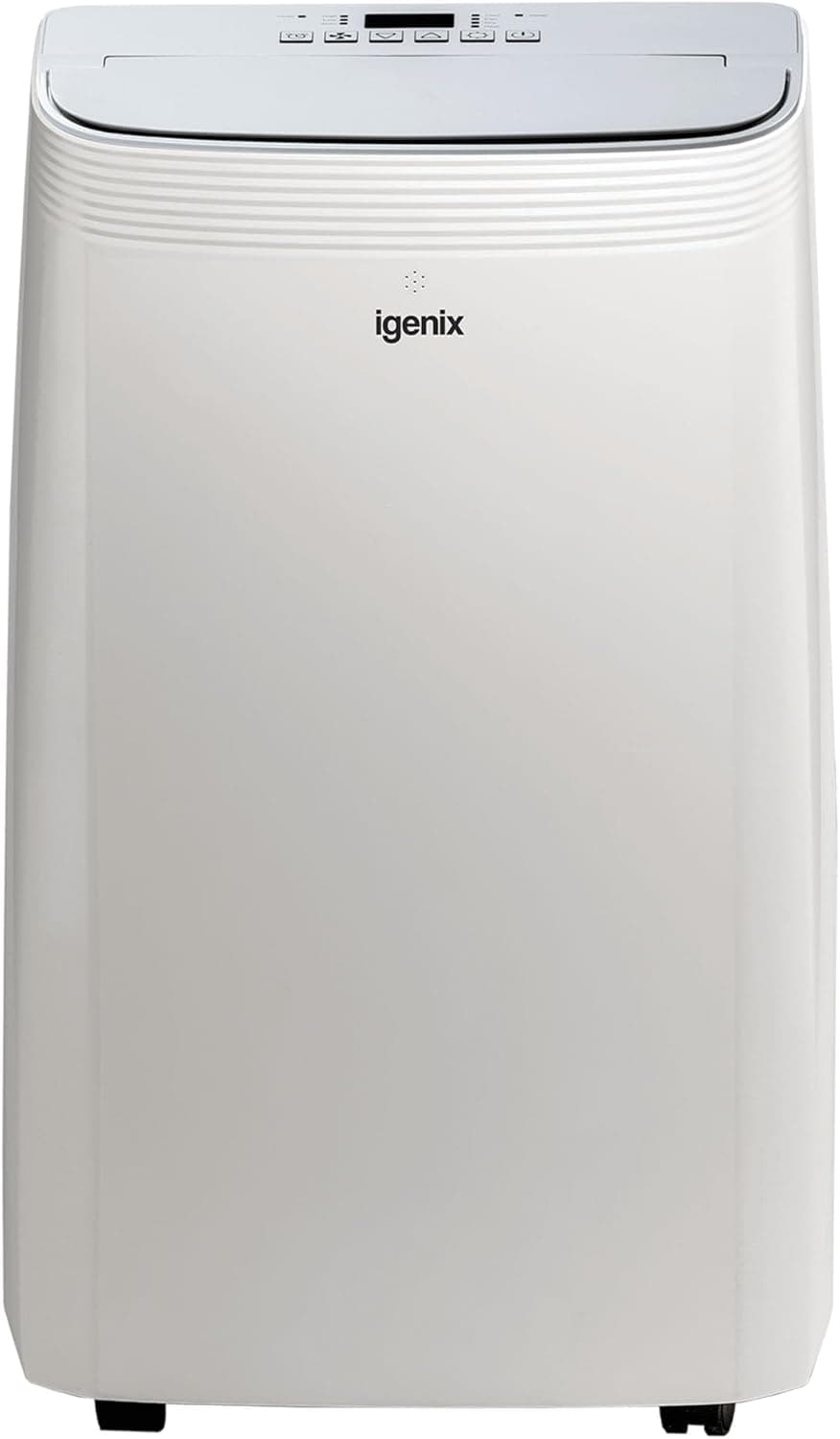
While it's out of stock, consider
The model we reviewed (Igenix IG9922) has been discontinued and is no longer listed on Amazon. We've left it here rather than quietly dropping it, because it's the only unit on the page that also heats. When it was available: 12,000 BTU with a heating mode for winter, giving you year-round value from one appliance. The Igenix has a dual motor design and covers rooms up to 23 sq m. It was the highest-rated unit on this list, though off a much smaller review count than the budget options.
The downsides: it's 31 kg (you won't be moving this between rooms), 65 dB means it's loud, and there's no Wi-Fi or app. But if you want heating and cooling in one unit (particularly useful for renters who can't install a heat pump), this fills that gap nicely.
Buy this if: you want heating and cooling from one portable unit, or you need 12,000 BTU on a budget.
Best Overall
Pro Breeze 9000 BTU Smart
£400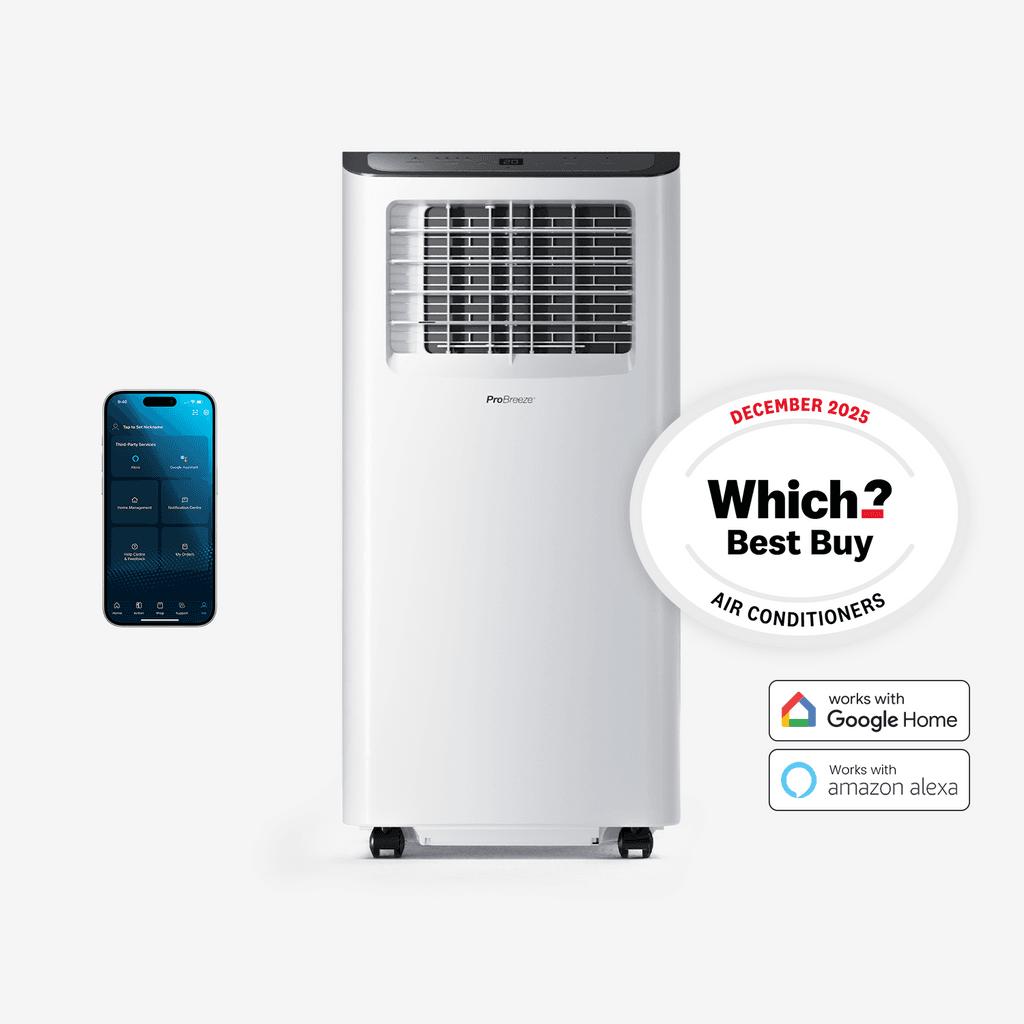
While it's out of stock, consider
The Pro Breeze won a Which? Best Buy award, which carries weight: Which? actually lab-tests these units with temperature sensor grids, not just opinions. It's a solid 4-in-1 unit with Alexa and Google Home integration (not just an app: proper voice control), and it's the most-reviewed mid-range unit on Amazon UK.
At 54 dB it's mid-range on noise, quieter than the budget units but you'll still hear it in a bedroom. The smart features and build quality justify the step up from the budget options. If you want one portable AC that does everything well, this is it.
Buy this if: you want the best all-rounder with smart home integration.
Best for Bedrooms
MeacoCool MC Series 9000R
£370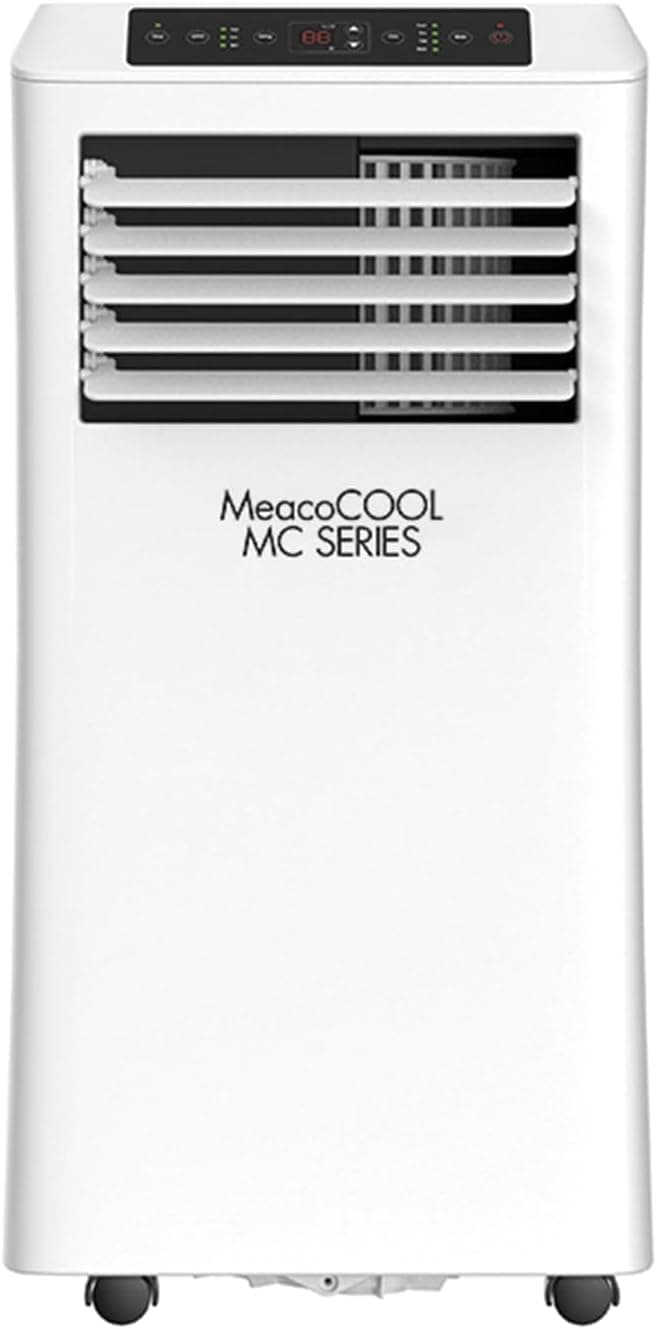
While it's out of stock, consider
Meaco is a British brand that specialises in dehumidifiers and air treatment, and they know air quality. The MC Series runs at 53 dB, comes with two window kits (sash and casement, while most brands only include one), and has a dedicated sleep mode. It's been on sale long enough to be well proven over multiple summers.
There's no Wi-Fi or app: this is the MC Series (older generation), not the newer Pro Series. But the 2-year warranty, Meaco's reputation for customer service, and the included casement window kit make it great value. For bedrooms where quiet operation matters more than smart features, this beats the Pro Breeze.
Buy this if: you're cooling a bedroom and want the quietest 9,000 BTU option without paying De'Longhi prices.
Best Quiet Mid-Range
MeacoCool Pro 8000
£380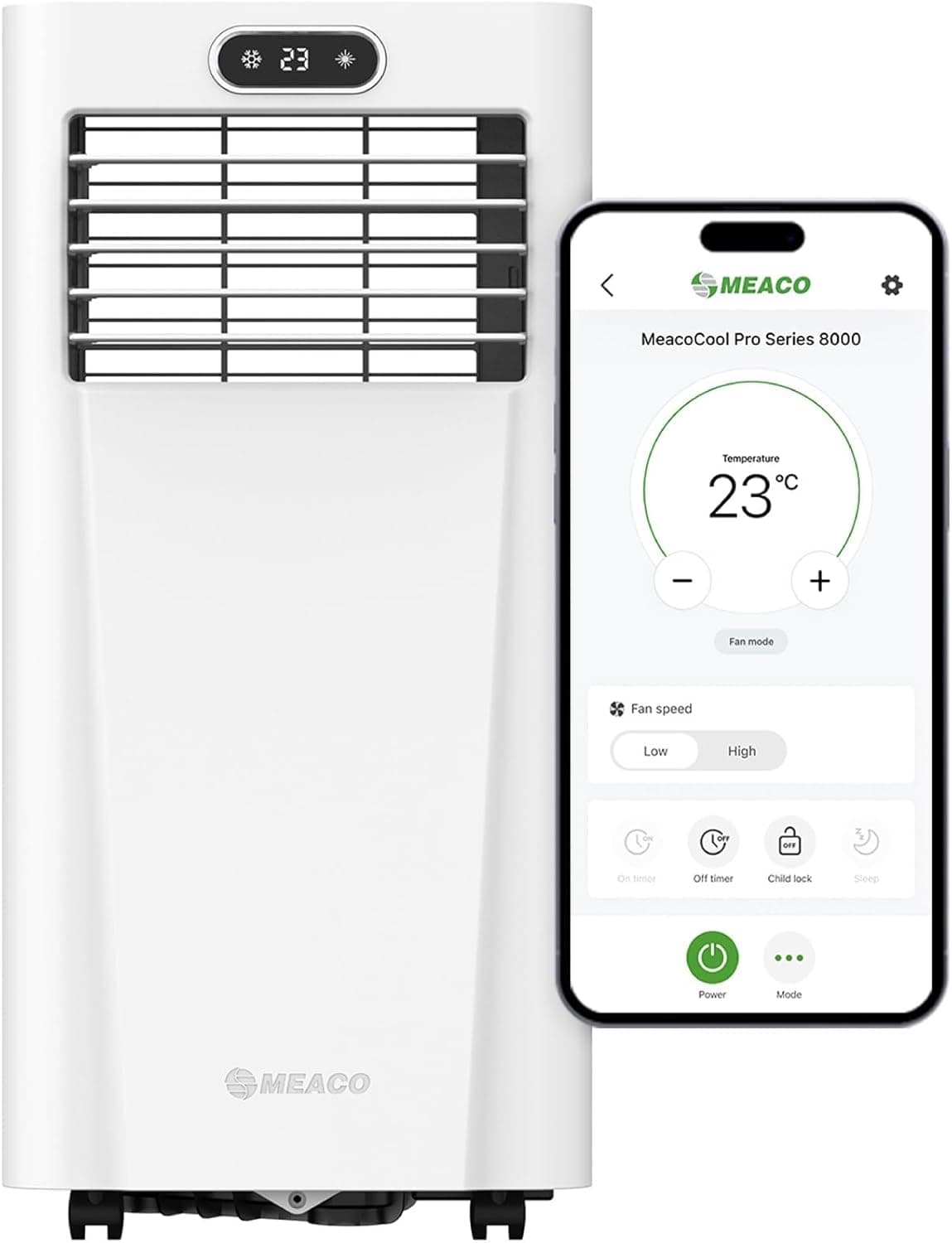
While it's out of stock, consider
The Pro 8000 is Meaco's newer Pro Series, adding app control via the Meaco app, a more refined sleep mode, and a flexible window kit. At 53 dB and 8,000 BTU, it's designed for bedrooms and smaller rooms where quiet matters more than raw power.
At £380 for 8,000 BTU, it's not cheap: you're paying a premium for the Meaco brand, the app, and the lower noise. If your room is under 20 sq m and you want the quietest experience short of spending £849 on the De'Longhi, this is the pick.
Buy this if: you want app control, Meaco quality, and quiet operation in a bedroom or small room.
Best for Large Rooms
Pro Breeze 14000 BTU WiFi
£500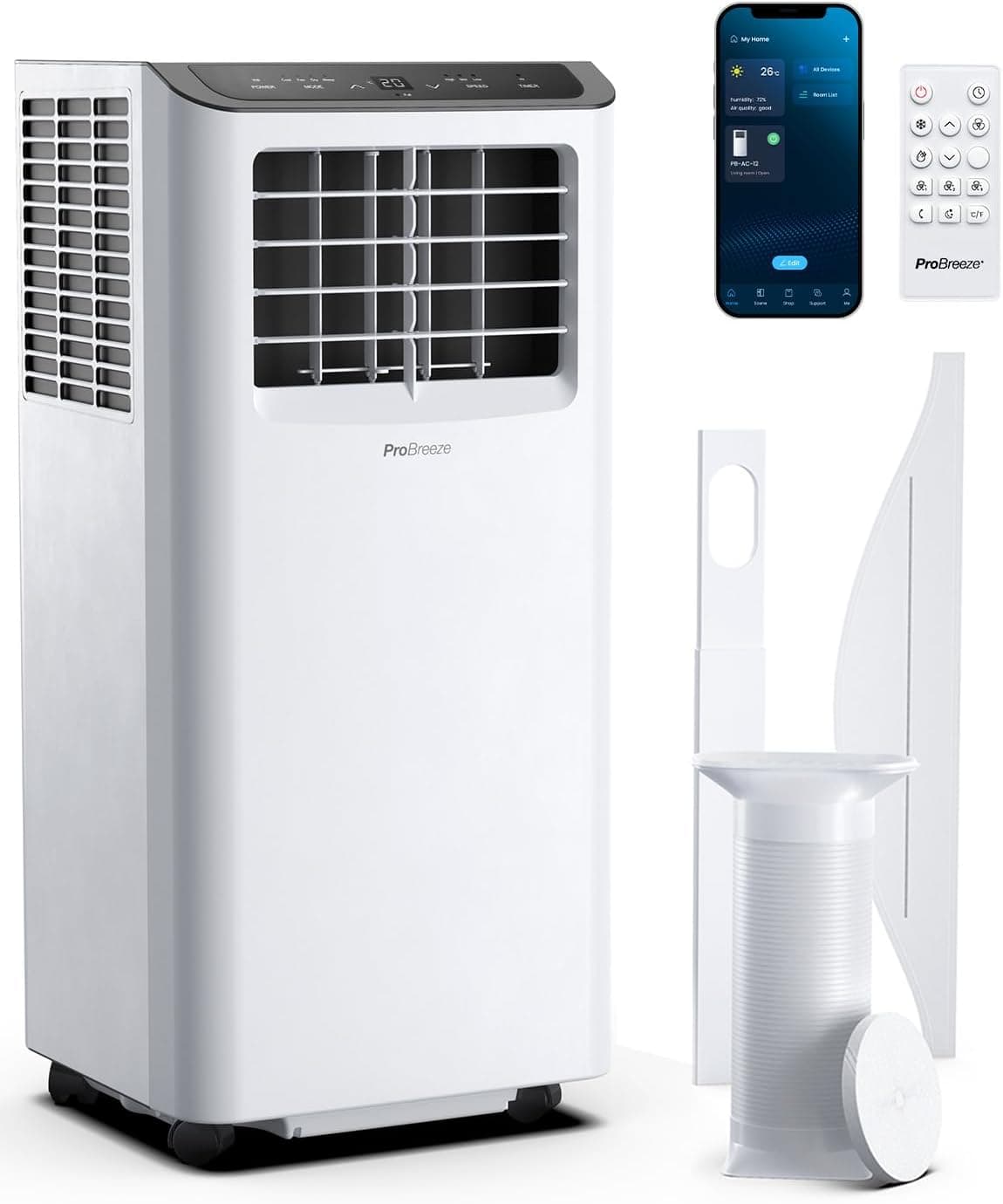
While it's out of stock, consider
If your living room or open-plan space is over 25 sq m, most 9,000 BTU units will struggle on the hottest days. The Pro Breeze 14000 is the most powerful portable AC on our list and handles rooms up to 35 sq m. WiFi and app control are included, and at 54 dB it's surprisingly quiet for this much cooling power.
The running cost is the highest on our list at 39p/hr (roughly 1,480W at the 26.32p/kWh cap rate), so this is a unit you'll want to use with the timer and thermostat rather than leaving it on all day. At 27.6 kg it's heavy but not the heaviest. It's a newer listing with fewer reviews, but Pro Breeze's track record with the 9000 BTU model gives confidence.
Buy this if: you need to cool a large living room, open-plan space, or converted loft.
Premium (£500+)
Quietest / Premium
De'Longhi Pinguino PAC EL112
£849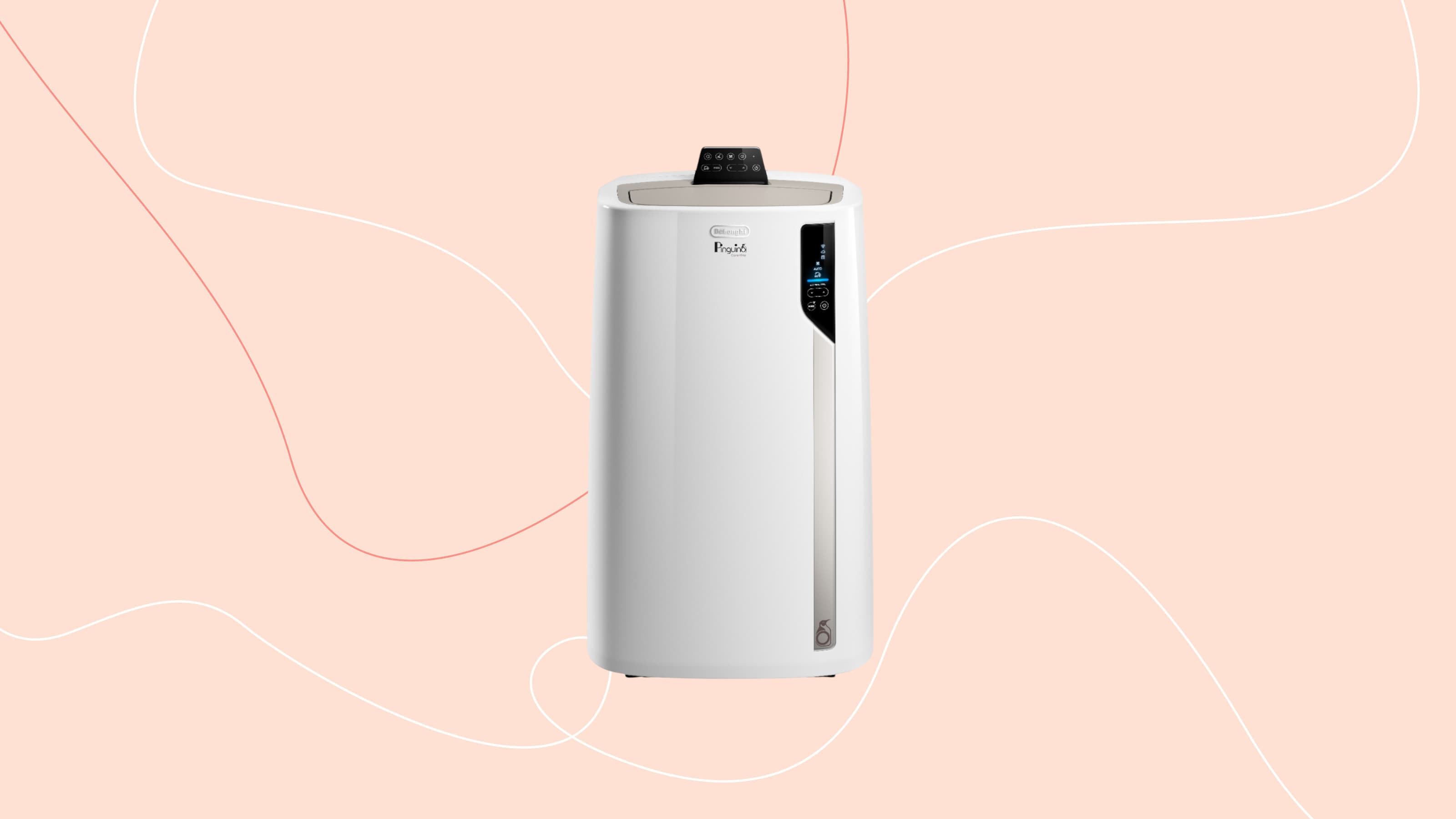
While it's out of stock, consider
If noise is your deciding factor (particularly for bedrooms), the De'Longhi EL112 is in a different league. At 47 dB on low speed it's 6 dB below the quiet Meacos and Pro Breezes, and 18 dB below the 65 dB budget units. Decibels are logarithmic, so against those budget units that's roughly three times quieter to the human ear.
It's also the most efficient unit here per unit of cooling (A+ rated, 23p/hr for 11,000 BTU, where the 7,000 BTU Pro Breeze costs 19p/hr). The Eco Real Feel technology automatically adjusts based on both temperature and humidity, which in practice means it doesn't overcool the room and waste electricity. Wi-Fi, Alexa, and a proper app round out the features.
The downsides: it's 33 kg (carry it once, never move it again), and you're paying over 2x what a mid-range unit costs. The premium is almost entirely for noise reduction and efficiency. If those matter to you (particularly for sleeping), it's worth every penny. If you just need a room cooled and don't care about noise, save your money.
Buy this if: you're a light sleeper, noise drives you mad, or you want the most cooling per penny of electricity.
What Real Owners Say
We cross-referenced hundreds of verified Amazon reviews across all nine units. Here are the patterns:
- The universal complaint: "It's louder than I expected." Every portable AC gets this. Manage your expectations: even the quietest unit (De'Longhi at 47 dB) is louder than a fridge.
- The universal praise: "I can't believe I waited so long." People who buy portable ACs consistently say they should have done it years ago. One reviewer: "My bedroom went from 28C to 21C in an hour. Best purchase I've made."
- The window kit frustration: Almost every budget and mid-range unit gets complaints about the included window kit not fitting UK casement windows. The MeacoCool MC 9000R is a notable exception: it includes two kits. For everything else, buy a fabric zip-seal kit separately (£15 to 25 on Amazon).
- Weight matters more than you think: Reviewers who chose lighter units (Belaco at 20.5 kg, Pro Breeze 7000 at 22 kg) consistently mention this as a key benefit. Reviewers with 30+ kg units like the Igenix and De'Longhi say "it's not moving from this room."
Single-Hose vs Dual-Hose: The Physics Nobody Explains
Almost every portable AC sold in the UK is single-hose. Here's why that matters:
A single-hose unit pulls in room air, passes it over the hot condenser coils, and blows it out the window through the exhaust hose. This creates negative air pressure inside the room, and the air you're pushing outside has to be replaced from somewhere. Warm air gets sucked in through gaps around doors, windows, and any other opening.
This means a single-hose unit is fighting itself: cooling the room with one hand, pulling hot air back in with the other. The US Department of Energy created the SACC (Seasonally Adjusted Cooling Capacity) rating to measure this. Real-world cooling output is typically 25 to 50% lower than the marketed BTU figure for single-hose units. A "9,000 BTU" unit might actually deliver 5,000 to 7,000 BTU of net cooling.
A dual-hose unit has a separate intake hose that draws outside air to cool the condenser, so no room air is lost. They're up to 40% more efficient, but they're rare in the UK market, more expensive, and bulkier. For most UK homes where you're cooling for 20 to 40 days per year, the efficiency difference doesn't justify the premium or the hassle of fitting two hoses.
The practical takeaway: buy one BTU size up from what you think you need. If your room calculation says 8,000 BTU, get a 9,000 to 10,000 BTU unit. The single-hose inefficiency is already factored into the recommendations in our BTU calculator above.
Window Venting: The UK Problem Nobody Solves
Every portable AC needs to vent hot air outside through a window. The unit comes with a hose and a window kit. The problem: most included kits are designed for sash (sliding) windows, and most UK homes have casement windows (the kind that swing outward on a hinge).
Sash / Sliding Windows
The easiest to vent. Slide the sash up, slot in the included rigid panel, and feed the hose through the hole. Most included window kits work fine here. If the gap isn't right, dedicated acrylic sash window kits (£20 to 50) give a better seal.
Casement Windows (Most Common UK Type)
The included rigid panel won't work because the opening is irregular when the window swings outward. You need a fabric zip-seal kit: a sheet of fabric that attaches around the window frame with adhesive Velcro strips, with a zip opening for the hose. Cost: £15 to 30 on Amazon. They're not perfectly airtight, but they're vastly better than leaving the window open (which defeats the entire point).
Tilt-and-Turn Windows
The tilt position (top opening) works with a fabric zip-seal kit. The full-turn position works like a casement. Fabric kits are the most versatile option for these.
Key tips:
- A poorly sealed vent kills your efficiency. Hot air leaks in, and the negative pressure problem gets worse.
- The exhaust hose itself radiates heat back into the room, so keep it as short and straight as possible.
- Never vent into another room. You're just moving the heat, not removing it.
- Insulating the hose with reflective foil wrap (£5 from any hardware shop) makes a noticeable difference.
Evaporative Coolers: Don't Waste Your Money
You'll see "air coolers" for £40 to 80 that look like they do the same job. They don't. Evaporative coolers work by passing air over a wet pad: as the water evaporates, it absorbs heat and cools the air. Cheap to run (40 to 100W vs 700 to 1,200W for a real AC) and no hose needed.
The problem: they only work when humidity is below 40 to 50%. UK summer humidity averages 70 to 85%. On a typical warm, muggy British day, an evaporative cooler is just making the room damper. It cannot lower the temperature below the outdoor wet-bulb temperature. In practical terms, it barely works.
On a rare dry, hot day (humidity below 50%, which does happen in southern England occasionally), an evaporative cooler will drop the temperature by 3 to 5C. But you can't predict those days in advance, and on the humid days when you need cooling most, they're useless.
The verdict: If you need to reliably cool a room on hot days, buy a proper portable AC. If you want a slightly cooler breeze for £50 and accept it won't work half the time, an evaporative cooler is fine. Don't confuse the two.
Noise Levels: What the Numbers Actually Mean
Every portable AC lists a decibel (dB) figure, but nobody explains what it feels like. Here's the reality:
| dB Level | Feels Like | Units at This Level |
|---|---|---|
| 19 to 30 dB | Whisper / rustling leaves | Split system indoor unit (not portable) |
| 42 to 47 dB | Quiet fridge / library | De'Longhi EL112 on low |
| 51 to 54 dB | Normal conversation at 1m | MeacoCool Pro 8000, MeacoCool MC 9000R, Pro Breeze 7000, Pro Breeze 9000, Pro Breeze 14000 |
| 57 to 63 dB | Running dishwasher | De'Longhi EL112 on high |
| 65 dB | Busy restaurant / hairdryer on low | Belaco, HOMCOM, Igenix |
For context, the British Standard BS 8233 recommends a maximum of 30 dB for bedrooms at night. Even the quietest portable AC here (the De'Longhi at 47 dB) exceeds this. Most people adapt to the consistent hum within a few nights. It's the compressor cycling on and off that's more disruptive than the steady noise.
Tips for sleeping:
- Use sleep mode: it runs the compressor slower and dims the display
- Place the unit on carpet or a rubber mat to reduce vibration
- Keep it as far from the bed as the hose length allows
- Set the timer to turn off at 3 to 4am, since outdoor temps drop naturally after midnight
Portable AC vs Split System
If you own your home, it's worth understanding what you're giving up by going portable:
| Portable AC | Split System | |
|---|---|---|
| Upfront cost | £200 to 900 | £1,500 to 3,500 installed |
| Installation | None (DIY, 5 mins) | Professional, half a day |
| Running cost/hr | 19 to 39p | 10 to 20p |
| Summer running cost | £30 to £190 | £15 to £95 |
| Noise (indoor) | 47 to 65 dB | 19 to 30 dB |
| Lifespan | 5 to 8 years | 10 to 15 years |
| Heats in winter? | Rarely | Yes (it's a heat pump) |
| Renter-friendly? | Yes | No (needs landlord permission) |
| Planning permission? | Not needed | Usually not for houses; may need for flats |
| Adds property value? | No | Yes |
The crossover point: if you'd use a portable AC for more than 3 to 4 summers, a split system pays for itself through lower running costs, longer lifespan, and winter heating. Plus it's essentially silent. If you're renting, have a flat where you can't install an outdoor unit, or just want to try AC before committing, portable is the way to go.
When to Buy: The Seasonal Price Trap
Portable AC prices follow a predictable pattern in the UK:
- March-April: Lowest prices. Full stock. Best time to buy.
- May: Prices start creeping up as the first warm days hit.
- June-July: Prices rise significantly and popular models sell out. Amazon marketplace sellers routinely increase prices during heatwaves.
- August: Stock is patchy. You might not find the model you want.
- September-February: Prices drop, but selection is limited and some models are discontinued.
Buy now if you're reading this before June. If you're reading this during a heatwave and everything is sold out, that's the pattern. Set a reminder for next March.
The Renter's Guide
Portable ACs are one of the few cooling options that need zero landlord permission. You're not modifying the property; it's a freestanding appliance with a hose out the window. Here's what renters should know:
- Fabric zip-seal window kits use adhesive Velcro, which peels off cleanly. No holes, no damage, no deposit issues.
- Units that also heat and dehumidify give you year-round value, particularly the Igenix IG9922 with its heating mode, or any unit with a good dehumidifier for damp autumn months.
- Never use an extension lead with a portable AC. The sustained current draw (3 to 5 amps continuously) can overheat cheap extension leads. Plug directly into a wall socket.
- Check your tenancy agreement for any appliance restrictions, though this is rare. The Renters' Rights Act 2025 doesn't cover cooling; landlords have no obligation to provide it.
- If you have shared walls, choose a unit under 55 dB. Your neighbours will thank you.
Common Myths
- "Leave the door open for circulation": No. Seal the room. An open door lets warm air flood in and makes the negative pressure problem worse.
- "A 14,000 BTU portable cools like a 14,000 BTU window unit": No. The marketed BTU figure (ASHRAE rating) overstates real-world output by 25 to 50% for single-hose portables. The SACC rating is more honest, but UK product listings rarely show it.
- "Bigger BTU is always better": No. An oversized unit short-cycles: cools too fast, shuts off before dehumidifying, leaving a cold but clammy room. Get the right size for your room.
- "You can cool your whole house": One unit cools one room. Moving it between rooms means waiting 20 to 30 minutes for each new space to cool. If you need multiple rooms cooled, you need multiple units or a split system.
- "The exhaust hose doesn't matter": It matters a lot. The hose radiates a significant amount of heat back into the room. Keep it short, keep it straight, and consider wrapping it in reflective foil insulation.
