
The Short Answer
The Meaco Arete One 12L is the best dehumidifier for drying clothes in most UK homes: about 4p an hour on normal mode and 5p in laundry mode, a proper laundry mode, and a full load dry in 3 to 5 hours. If your drying room is cold (garage, unheated utility room, conservatory), get the EcoAir DD1 Simple instead; it's a desiccant type that works properly below 15C where compressor models struggle.
But here's what nobody tells you: a dehumidifier on its own is slower than you think. The real winning setup is dehumidifier + heated airer + cover. The airer provides direct heat to the clothes, the cover traps moisture, and the dehumidifier pulls that moisture out of the air. Together they dry a full load in 2 to 3 hours for 27 to 40p, which is about the same money as a covered heated airer on its own and roughly half the time, with none of the moisture ending up on your windows. It is not, as we used to claim here, cheaper than the airer alone. It is faster, and it keeps the damp out of the room.
What "20 Litres Per Day" Actually Means
Every dehumidifier is sold with an extraction rate: "12L/day", "20L/day", sometimes even "25L/day". These numbers are basically marketing fiction. They're measured at 30C and 80% relative humidity, which is the climate of a tropical greenhouse, not a spare bedroom in Newcastle.
In a typical UK home at 18 to 20C and 50 to 60% humidity, you'll get roughly half the advertised rate. A "20L" dehumidifier realistically extracts 8 to 12L per day in normal UK conditions. A "12L" unit extracts 5 to 7L. Still useful; just don't expect the number on the box.
For drying clothes specifically: a typical 4kg wash load contains about 2 to 2.5 litres of water. So even a 12L dehumidifier can handle that in 4 to 6 hours. You don't need a massive unit for laundry; a 12L is fine for most homes. Only go bigger if your house also has a persistent damp problem and you want the dehumidifier pulling double duty.
The one number that does matter? Wattage. That's what determines your running cost, and it varies hugely, from 150W (cheap to run) to 600W (not so cheap). More on that below.
Compressor vs Desiccant: Which Type Do You Need?
This is the single most important decision, and it depends on one thing: room temperature.
Compressor dehumidifiers (Meaco Arete, Pro Breeze, De'Longhi)
Compressor models work like a fridge in reverse: they cool a metal plate, moisture condenses on it, drips into a tank. They're the standard choice for heated rooms above 15C. Running costs are lower (150 to 300W), they're quieter at low settings, and they handle most UK laundry situations perfectly well. The catch? Below about 15C, efficiency drops off a cliff. The cold plate can ice up, the compressor cycles on and off, and extraction rates plummet. If your drying room has heating, this won't be a problem.
Desiccant dehumidifiers (EcoAir DD1, Meaco DD8L)
Desiccant models use a rotating wheel of moisture-absorbing material and a small heater to extract water. They work at any temperature down to 1C, perfect for garages, unheated utility rooms, conservatories, and anywhere you wouldn't put a radiator. They use more electricity (300 to 600W) but they actually extract moisture in cold conditions where compressors are useless. They're also lighter and more portable.
The decision is simple: if your drying room has heating or stays above 15C, get a compressor. If it's cold, get a desiccant. That's it.
Our Picks
Best Overall
Meaco Arete One 12L
£179.99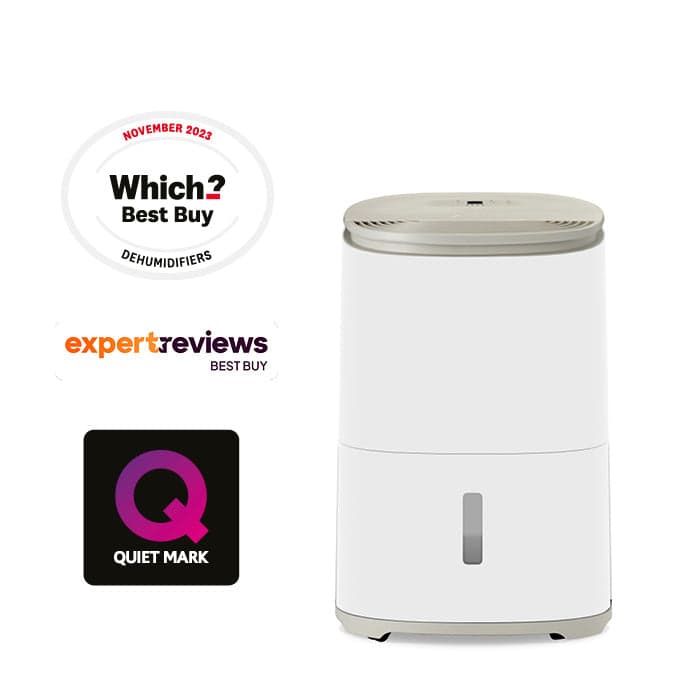
The Meaco Arete One 12L is the dehumidifier we'd recommend to most people. It's a compressor model that draws 155W in normal mode and 205W in laundry mode. At the current Ofgem rate of 26.32p/kWh that's 4.1p an hour and 5.4p an hour respectively. Genuinely cheap to run: less than a single LED floodlight.
The laundry mode is the standout feature. It boosts fan speed and targets a lower humidity level, actively pulling moisture from the air around your clothes rather than just maintaining a comfortable room humidity. In a small room with the door closed, it'll dry a full load in 3 to 5 hours depending on fabric weight and how well you spun the wash.
It's also properly quiet: 39dB at the lowest setting is about the same as a library. You can run it overnight without it keeping you up. And Meaco threw in a HEPA filter that doubles as an air purifier, which is a nice bonus if anyone in your house has allergies or hayfever.
The 2.6L tank is big enough for one drying session without emptying. If you want to run it continuously, there's a drain hose connection on the back: run a hose to a sink or out of a window and forget about it.
Specs: £179.99 on 18 September 2026 | Type: Compressor | Laundry mode 205W, so 16 to 27p a load over 3 to 5 hours | Tank: 2.6L | Weight: 10.5kg
Pros: Quiet, low running cost, built-in air purifier, dedicated laundry mode, continuous drain option
Cons: Struggles below 15C (get a desiccant for cold rooms), 12L extraction not enough for very damp houses needing whole-home dehumidification
Best for Large Homes
Meaco Arete One 20L
£261.00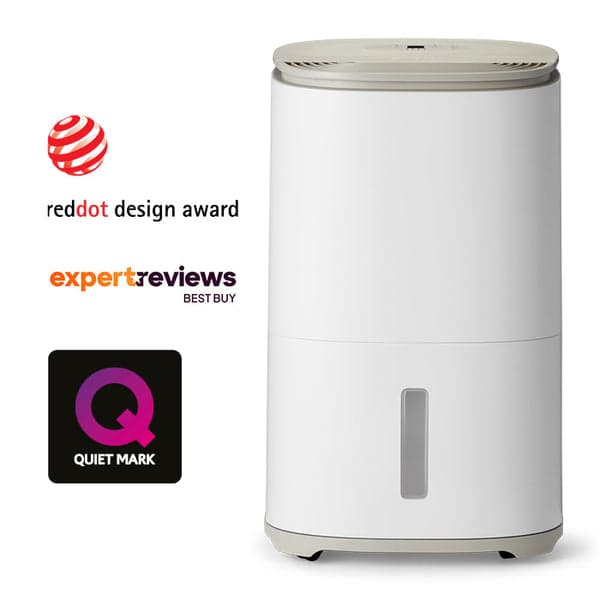
Same technology as the 12L, scaled up. The Meaco Arete One 20L makes sense if you've got a larger drying room, an open-plan space you can't easily close off, or if your home has a persistent damp problem alongside the laundry issue. It extracts more moisture per hour, so it handles bigger spaces without working as hard.
For laundry-only use in a normal-sized room, the 12L is genuinely all you need; the 20L won't dry clothes noticeably faster in a small space because the bottleneck is moisture evaporating from the fabric, not the dehumidifier's extraction rate. But if you want one machine to tackle damp walls, condensation on windows, AND dry your clothes, the 20L earns its keep.
It has the same HEPA filter, laundry mode, and continuous drain as the 12L. The main trade-off is size and weight; it's bulkier and heavier, so it's less convenient to move between rooms.
Specs: £261 on 18 September 2026 | Type: Compressor | Similar pence per hour to the 12L in laundry mode | Tank: 3L | Weight: 13.5kg
Pros: Higher extraction rate, handles damp + laundry simultaneously, same air purifier as 12L, laundry mode
Cons: Larger and heavier, overkill for laundry-only use, still struggles below 15C
Best for Cold Rooms
EcoAir DD1 Simple
£179.99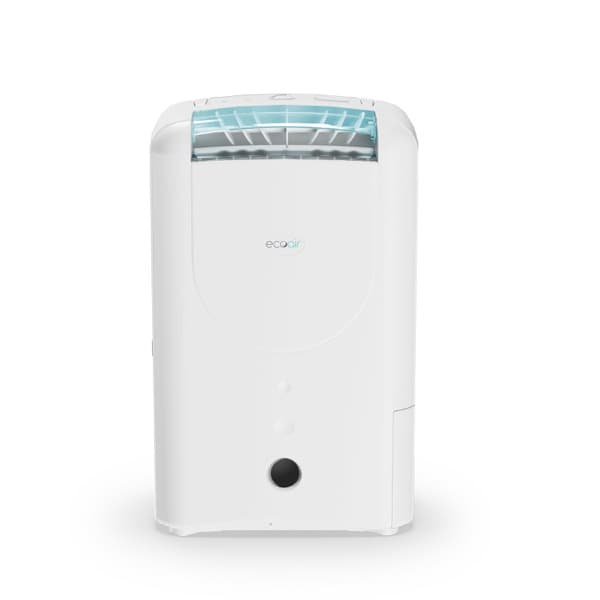
If your drying room is a garage, unheated utility room, conservatory, or any space that regularly drops below 15C, you need a desiccant, and the EcoAir DD1 Simple is the one to get. It works from 1C to 35C, so temperature is never an issue. While a compressor model would be sitting there with ice on its coils doing nothing, the DD1 is steadily pulling moisture out of the air.
It draws about 350W, which at 26.32p/kWh is 9.2p an hour: more than double the Meaco Arete. That's the trade-off with desiccant technology: higher running cost but it actually works where compressors don't. If a compressor model can't extract moisture because the room is cold, its "cheaper" running cost is irrelevant; you're paying for nothing.
At just 6kg, it's also significantly lighter than any compressor model, making it easy to carry between rooms. The "Simple" in the name means it's stripped back: no app, no air purifier, just straightforward controls and reliable drying. Sometimes that's exactly what you want.
Specs: £179.99 on 18 September 2026 | Type: Desiccant | 350W, so 37 to 55p a load over 4 to 6 hours | Tank: 2L | Weight: 6kg
Pros: Works at any temperature (1C-35C), lightweight and portable, effective in cold rooms, reliable
Cons: Higher running cost than compressor models, no air purifier, no smart features, smaller tank needs emptying more often
Best Budget
Blyss 16L
£100 to 130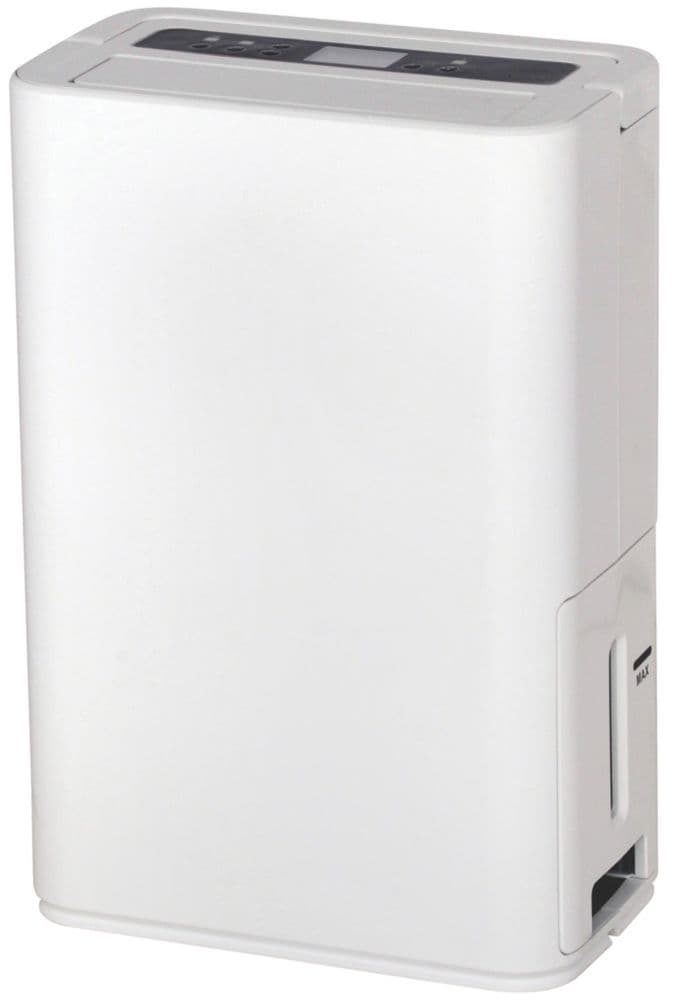
The Blyss 16L is a B&Q exclusive, so you won't find it on Amazon, and it's the cheapest dehumidifier we'd actually recommend for drying clothes. At around £130 against £180 for a Meaco Arete the gap is smaller than it used to be, but it's still real money. You give up laundry mode, smart features, the HEPA filter and continuous drain; the core job of pulling moisture out of the air it does perfectly well.
B&Q doesn't publish a wattage for it, so we can't derive an hourly cost and we aren't going to invent one. Check the rating plate: watts divided by 1,000, times 26.32, gives you pence per hour. It's louder than the Meaco, and the controls are basic: an on/off button and a humidity dial. But if you're on a budget and your drying room is heated, it'll dry clothes in roughly the same timeframe as the fancier models. The moisture doesn't care how much your dehumidifier cost.
One annoyance: no continuous drain option, so you're emptying the tank manually. For most people doing a load every day or two, that's not a big deal; the tank holds enough for one drying session.
Specs: around £130 at B&Q, not sold on Amazon | Type: Compressor | Wattage not published | Tank: 2.2L | Weight: 11kg
Pros: Cheapest effective dehumidifier, decent extraction rate, widely available at B&Q, simple to use
Cons: No laundry mode, no smart features, no continuous drain, louder than premium models
Best Laundry Mode
Meaco DD8L Pro
£200 to 240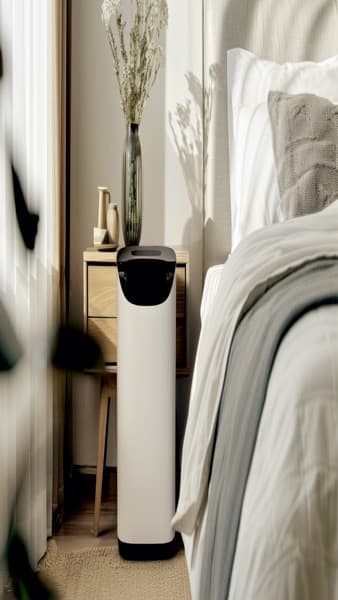
While it's out of stock, consider
 EcoAir DD1 Simple Blue MK3 Desiccant Dehumidifier | Rotary Dial | 7.5 L/Day | Quiet 34dBA | Anti Bacterial Filter | Laundry | 6Kg£179.99 on Amazon
 MeacoDry Arete® One 12L dual Dehumidifier & HEPA air purifier for regular sized homes - prevents damp and condensation - ultra-quiet - low energy laundry mode- night mode - five year warranty£179.99 on Amazon
The Meaco DD8L Pro is a desiccant with a trick up its sleeve: its laundry mode blows warm, dry air directly at your clothes. Most dehumidifiers just pull moisture from the surrounding air. The DD8L Pro actively pushes heated air towards the laundry, which speeds up evaporation significantly; think of it as a cross between a dehumidifier and a fan heater.
This makes it particularly effective in cold rooms where you'd normally expect slow drying. The warm air keeps the clothes from going cold and clammy, which is the main reason drying takes forever in unheated spaces. In laundry mode it draws up to about 650W, which at 26.32p/kWh is 17.1p an hour. That is not cheap, but it finishes faster, so the cost per load lands in the same region as a slower, thriftier machine.
It's also a desiccant, so it works at any temperature. If you're drying in a garage or conservatory and you want the fastest possible drying time without a tumble dryer, this is the one.
Specs: out of stock on 18 September 2026, check the card above | Type: Desiccant | Up to 650W in laundry mode, so 17.1p an hour | Tank: 2L | Weight: 6.4kg
Pros: Warm air laundry mode speeds drying significantly, works in cold rooms, lightweight, effective drying even in winter
Cons: Higher running cost on full power (17p an hour), louder in laundry mode, smaller tank
Best Smart
Pro Breeze 20L OmniDry
£169.99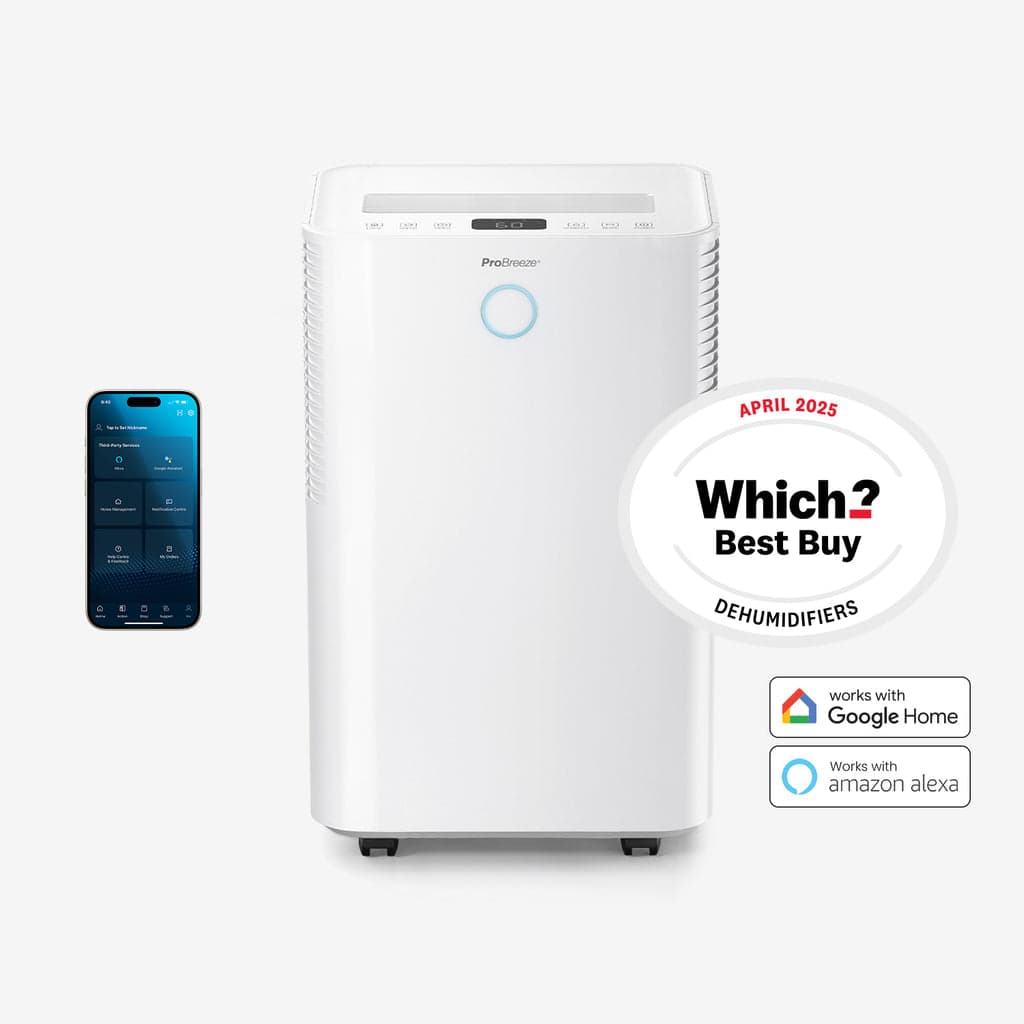
If you want to control your dehumidifier from the sofa (or more usefully, schedule it to run overnight on a cheap electricity tariff), the Pro Breeze 20L OmniDry has WiFi and app control. Set it to start at 00:30 on Octopus Go (when electricity drops to 9.5p/kWh on the current fixed version) and your laundry is dry by morning at a bit over a third of the normal running cost.
The app lets you set schedules, switch between modes, check the tank level, and monitor humidity remotely. It's genuinely useful rather than gimmicky; you don't need to keep going upstairs to check if it's finished. Extraction rate is solid at 20L (advertised). Pro Breeze doesn't publish a laundry-mode wattage, so we're not going to print a pence-per-hour figure for it; check the rating plate and do the sum.
The app itself can be a bit glitchy; it occasionally loses connection and the initial setup is fiddly. Once it's working it's fine, but don't expect Dyson-level polish. It's a compressor model, so the usual cold-room caveat applies.
Specs: £169.99 on 18 September 2026 | Type: Compressor | Wattage not published | Tank: 3.2L | Weight: 12kg
Pros: WiFi app control, schedule overnight runs on cheap tariffs, good extraction rate, large tank
Cons: App can be glitchy, compressor type (not for cold rooms), bulkier than 12L models
Best Compact
De'Longhi AriaDry 12L
£170 to 220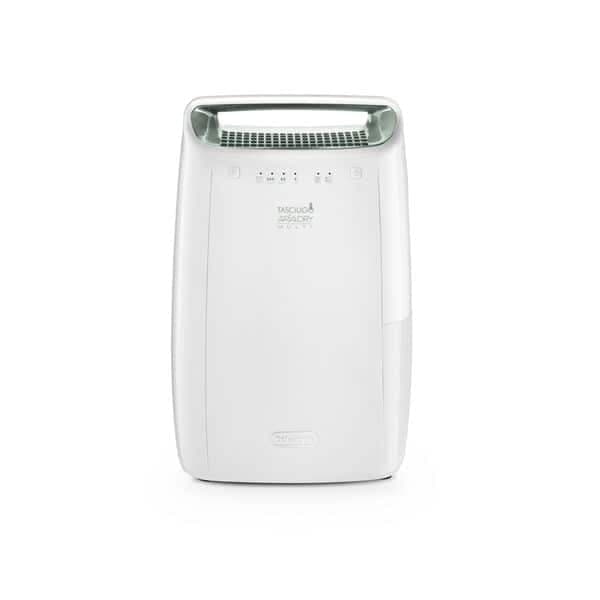
While it's out of stock, consider
- MeacoDry Arete® One 12L dual Dehumidifier & HEPA air purifier for regular sized homes - prevents damp and condensation - ultra-quiet - low energy laundry mode- night mode - five year warranty£179.99 on Amazon
 Pro Breeze® 20L OmniDry Smart Dehumidifier, WHICH? Best Buy Award WINNER, Low Energy, Ultra-Quiet, Automatic Humidity Sensor & Display, Sleep Mode, 24Hr Timer, Laundry Drying, Wifi App, Prevents Damp£169.99 on Amazon
If space is tight (a small utility cupboard, a box room doubling as a drying room, or a flat without a dedicated laundry space), the De'Longhi AriaDry has a noticeably smaller footprint than most 12L compressors. It tucks into a corner without dominating the room.
De'Longhi's build quality is a step above most budget brands. The controls are simple but well-made, the plastics don't feel cheap, and it's quieter than the Blyss at a similar price point. De'Longhi doesn't publish a wattage for it either, so treat any hourly figure you see as a guess; a 12L compressor is typically 150 to 250W, which is 4 to 7p an hour.
The trade-off for the compact size is a smaller tank and no dedicated laundry mode. You can work around the laundry mode thing by manually setting target humidity to 35 to 40%, which achieves roughly the same result. The tank is manageable for a single drying session but you'll be emptying it more often than the Meaco.
Specs: out of stock on 18 September 2026, check the card above | Type: Compressor | Wattage not published | Tank: 2.1L | Weight: 9.5kg
Pros: Compact footprint for small spaces, reliable De'Longhi build quality, quiet, reasonable running cost
Cons: No dedicated laundry mode, no smart features, smaller tank needs emptying sooner
All 7 Products Compared
Blyss 16L
As an Amazon Associate we earn from qualifying purchases. Prices correct as of 12 October 2026, checked against Amazon every few hours.
The Winning Setup: Dehumidifier + Heated Airer + Cover
This is the section that makes this guide worth reading. Every other review treats dehumidifiers as standalone products. In reality, the fastest and most cost-effective indoor drying setup is the combo.
Here's how it works:
- Heated airer (£100 to 170): a standard 3-tier airer draws 300W, which is 7.9p an hour at 26.32p/kWh. The heat speeds up evaporation from the fabric, which is the bottleneck in any drying process.
- Cover (£10 to 18): traps warm, moist air around the clothes, creating a mini warm-air zone. Without a cover the moisture just drifts into the room, and the same load takes six hours instead of four.
- Dehumidifier: pulls the trapped moisture out of the air at 5.4p an hour in the Meaco's laundry mode, preventing condensation on windows and walls.
Add those up: 300W plus 205W is 505W, which is 13.3p an hour. A full load dries in 2 to 3 hours, so 27 to 40p a load.
Now the honest comparison, because we had this wrong and the sums are easy to check. A covered 300W airer on its own is 32p a load over four hours. The combo is 27 to 40p over two or three. So the combo is not cheaper: it costs about the same and takes roughly half the time, and crucially it puts the two litres of water in a tank instead of on your bedroom window. That is the reason to run both, and it is a perfectly good reason. It just isn't a saving.
For which heated airer to pair with your dehumidifier, see our best heated clothes airers guide. The Dry:Soon Deluxe with a cover is the popular choice, though the Black & Decker is the same 300W for about £70 less.
Cost Per Load: Every Drying Method Compared
What it actually costs to dry one full wash load (4kg) using each method, derived from each appliance's stated wattage at the Ofgem cap rate of 26.32p/kWh (1 October to 31 December 2026).
As an Amazon Associate we earn from qualifying purchases.
Here's what every common drying method actually costs per load, based on a typical 4kg wash at current energy prices (26.32p/kWh, Ofgem cap 1 October to 31 December 2026):
| Method | Power | Time | Cost per load |
|---|---|---|---|
| Tumble dryer (condenser) | 3.5 kWh a load | 1–2 hours | 92p |
| Desiccant dehumidifier alone (EcoAir DD1) | 350W | 4–6 hours | 37–55p |
| Tumble dryer (heat pump) | 2.0 kWh a load | 2–3 hours | 53p |
| Heated airer, no cover | 300W | 6 hours | 47p |
| Dehumidifier + heated airer + cover | 505W | 2–3 hours | 27–40p |
| Heated airer + cover | 300W | 4 hours | 32p |
| Compressor dehumidifier alone (Meaco laundry mode) | 205W | 4–6 hours | 22–32p |
| Unheated airer (free-standing) | 0W | 12–24+ hours | Free, but causes damp and condensation |
Every figure is watts × hours ÷ 1,000 × 26.32p, using the Ofgem cap rate for 1 October to 31 December 2026. Nothing rounded in our favour. The same wattages and the same arithmetic are used in our heated clothes airer guide, so the two pages agree.
Three things fall out of that. The cheapest powered option is a compressor dehumidifier on its own, if you can live with four to six hours. The combo is the fastest thing here short of a tumble dryer, at a third of a condenser dryer's cost. And the cover is doing more work than most of the appliances: it turns a 47p load into a 32p one for a fifteen-quid purchase.
One more thing: if you're on a smart tariff like Intelligent Octopus Go (7.6p/kWh between 23:30 and 05:30), everything in that table gets about 70% cheaper, because 7.6p is 29% of 26.32p. The dehumidifier-alone load drops from 22 to 32p to 6 to 9p, and the combo from 27 to 40p to 8 to 12p. The Pro Breeze OmniDry's scheduling feature is handy for this, though a £8 plug-in timer does the same job on any machine.
What You Don't Need
Don't buy a Peltier/thermoelectric mini dehumidifier. Those £30 to 50 ones on Amazon that claim "500ml/day" or similar are designed for a wardrobe, a small boat cabin, or maybe a bathroom cabinet. They extract a few hundred millilitres a day in ideal conditions, a fraction of the two litres or more in one wash load, and the manufacturers rarely publish a figure measured anywhere near UK room conditions. You'd need to run one for a week to dry a single load of laundry. They're not dehumidifiers in any meaningful sense for clothes drying.
You probably don't need 20L extraction for laundry alone. A 12L unit handles a 4kg wash load's 2 to 2.5 litres of moisture easily within 4 to 6 hours. The 20L models are for larger homes with persistent damp issues on top of laundry needs. If your only problem is drying clothes, save the £60 and get the 12L.
Don't dry clothes with the dehumidifier in a huge open-plan room. Close the door. Keep the room as small as practical. A dehumidifier works by reducing the air's relative humidity; the smaller the volume of air, the faster the humidity drops, and the faster moisture evaporates from your clothes. Drying in a small bedroom with the door shut takes half the time of drying in an open-plan kitchen-diner.
Tips for Best Results
- Spin at 1400rpm or higher if your washing machine allows it. The more water you remove mechanically, the less the dehumidifier has to do. Going from 1000rpm to 1400rpm can cut drying time by an hour.
- Close the room door. This is the single biggest tip. A dehumidifier in a closed room can drop humidity to 35 to 40% in an hour. In an open room, it's fighting the moisture from the entire house.
- Position the dehumidifier 1 to 2 metres from the clothes. Too close and you're just drying the nearest items. Too far and the moist air disperses before reaching the unit.
- Point the air outlet toward the clothes if the dehumidifier has a directional vent. The dry air blowing over wet fabric speeds evaporation.
- Use laundry mode if available. It targets a lower humidity level (typically 35 to 40% vs the normal 50 to 55%) and boosts fan speed. If your model doesn't have one, manually set the target humidity to 35 to 40%.
- Consider overnight drying on a cheap tariff. Intelligent Octopus Go charges 7.6p/kWh between 23:30 and 05:30, which is about 70% off the cap rate. A dehumidifier-only session drops from 22 to 32p to 6 to 9p.
- Empty the tank before starting, or use the continuous drain hose if your model has one. A dehumidifier that stops mid-cycle because the tank's full means damp clothes in the morning.
- Space clothes out on the airer. Overlapping fabric traps moisture between layers and doubles drying time. One item per rung if possible.
How a Dehumidifier Helps Your Home (Beyond Laundry)
Drying clothes indoors without a dehumidifier releases 2 to 2.5 litres of water into your home with every load. Over a week, that's 10+ litres of moisture from laundry alone. It condenses on windows, feeds mould growth, and makes your home feel colder (humid air feels colder than dry air at the same temperature).
If damp, condensation or mould is your main problem rather than washing, our best dehumidifier guide compares models on what they actually extract at normal room temperatures, and covers which type to use in a cold room.
A dehumidifier catches that moisture before it causes problems. Many people buy one for drying clothes and discover it also fixes their condensation problems, musty smells, and even helps with dust mite allergies. If you've been wondering why your bathroom window is dripping every morning, the answer might be the clothes horse in the spare room.
For more ways to improve your home's energy efficiency and tackle damp, see our complete energy efficiency guide.
