
The Short Answer
The Hoover H-DRY 350 HRE H9A3TBE-80/N (£449) is the best heat pump tumble dryer for most homes. It's a 9 kg A+++ model with a true inverter motor and Wi-Fi, and it undercuts every Bosch or Samsung A+++ alternative. At 194 kWh a year it costs about £51 to run on the label's basis of 160 drying cycles, or about £45 if you're a 140-cycle household.
- Haier X Series 7 (£519): the only sensibly priced A+++ pick if you need 10 kg for a big household.
- Samsung Series 7 DV90T6240LE/S1 (£686): the smart-premium choice for SmartThings users.
- AEG 7000 Series TR708L0B (£409): AEG build quality, and the cheapest of our picks that isn't the Sharp. Out of stock on Amazon at the time of writing.
- Sharp KD-NHH8S7GW21-EN (£339): the cheapest heat pump dryer that isn't a compromise.
Bosch's A+++ Serie 6 dryers are worth a look too, though you'll usually find them at Currys or AO rather than Amazon.
How We Picked
We took the live "heat pump tumble dryer" search on Amazon UK and verified each candidate was actually in stock with a real price (not "currently unavailable" or "available from third-party sellers"). From the in-stock pool we filtered out anything below 8 kg, anything where the manufacturer wouldn't publish a verified annual kWh figure, and anything with fewer than 50 customer reviews. We then picked five that cover the genuinely different use cases: cheapest reliable entry, AEG-brand build, smart-home premium, big-household 10 kg, and outright budget.
We didn't run our own washing tests. Which?, Trusted Reviews, and Reviewed have already done the proper sock-and-towel chambers and we trust their numbers. What we did was the part those reviews skip: cross-check the declared energy label figures against the listings, work out the real running cost at the Ofgem price cap for 1 October to 31 December 2026, and pressure-test each pick on actual Amazon stock the day we wrote this.
Our Picks
Cost-per-year figures below use each model's declared annual kWh consumption at 26.32p/kWh, the Ofgem price cap rate for 1 October to 31 December 2026. That declared figure is calculated over 160 drying cycles a year, which is what assimilated Regulation 392/2012 specifies for the GB label, so it's already close to real use for most households. If you dry 140 loads a year rather than 160, knock about 12% off. If you only tumble dry through the winter, knock off a lot more.
All 5 Products Compared
As an Amazon Associate we earn from qualifying purchases. Prices correct as of 12 October 2026, checked against Amazon every few hours.
Best Overall
Hoover H-DRY 350 HRE H9A3TBE-80/N
£419.00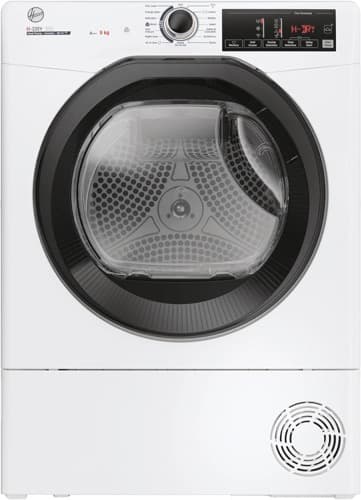
The Hoover wins on the one thing that actually matters: cost over the lifetime of the appliance. At around £449 on Amazon UK it's the cheapest A+++ rated heat pump dryer you can buy from Amazon today, and it does drop into the low £400s in sales. The A+++ figure is verified at 194 kWh a year, which puts it level on energy with the Samsung that costs about £235 more, and ahead of every A++ rival.
The inverter heat pump motor is the technical reason it's so efficient at this price. Inverter motors vary their speed continuously, which is quieter, lasts longer, and dials back power use at the tail end of the cycle when the load is nearly dry. Cheaper sub-£300 models often skip this and use a single-speed motor instead.
The hOn app is fine. You can start, pause and resume cycles, see how much time is left without going into the utility room, and get a notification when the load is done. We wouldn't pay extra for it, but at this price you're getting it included. The Anti-Allergy programme is the standout extra, it runs hotter for longer to deal with dust mites and pollen, useful if anyone in the house has hay fever or asthma.
Where it falls short of the AEG and Samsung is build. The drum lining is plastic rather than stainless steel, the door hinge feels lighter, and the buttons are membrane rather than mechanical. None of that affects how well it dries clothes, but you can tell where the saving went. Hoover's long-term reliability record is mid-table in the industry: not as strong as Bosch or AEG, generally better-regarded than Samsung or Hotpoint.
Pros: Cheapest A+++ rated heat pump dryer in this lineup, inverter motor, Wi-Fi included, Anti-Allergy programme, 9 kg drum
Cons: Plastic drum lining, hOn app is functional but plain, Hoover reliability is mid-table
Best Smart Premium
Samsung Series 7 DV90T6240LE/S1
£703.47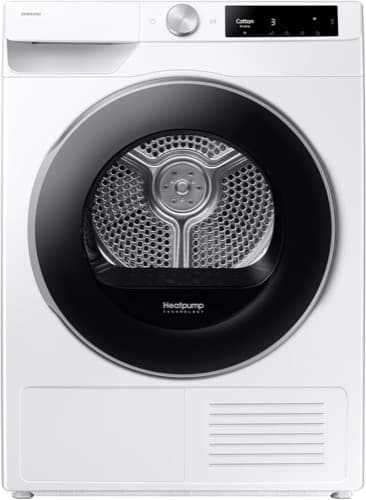
The case for the Samsung Series 7 is SmartThings. If you've already got a Samsung washing machine, fridge, or hub, this dryer slots into the ecosystem and the laundry assistant function will suggest cycle settings based on what came out of the washer. AI Energy Mode picks the most efficient cycle automatically, and the 194 kWh/year figure matches the Hoover at the same energy class.
OptimalDry is the genuine technical differentiator. It uses moisture and temperature sensors inside the drum to predict not just when the clothes are dry, but how dry they need to be for the fabric type, and it's the system Which?'s testers consistently praise for even dryness across mixed loads.
Where it falls down is the Samsung problem. Samsung's laundry appliances have repeatedly ranked at or near the bottom of Which?'s public reliability summaries. The faults aren't usually the dryer mechanism (the heat pump itself is sealed and well made) but the electronics: control boards, Wi-Fi modules, and the touchscreen interface. If the screen dies after five years and the part costs £300, the smart features stop looking quite so smart. Cycle times are also the longest in this list, 220 minutes for a full cotton load against around 189 minutes for the Sharp.
Pros: OptimalDry sensors are consistently praised by Which? testers, SmartThings integration works well, AI Energy mode, A+++ on the GB label, Quick Dry 35 min for small loads
Cons: Slowest cycle time in this list at 220 min, Samsung's laundry appliances rank at or near the bottom of Which?'s public reliability summaries, premium price for the same energy class as the cheaper Hoover
Best for Big Households
Haier X Series 7 HD100-C367GU1-UK
£569.00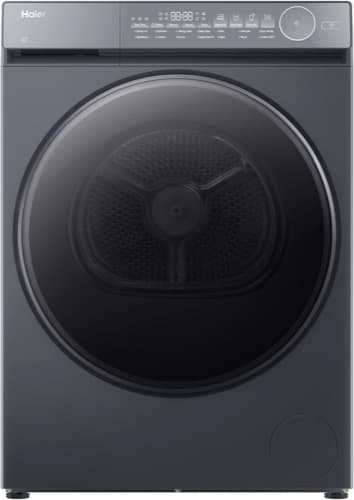
If you've got four or more people in the house, a king-sized duvet, or you regularly wash bedding, a 9 kg dryer fills up too fast. The Haier X Series 7 is the only 10 kg heat pump dryer at a sensible price that still earns A+++ on the GB label. At £519 it's about £70 more than the Hoover for the bigger drum, and a slightly higher annual energy figure (215 kWh/year against 194, so £57 a year against £51), which is about £6 a year extra to run.
Haier is owned by the same group as Hoover and Candy, and the Haier X Series 7 uses the same hOn app for Wi-Fi control. The Ion Fresh feature is a UV-light cycle that runs without heat, useful for refreshing worn clothes between washes (jeans, jumpers, towels you've used once). It's a gimmick if you don't use it but it works as advertised.
The drum is what Haier calls a "Pillow Drum" with slight curves rather than straight ribbing. It's gentler on clothes but reduces effective fill volume slightly, so a full 10 kg of cotton bedlinen will take closer to 3.5 hours rather than the 3 hours an equivalent Samsung 10 kg would run. The flip side: significantly less wear on fabrics over the long run.
Reliability data is the weak link. Haier is newer to UK laundry, and the published Which? reliability surveys don't yet have enough Haier owners to give the brand a star rating. Anecdotally the dryers are well-built (Haier owns Candy and Hoover, so the underlying engineering is shared), but you're partly taking the brand on faith.
Pros: 10 kg drum is rare at this price and energy class, A+++ on the GB label, Wi-Fi via hOn app, Ion Fresh UV refresh cycle, Twin Turbo for faster drying
Cons: Long cycle times on full loads (allow 3.5 hours), Haier reliability data is thin, the brand is still building UK service network
Best AEG Build Quality
AEG 7000 Series TR708L0B
£399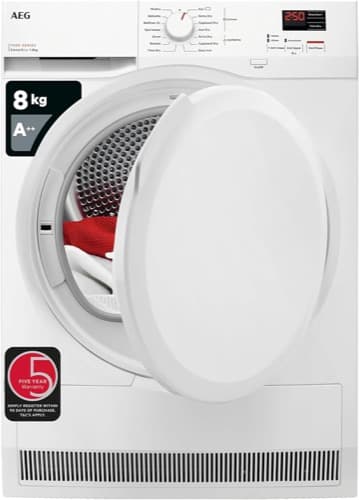


One thing first: Amazon has this out of stock as we write, and AEG stock comes and goes, so check the box above before you get attached. If you want AEG cabinet build quality without paying what the AEG 9000 Series goes for elsewhere, this is the AEG on Amazon worth buying. The AEG 7000 sits below the premium 9000 line but uses the same SensiDry humidity sensing technology, the same EasyClean integrated filter design, and the same solid cabinet build. AEG laundry appliances have a strong long-term reliability reputation, typically grouped with Bosch and Miele at the top of consumer reliability surveys.
The catch is the A++ rating, one class down, which means it uses about 21% more electricity than the Hoover or Samsung. At 235 kWh/year that's around £62 a year to run versus £51 for the A+++ models, a difference of about £11 a year. Over a 10-year life that's roughly £110 in extra electricity, which is the price you pay for staying well under what the AEG 9000 goes for elsewhere. Against the Hoover it's a closer call than it used to be: the AEG is around £40 cheaper to buy but £11 a year dearer to run, so the Hoover is ahead on total cost after about four years, and it has Wi-Fi the AEG doesn't.
So why include it? AEG reliability. The brand has a long-running reputation for laundry appliances that survive past their warranty without major faults, where cheaper rivals often need a control-board swap somewhere in the middle of the appliance's life. If you're the type who buys appliances expecting them to outlast the warranty by a decade, this is the one.
Pros: AEG build quality at AEG-7000 price, SensiDry humidity sensors, EasyClean integrated filter, AEG groups with Bosch and Miele near the top of laundry reliability surveys
Cons: A++ not A+++ so noticeably more electricity than the Hoover, 8 kg drum, louder at 66 dB, stock often shows "only 10 left" on Amazon
Best Budget
Sharp KD-NHH8S7GW21-EN
£429.00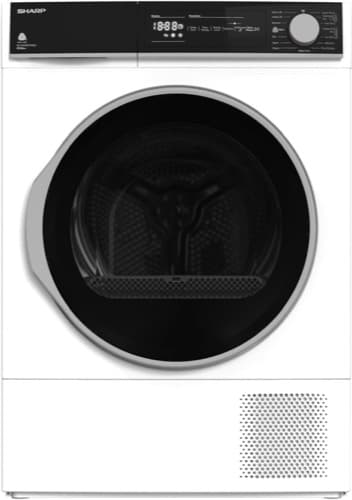
The Sharp is here for one reason: it's the cheapest heat pump dryer that isn't a gamble. At £339 it's about £70 less than the AEG 7000, £110 less than the Hoover, and nearly £350 less than the Samsung. For people who tumble dry occasionally rather than as a daily habit, the up-front saving covers the years of higher running costs and you still end up ahead.
The specs are honest. 8 kg drum, A++ on the GB label, 235 kWh/year (the same figure as the AEG 7000), 189 minutes for a full cotton cycle, 64 dB. The cabinet is plain plastic with a basic LED display, no frills.
What you don't get: Wi-Fi, an app, smart sensors beyond a basic moisture probe, steam refresh, or a touch screen. What you do get is a dryer that earns its place against vented or condenser dryers on running cost alone: about £62 a year against roughly £130 for a vented or condenser machine, so £68 a year back in your pocket. Against a cheap vented dryer at around £200, the extra you pay here comes back in a little over two years, and you keep saving for the decade after that.
The risk: Sharp's UK appliance service network is thinner than Bosch or AEG. Out-of-warranty repairs typically go through Sharp's authorised contractor network, which can mean longer wait times for parts. The 2-year manufacturer warranty is industry-standard but doesn't cover labour after year 1.
Pros: Cheapest verified heat pump dryer worth buying, genuine 235 kWh/year (not a fake "heat pump" badge), 8 kg drum, faster cycle than the Samsung
Cons: No Wi-Fi or smart features, Sharp UK service network is smaller, basic LED display, no steam refresh
What You Don't Need
Wi-Fi for the sake of Wi-Fi. If you're not going to use the app, skip the Wi-Fi premium. We've owned three smart dryers and after the first six months we mostly just press buttons on the machine like normal humans. The exception is if you're stacking the dryer on top of a washing machine in a cupboard you can't easily reach: notifications on your phone become genuinely useful.
An 11 kg or 12 kg drum. Unless you have five or more people in your household, drum sizes above 10 kg are wasted capacity. Heat pump dryers run at lower temperatures and they need air space around the clothes to work. Over-fill a big drum and the cycle time stretches to 4+ hours, which defeats the point.
Reverse drum rotation as a headline feature. Every dryer above £350 has reverse drum rotation. Manufacturers tout it as if it's special. It isn't.
Quick 30-minute programmes. A 30-minute cycle on a heat pump dryer doesn't dry clothes, it warms them. Heat pump tech doesn't get hot enough to drive moisture out in half an hour. If you genuinely need clothes dry in 30 minutes, you need a vented dryer (or a hair dryer and patience).
Bigger water tanks. The size of the condensation tank doesn't change how often you need to empty it, that's determined by load size. Connect the drain hose to a sink trap or external drain (about £8 on Amazon) and you never empty the tank.
Heat Pump vs Condenser vs Vented: What It Really Costs
What Each Type of Tumble Dryer Costs to Run
Cost per cycle and annual cost at the Ofgem price cap for 1 Oct to 31 Dec 2026 (26.32p/kWh). Annual figures use Which?'s methodology of 3 loads per week (156 cycles/year).
As an Amazon Associate we earn from qualifying purchases.
The chart above is the single most important piece of information on this page. According to Which?'s 2026 figures, vented and condenser dryers actually cost almost the same to run, around £130 a year for three loads a week, because both use a 2.5 to 3 kW heating element. The split between them is whether the moisture goes out through a hose (vented) or into a tank (condenser). A heat pump dryer costs about £51 a year for the same use, less than half. (Which? works to 156 loads a year, near enough the label's 160 that the two sets of figures on this page line up rather than fighting each other.) The £80 a year you save will pay back the price difference between a heat pump and a basic condenser in roughly 3 to 5 years, and the heat pump itself runs cooler so the appliance typically lasts 12 to 15 years versus 8 to 10 for a hot-element machine.
The case against heat pump dryers used to be cycle time. A vented dryer would do a load in 90 minutes, a heat pump in three hours. That's still broadly true, but the gap has narrowed: the Sharp does a full cotton cycle in 189 minutes, the Samsung in 220, with most A+++ models landing somewhere between. If you regularly need clothes dried in under 90 minutes, get a vented dryer and accept the higher bills. For most people, "I want it dry by morning" is the real requirement, and three hours overnight is fine for that.
Why the Energy Labels Look Like a Mess
Here's the bit almost every buying guide gets wrong, including ours until we checked it properly: Great Britain and the EU are now on different tumble dryer labels, and Great Britain is still on the old one.
The government's own guidance spells it out. Tumble dryers placed on the market in GB "continue to meet assimilated regulation 932/2012", and GB suppliers "may provide either the current GB energy label and product fiche in accordance with assimilated regulation 392/2012, or use a temporary easement energy label and easement product information sheet". Assimilated 392/2012 is the A+++ to D scale. So in England, Scotland and Wales, A+++ is still the current, legally correct top class.
The EU rescaled its own label instead. From 1 July 2025, CE marked dryers going onto the Northern Ireland and EU markets have to comply with EU regulation 2023/2533, which is where the A to G scale comes from. Northern Ireland follows the EU here, Great Britain doesn't.
And then the fudge: DESNZ has recommended "that it is not in the public interest for OPSS to take enforcement action in respect of any CE marked tumble dryers (which comply with the new EU regulations 2023/2533) that are placed on the GB market from 1 July 2025 onwards", pending a consultation on whether to align. In plain English, manufacturers can print the new EU label on a dryer sold in Britain and nobody will stop them, but they don't have to, and plenty still use the old GB one.
That's why Amazon looks the way it does. One listing says A+++, the next says C, and they can be near-identical machines. Neither seller is lying. They're labelling to different rulebooks, and the two scales were drawn up under different regulations, so the letters do not convert cleanly between them.
The way through it: ignore the letter and read the kWh figure. The GB label's annual number is calculated over 160 drying cycles, so it's a figure you can put a price on directly. Our picks run 194 to 235 kWh a year, which is £51 to £62 at the current cap. Under 200 kWh/year is excellent, 200 to 250 is fine, and anything over 280 isn't really a heat pump dryer, it's a condenser with marketing on top.
Installation and Maintenance Tips
Plumb the drain hose. Every dryer in this list has a drain hose connection on the back. Run a hose to a sink trap, washing machine standpipe, or external drain, and you never empty the water tank. The hose isn't always supplied (some manufacturers include one, others don't). A 1 metre hose with the right fitting costs about £8 on Amazon. Worth doing on day one.
Don't stack on a vibrating washing machine without a stacking kit. Heat pump dryers contain a sealed refrigeration circuit. Long-term vibration from a washing machine spin cycle below them can prematurely fail the compressor. A proper stacking kit from the manufacturer (typically £25 to £50 depending on brand) decouples the dryer from the washing machine vibration. Don't use bungee cords or sit it on a tray.
Rinse the filters monthly. Most dryers have two filters: a fluff filter inside the door and a condenser filter at the bottom front. Both need rinsing under a tap every few cycles. If you skip it, drying times stretch and the dryer eventually flags an error. Bosch's higher-end SelfCleaning models do the condenser one automatically, but you'll still have to do the door filter.
Air it before first use. Heat pump dryers are filled with refrigerant gas at the factory. After delivery, leave the dryer upright for 4 hours before plugging in so the refrigerant settles in the compressor. Skipping this is the single most common cause of a brand-new dryer failing within the first week.
Frequently Asked Questions
Our Top Picks
The best heat pump tumble dryers in stock on Amazon UK right now.
Hoover H-DRY 350 HRE H9A3TBE-80/N
£419.00Cheapest A+++ heat pump dryer on Amazon UK. Inverter motor and 194 kWh/yr running cost beat every Bosch or Samsung A+++ at this price.
Samsung Series 7 DV90T6240LE/S1
£703.47OptimalDry sensors and SmartThings integration. The pick if you live in the Samsung ecosystem and want smart-home control.
Haier X Series 7 HD100-C367GU1-UK
£569.00Rare 10 kg A+++ heat pump dryer at a sensible price. The only one we'd buy if you need the bigger drum.
AEG 7000 Series TR708L0B
£399AEG cabinet build quality at a sub-£400 price. AEG sits near the top of laundry reliability surveys alongside Bosch and Miele.
Sharp KD-NHH8S7GW21-EN
£429.00Cheapest heat pump dryer on Amazon UK worth buying. The maths still works against a vented or condenser dryer.
As an Amazon Associate we earn from qualifying purchases. Prices and stock are checked against Amazon every few hours and may have changed since.
