
The Short Answer
Buy a radiator booster fan to fix a specific comfort problem, not to cut your heating bill. They genuinely work at what they do, which is stopping heat pooling at the ceiling and getting it out into the room where your feet are. But on our own sums the bill saving is about £6 to £14 per radiator per winter once you take off the fan's own electricity, and against a £38 fan that's a payback of three to six winters. Anyone quoting you one or two is not showing their working.
Fit one if a room has high ceilings, a radiator under a window, or a heat pump running low flow temperatures. Skip it everywhere else.
- EcoCalm Radiator Fan Booster 3.0 (about £38): one fan, one radiator, automatic heat sensor. The one to try first.
- SpeedComfort Trio Set (around £107): three magnetically mounted fans for a wide radiator. Better engineered, far harder to justify on cost.
How They Work
When a radiator heats up, warm air rises straight off the top in a convection current. In a room with 2.4m ceilings that's fine; the air circulates and the room evens out. In a room with a high ceiling, a lot of that heat collects above head height and stays there. If the radiator sits under a window, the rising air hits cold glass, loses its heat, and drops back down as a cold draught across the floor. Warm ceiling, cold ankles.
A booster fan sits on top of the radiator, or clips underneath it, and pushes the air forward into the room at low level instead of letting it climb. The room reaches the thermostat's target faster, so the boiler or heat pump runs for less time per cycle. That's the whole mechanism, and it's real.
The fans are thermostatically controlled: they switch on when the radiator warms up and off when it cools. You fit them and forget them.
What They Cost to Run
A 5W fan running roughly 8 hours a day through a 180-day heating season uses about 7.2 kWh. At the Ofgem rate of 26.32p/kWh that's about £1.90 a winter, or roughly 30p a month while the heating's on.
That's small, but it's not "a few pence a month" as we used to say here, and it matters because it comes straight off a saving that isn't very big either. Hold that £1.90 in mind for the next section.
Realistic Savings, With the Working Shown
Nobody publishes measured data on radiator fans. The Energy Saving Trust doesn't cover them. So the only honest thing to do is build an estimate from stated assumptions and let you argue with them.
- Assume the fan gets the room to temperature 15–20 minutes sooner on each heating cycle, over two or three cycles a day.
- For a room whose radiator would otherwise run around 8 hours a day, that's roughly 0.5 to 1.0 kWh of heat a day you don't have to put into the room.
- A UK heating season is about 180 days, so 90 to 180 kWh of heat over a winter.
- Heat delivered by a 90% efficient gas boiler costs 8.86p/kWh (gas is 7.97p/kWh at the meter under the current cap, divided by 0.9).
- 90 kWh × 8.86p = £7.97. 180 kWh × 8.86p = £15.95.
- Take off the fan's own £1.90 of electricity and you net £6 to £14 a year, per radiator.
Call it £10 in a typical room. Against an EcoCalm at about £38, that's roughly four winters to pay back, and on the pessimistic end nearer six. Against the SpeedComfort Trio at around £107, you are not getting your money back inside a decade.
We previously said £10–£25 a year and a payback of one to two winters on this page. Our own derivation never supported it, and we've corrected it rather than quietly adjusting the conclusion. If you see that range elsewhere, ask what it's divided by.
One thing that genuinely could move the number: if the fan lets you drop the thermostat by a degree because the room feels evenly warm, that's worth £120 a year in GB across the whole house according to the Energy Saving Trust. That's ten times the fan saving, and it's the reason to think of these as a comfort product with a financial side effect rather than the other way round.
When They're Worth It
- Radiators under windows. This is the best case by a distance. Warm air rising off the radiator hits cold glass, cools, and falls back as a draught along the floor. A fan pushes it into the room before it ever reaches the window.
- Rooms with high ceilings. Victorian front rooms, barn conversions, anything with a vaulted ceiling where heat parks itself above where you live.
- Rooms that take forever to warm up. If the radiator is hot to the touch but the room still feels cold an hour later, the heat isn't getting to you and a fan is a cheap thing to try.
- Heat pump systems. A heat pump runs radiators at 35–50°C rather than 70°C, so the convection current is much weaker and rooms warm up more slowly. A fan compensates by moving the gentler warmth about actively. This is arguably the strongest case of the lot, and it's a comfort fix for the most common complaint people have about a new heat pump.
When They're Not Worth It
- Standard 2.4m ceilings, radiator not under a window, room heats up fine. There's nothing to fix. Don't spend £38 confirming it.
- If the radiator is undersized. A fan can't create heat that isn't there. If the radiator is too small for the room you need a bigger radiator, and our radiator sizing guide will tell you what size.
- If the radiator has cold patches. That's trapped air or sludge, not airflow. Bleed it first. It's free and it takes two minutes.
- Underfloor heating. No radiator, no fan.
- As a first purchase. If you've got £38 and a cold house, loft insulation top-ups, draught proofing and a smart TRV on the rooms you don't use all beat this on return.
Our Picks
Best for a Single Radiator: EcoCalm Radiator Fan Booster 3.0
The EcoCalm 3.0 is the one most people end up with. It sits on top of the radiator on rubber feet, draws just 5 watts, and has a built-in heat sensor that starts it when the radiator warms and stops it when it cools. Five blades, quiet in use, and it fits standard UK Type 21, 22 and 32 radiators.
At about £38 it's not cheap for what is a small fan with a thermostat in it, and on our numbers it takes about four winters to pay for itself. What you're really buying is a room that stops having cold ankles, fitted in two minutes with no tools and nothing to switch on or off.
Worth knowing: availability on this one comes and goes. If it's showing as unavailable when you look, that's the listing, not a discontinuation, and there are near-identical single-fan units from other sellers at similar money.
For a Wide Radiator: SpeedComfort Trio Set
The SpeedComfort Trio is three fans on a magnetic rail that clips under the radiator rather than balancing on top, which is a neater bit of engineering and much better if you've got children or a cat. It's a Dutch product, the build quality is a step up, and the thermostat activation is reliable. The manufacturer claims up to 22% energy savings and twice as fast heating, which is a manufacturer's claim and should be read as one.
The problem is the price. It's around £107 for the set, and on the arithmetic above a single radiator saves you about £10 a year. Even if you accept that three fans on a wide radiator do better than one, and they probably do, you're looking at a decade-plus payback.
Buy it if you've got a long radiator in a room you actually live in and you want the problem solved properly. If you're testing whether the whole idea works in your house, spend £38 on the EcoCalm first and see whether you notice anything. That's the honest order to do this in.
Getting More Out of Them
- Fix the basics first. Bleed the radiator, check the TRV actually turns, and make sure nothing's parked in front of it. A sofa across a radiator undoes more than a fan adds.
- Don't hang a full-length curtain in front of it. A floor-length curtain over a radiator under a window sends its output straight up the cold glass, which is the exact problem the fan is trying to fix. The curtain should sit behind the radiator or stop at the sill.
- Pair it with a reflector panel if the radiator is on an external wall. Reflector panels are a few pounds and tackle a different loss, so the two don't overlap.
- Try the one room first. Fit a single fan in the worst room, live with it for a fortnight, and decide honestly whether you'd pay £38 again for the next room. Most people buy one more and stop.
For other ways to get more out of your radiators, see our guides to radiator reflector panels and bleeding your radiators. For the measures that beat this one on payback, read our complete energy efficiency guide.
Our Top Picks
One fan for a single radiator, and a three-fan set for a wide one.
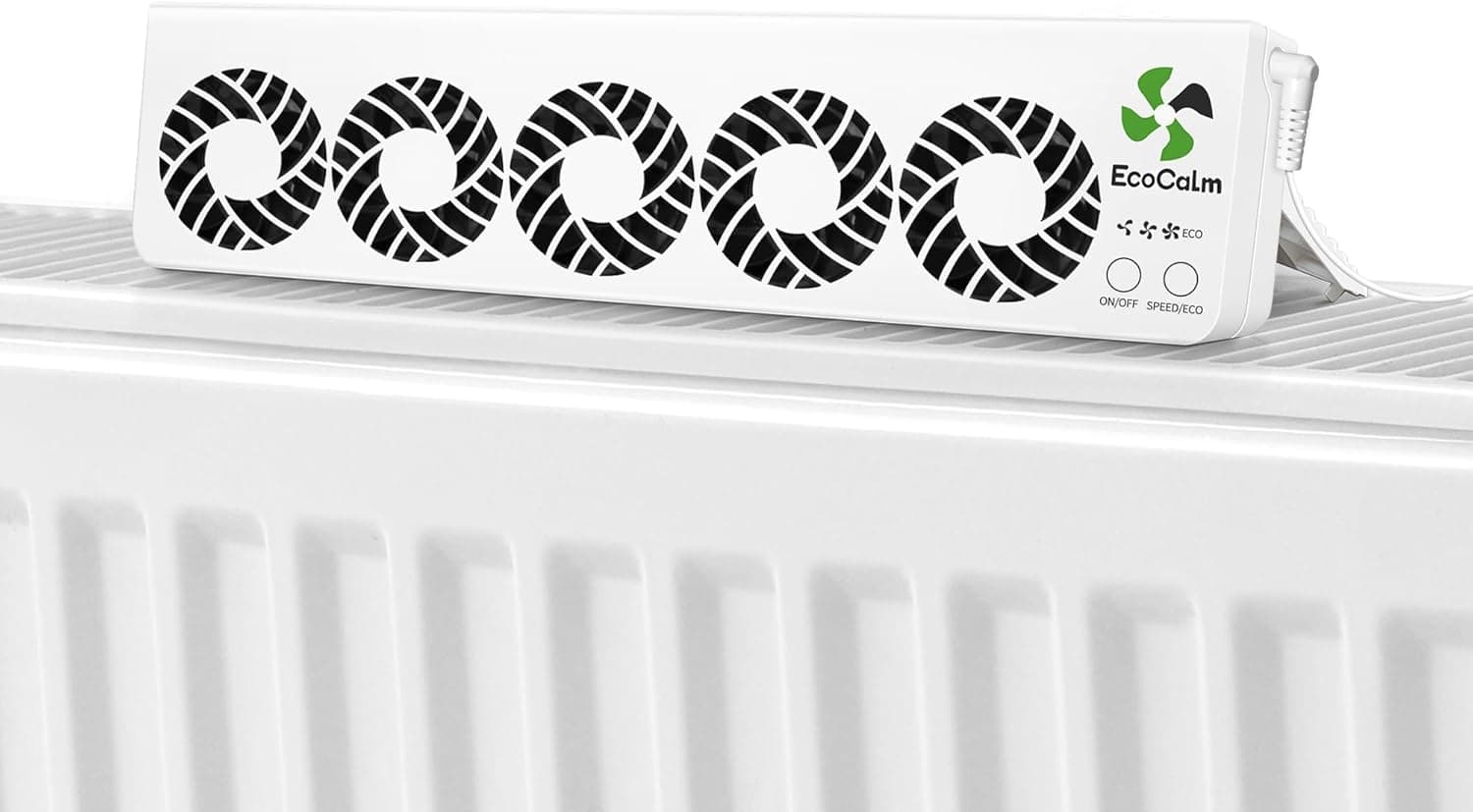
EcoCalm Radiator Fan Booster 3.0
£35–£40Pushes warm air off the radiator and into the room. Most effective on radiators below windows where heat rises and escapes.
SpeedComfort Radiator Fan Trio Set
£107.00Triple-fan set covers a wider radiator than a single fan. Auto-thermostat switches on/off with the heating. Claims 22% energy savings.
As an Amazon Associate we earn from qualifying purchases. Prices and stock are checked against Amazon every few hours and may have changed since.
