
The Short Answer
Here's something most thermostat reviews won't tell you: most heat pump owners don't need a third-party smart thermostat at all. Your heat pump's built-in controller already handles weather compensation, which is the thing that actually saves you money. Sticking a Nest or Hive on there in basic on/off mode can genuinely make your heat pump less efficient by forcing it to cycle on and off instead of modulating smoothly at a low flow temperature.
That said, if you do want app control and smart scheduling, here's what to get depending on your setup:
- tado° Smart Thermostat X: the best option for app control, scheduling and geofencing, but only if your heat pump supports OpenTherm (and most don't).
- Drayton Wiser: the best value system for everyone else, with solid TRV support and no subscription fees.
- Homely: the specialist option built specifically for heat pumps, if you want proper heat-pump-optimised control without learning what a weather compensation curve is.
If you've got a Vaillant? Skip all of these and use the sensoCOMFORT. It speaks your heat pump's native language better than any third-party thermostat ever will.
Why Heat Pumps Need Different Thermostats
Your old gas boiler was simple. The thermostat said "heat on", the boiler fired up to 70°C, blasted hot water around your radiators, and switched off when the room hit temperature. On/off control worked fine because gas boilers are designed for short, aggressive burn cycles.
Heat pumps are fundamentally different. They work best running gently for hours, sometimes all day, at a low flow temperature (30–45°C). When a basic thermostat forces a heat pump to cycle on and off, it's like driving a car by flooring the accelerator then slamming the brakes. You'll get there, but you'll use twice the fuel.
The magic word is modulation. A thermostat that can tell the heat pump "run at 35°C flow temperature" is fundamentally different from one that just says "on" or "off". The protocol that enables this is called OpenTherm, an open communication standard that lets the thermostat and heat pump have a proper two-way conversation about what's needed.
Here's the catch: most UK heat pumps don't support OpenTherm natively. Vaillant uses its own eBUS protocol. Mitsubishi has MELCloud. Samsung has SmartThings. Only Daikin and a few others speak OpenTherm out of the box. So buying a fancy OpenTherm thermostat for a Vaillant Arotherm is a bit like buying a French phrasebook for a trip to Japan.
The other key concept is weather compensation, which adjusts the flow temperature based on the outdoor temperature. On a mild 12°C day, your heat pump barely needs to work. On a -3°C night, it ramps up. The good news? Most modern heat pumps (Vaillant, Mitsubishi, Daikin, Samsung) do this internally using their own outdoor temperature sensors. A third-party thermostat that overrides this with on/off control actually makes things worse.
Check Your Heat Pump First
Before spending £100+ on a thermostat, find out what your heat pump already does. Your existing controller might be handling weather compensation perfectly well. If so, you only need a smart thermostat for convenience features like app control and scheduling, not for efficiency.
Heat Pump Compatibility Checker
Select your heat pump brand to see which thermostats actually work, and which are a waste of money.
Select your heat pump brand above to see personalised thermostat recommendations.
Our Picks
Best Overall
tado° Smart Thermostat X
£109.99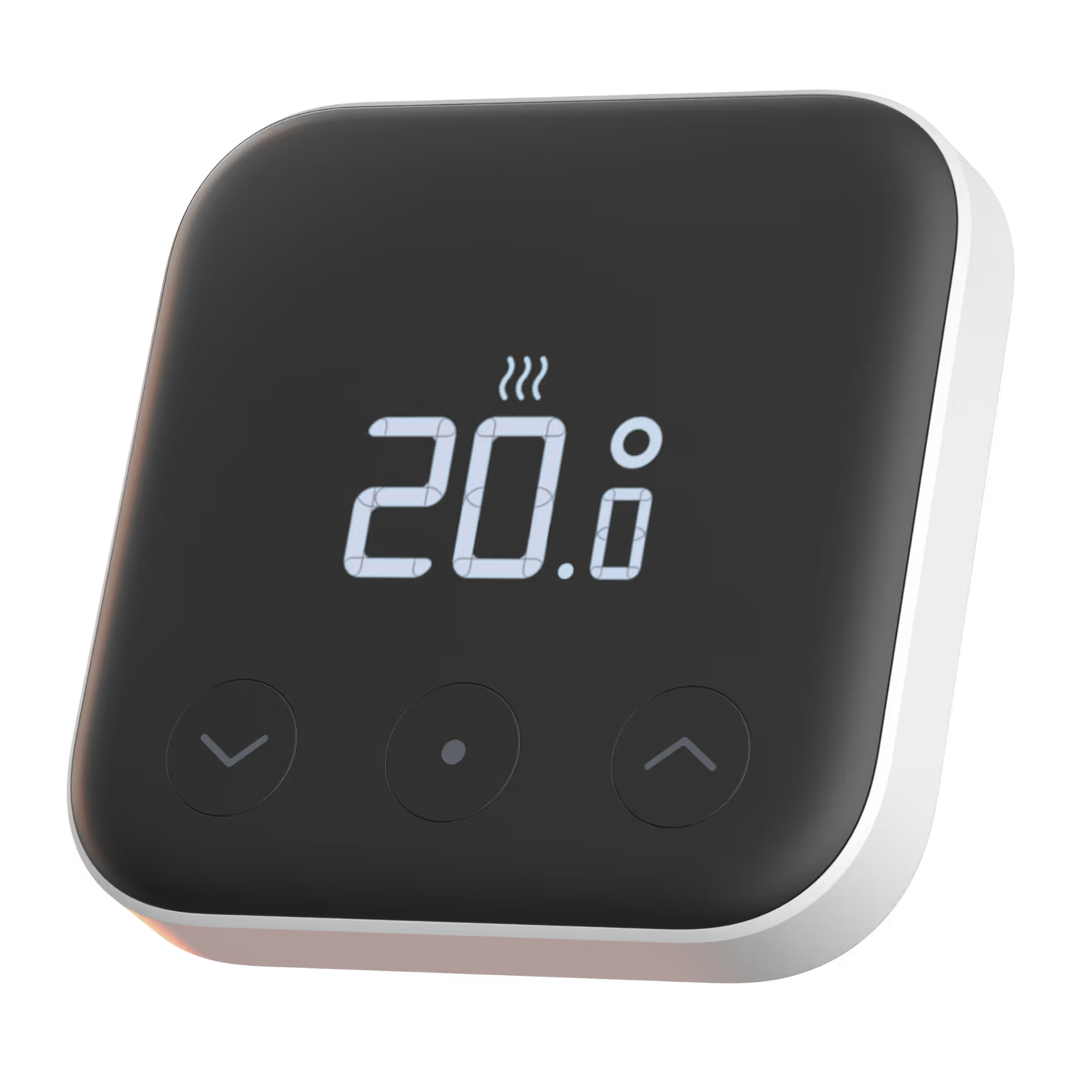
The tado° X is the latest generation and it earns the top spot for one reason: it's the most polished OpenTherm thermostat you can buy in the UK. When connected via OpenTherm, it can modulate your heat pump, telling it to run at 35°C flow temperature on a mild day and 45°C when it's genuinely cold, instead of just flicking it on and off like a light switch.
The geofencing is genuinely useful with a heat pump. It detects when the last person leaves the house and gently backs off the heating, then pre-warms before you get home. For a heat pump, "gently" is the key word; unlike a gas boiler, you can't crank a heat pump up for a quick blast of warmth. The tado° understands this and makes gradual adjustments rather than demanding a sudden spike in output.
The X model uses the new Matter protocol alongside its existing smart home integrations, so it works with Alexa, Google Home, and Apple HomeKit. The app is clean, the hardware looks good on the wall, and tado° makes matching Smart Radiator Thermostats if you want per-room control; more on that later.
The catch: the automatic features sit behind a subscription. tado° now publishes it as AI Assist at £3.99 a month, with an annual plan it advertises as 37% cheaper, so about £30 a year against £48 paying monthly. Geofencing, pre-heating before you arrive, advanced open-window detection and the energy dashboards are all in that tier; scheduling and remote control are not. The core thermostat works fine without it, but it's the kind of thing that should just be included at this price point.
The bigger catch: if your heat pump doesn't support OpenTherm (Vaillant, Samsung, Grant, most Mitsubishi models), the tado° X falls back to on/off relay control. At that point, it's just an expensive on/off switch with a nice app. Check compatibility before you buy.
Best Value System
Drayton Wiser
£120–160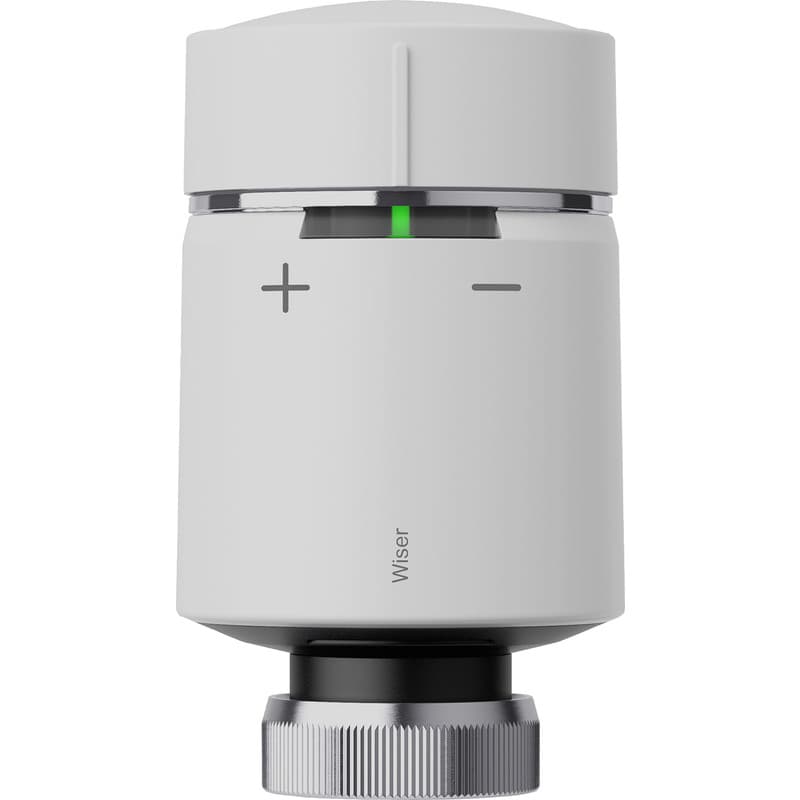
While it's out of stock, consider


If tado° is the premium option, Drayton Wiser is the smart choice for people who'd rather spend less upfront and nothing ongoing. Crucially there are no subscription fees ever: everything works from day one, no monthly ransom. Check the live price on the card above, because the Wiser thermostat kit has been drifting in and out of stock on Amazon.
Newer Wiser models support OpenTherm, putting them on par with tado° for heat pump modulation. The app isn't quite as slick; it's functional rather than beautiful, but it does everything you need: scheduling, boost, holiday mode, energy reports. The real strength is the TRV ecosystem. Wiser TRVs are a few pounds cheaper per valve than tado°'s (about £49 against £55–60 when we checked on 18 September 2026), and over five years the absent subscription is worth far more than that difference.
Drayton is owned by Schneider Electric, which means solid UK installer support and a brand that's been in the heating game for decades. Your plumber has probably fitted a Drayton valve before. That matters when something needs troubleshooting.
The multi-zone control works well out of the box. Each room with a TRV becomes its own zone, so you can heat the living room to 21°C while keeping bedrooms at 17°C. With a heat pump, this kind of zoning is valuable; every degree you don't heat saves electricity.
Who should buy this: anyone who wants a solid smart heating system with good TRV support and doesn't want to pay tado° prices or subscription fees. If you're kitting out more than three rooms with TRVs, the savings on valves alone make Wiser the better deal.
Best for Heat Pumps
Homely Energy
£200–250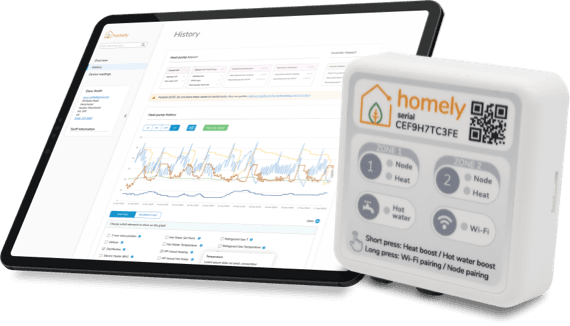
Homely is the oddball in this lineup, and that's exactly why it's interesting. While every other thermostat on this list was designed for gas boilers and then adapted for heat pumps, Homely was built from the ground up specifically for heat pumps. It doesn't just communicate with your heat pump; it actively optimises how it runs.
Instead of relying on OpenTherm (which most UK heat pumps don't support anyway), Homely integrates directly with heat pump manufacturers. It reads the outdoor temperature, your home's thermal characteristics, your energy tariff, and weather forecasts, then automatically adjusts the flow temperature and scheduling to minimise running costs.
A note on the savings claim. Homely used to be quoted everywhere as promising "up to 31%" off running costs. As of September 2026 that figure appears nowhere on homelyenergy.com. What the site actually claims now is installation in under 45 minutes with no weather compensation curves to set, automatic shifting of heating into cheap tariff windows, remote monitoring by your installer, and around 2 tonnes of CO2 avoided a year. No percentage, no pounds. We're not going to print a number the manufacturer no longer stands behind, and neither should anyone selling it to you.
The installer dashboard is a genuinely clever touch. Your heating engineer can remotely monitor your system, spot issues, and adjust settings without a site visit. If your flow temperature is set too high or the system is cycling excessively, they'll know.
The catch: Homely requires an annual subscription (the exact price isn't publicly listed, which is never a good sign). Brand compatibility is growing but still limited; Mitsubishi Ecodan is the strongest integration, with Vaillant, Daikin, and others in various stages of development. It's also a relatively young company, so you're betting on them sticking around.
Who should buy this: anyone with a compatible heat pump who wants the system properly optimised but doesn't want to learn what weather compensation curves are. If you're the kind of person who wants to set it and forget it, Homely is the closest thing to a "just make it work properly" button.
Best Budget
Hive Mini
£80–120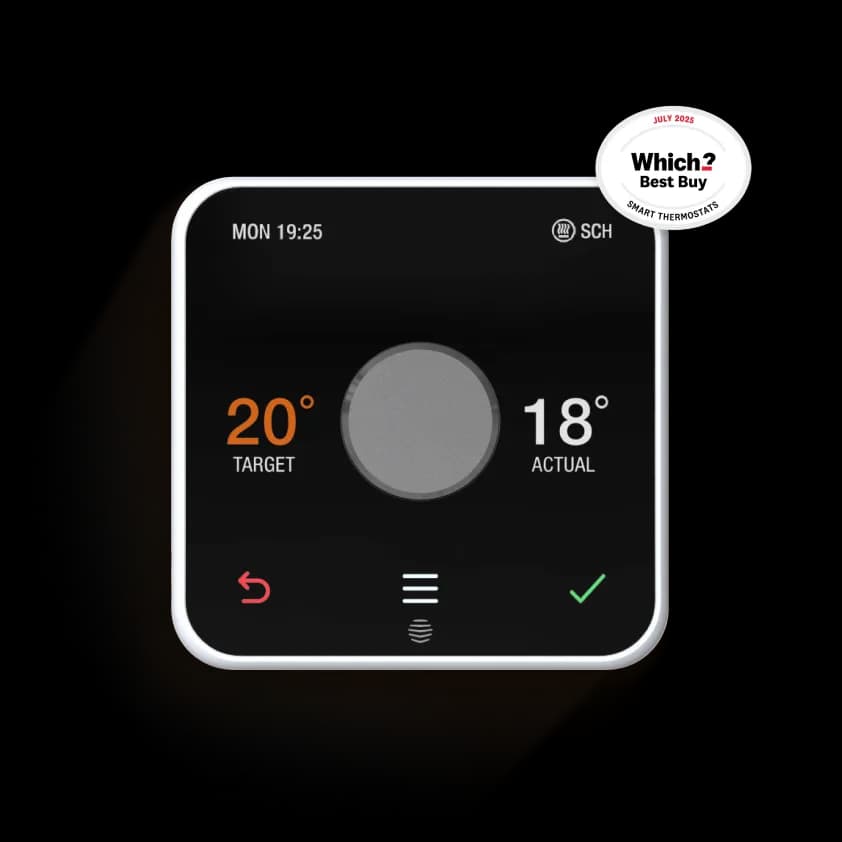
While it's out of stock, consider
Let's be honest: not everyone needs or wants to spend three figures on a thermostat. The Hive Mini does the basics well at the cheap end of this list, and here's the thing: for many heat pump owners, the basics are all you need. Check the card above for the live price and stock before you plan around it.
The Hive doesn't support OpenTherm. It's on/off relay control only. But here's why that's often absolutely fine: most modern heat pumps from Vaillant, Mitsubishi, Daikin, and Samsung have their own built-in weather compensation that adjusts flow temperature automatically using the outdoor sensor that came with the unit. If your heat pump is already doing the clever modulation stuff internally, you don't need the thermostat to do it too.
What the Hive gives you is smart scheduling, app control from your phone, and geolocation, so you're not heating an empty house. It's well supported by British Gas and other UK energy suppliers, the hardware is simple and reliable, and there are no subscription fees.
If your installer tells you the heat pump handles weather compensation on its own, save your money and go with Hive. Spend the £100 you saved on a couple of smart TRVs instead; you'll get a bigger efficiency gain from not heating empty rooms than from a fancier thermostat.
Best for Google Homes
Google Nest 3rd Gen
£269.99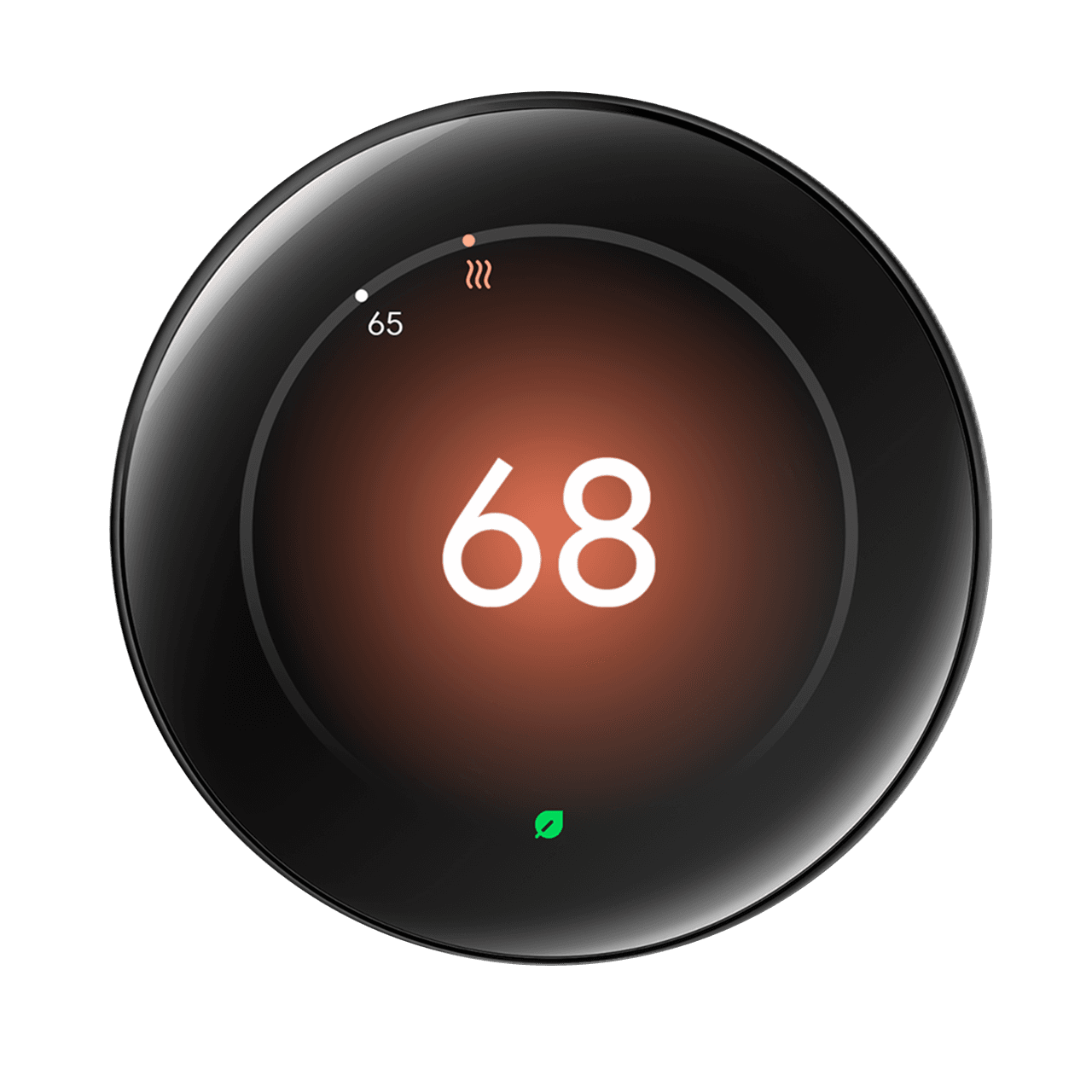
If your house already runs on Google Home, the Nest 3rd Gen is the natural choice. The auto-learning schedule is its party trick; it watches your routine for a week, then builds a heating programme automatically. And the display is genuinely gorgeous. It's the only thermostat on this list that people actually compliment.
The hardware is beautiful and the software is polished. It's been on the market for years with a proven track record, and it integrates seamlessly with Google Home and Google Assistant for voice control.
The main limitation: it's relay-based (on/off) rather than OpenTherm, so it can't modulate a heat pump's flow temperature the way tado° or Wiser can. For a gas boiler this doesn't matter much, but for a heat pump it means slightly less efficient operation. If you've got a heat pump, tado° is the better choice for efficiency.
The other downside: there are no native Nest TRVs. If you want per-room control (and with a heat pump, you really should), you'll need third-party TRVs that may or may not play nicely with the Nest ecosystem. The tado° and Wiser systems have fully integrated TRV ranges. That's a significant practical advantage.
The other thing to know is the price. The Nest Learning Thermostat is the most expensive box on this page by a distance, and the gap has widened: it was £269.99 when we checked on 18 September 2026, against £109.99 for a tado° V3+ starter kit that includes a thermostat and a bridge. You are paying a substantial premium for the hardware and the ecosystem, not for anything that makes a heat pump run better.
Who should buy this: people already deep in the Google Home ecosystem who want a gorgeous thermostat, don't need OpenTherm modulation, and have looked at that price with clear eyes.
Best for Vaillant Owners
Vaillant sensoCOMFORT
Included–£150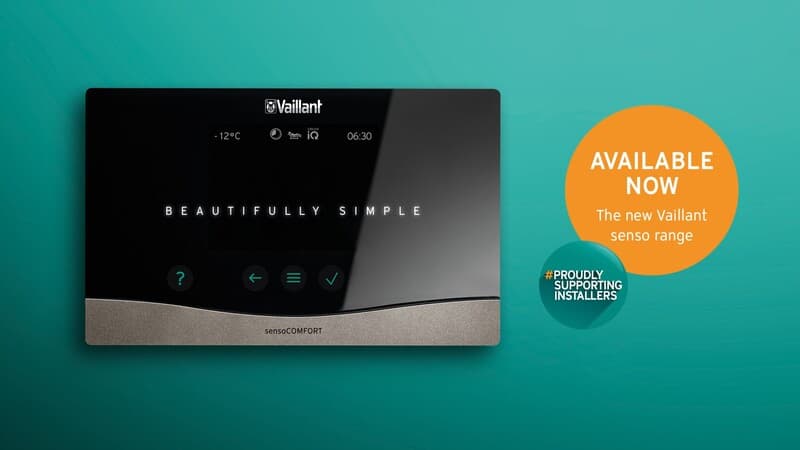
This is the sleeper pick that most "best thermostat" articles ignore entirely, because it only works with one brand. But if you have a Vaillant heat pump (and Vaillant is the UK's most popular heat pump brand) the sensoCOMFORT is genuinely better than any third-party thermostat you can buy.
Here's why: Vaillant heat pumps don't use OpenTherm. They use their own proprietary protocol called eBUS, which allows much deeper two-way communication than OpenTherm can achieve. The sensoCOMFORT speaks eBUS natively, so it has full access to every parameter in the heat pump: flow temperature curves, compressor speed, defrost cycles, energy monitoring, fault diagnostics. A tado° or Nest connected to a Vaillant can only do on/off switching. The sensoCOMFORT can do everything.
Weather compensation is built in and works properly because the sensoCOMFORT and the heat pump were designed as a system. You can monitor energy consumption in the myVAILLANT app, adjust heating curves remotely, and your installer can diagnose problems without a site visit.
The sensoCOMFORT is often included with new Vaillant installations, or available as an add-on for £100–£150. The app isn't as polished as tado° or Nest; it's functional but a bit clunky, but the control it gives you over a Vaillant system is unmatched.
If you have a Vaillant Arotherm Plus, use the sensoCOMFORT. Don't waste money on a tado° that can only talk to your heat pump in on/off grunts when the sensoCOMFORT can have a full conversation.
Side-by-Side Comparison
All 6 Products Compared
Homely Energy
Vaillant sensoCOMFORT
As an Amazon Associate we earn from qualifying purchases. Prices correct as of 25 September 2026, checked against Amazon every few hours.
The Real Question: Do You Even Need One?
Here's what nobody else in the thermostat review game will tell you: if you have a Vaillant, Mitsubishi, or Daikin heat pump installed by a competent MCS-certified installer, the manufacturer's own controller with properly configured weather compensation curves will probably run your system more efficiently than a tado° or Nest in on/off mode.
The only genuine reasons to add a third-party smart thermostat are:
- App control and smart scheduling: convenience, not efficiency. Being able to adjust heating from the sofa or set a schedule from your phone is nice.
- Geofencing: automatically reducing heating when everyone's out. This does save real money, though no independent UK body publishes a figure for it on its own, so treat any percentage you see (including the manufacturers' own) as a best case.
- OpenTherm modulation: but only if your heat pump actually supports it. If it doesn't, you're paying for a feature you can't use.
- Per-room control via smart TRVs: this is actually the biggest win, and you need a compatible hub thermostat to coordinate them.
- Your installer didn't optimise the weather compensation curves: this is depressingly common. Before buying a thermostat, ask your installer to review the heating curves. It's free and often makes a bigger difference than any smart thermostat.
If none of those apply to you, if your heat pump's built-in controller works fine and you don't need app control, save your money. Seriously. A properly configured manufacturer controller is better than an improperly configured smart thermostat, every single time.
What Your Existing Controller Already Does, and What Each Add-On Adds
Most savings charts in thermostat reviews compare each product against nothing at all, which flatters everything. The useful question is different: your heat pump came with a controller, that controller almost certainly does weather compensation, so what does each upgrade add on top of that?
Here's how the pieces stack up for a typical 3-bed semi with a heat pump using about £1,000 a year of electricity. Treat the figures as estimates, because the honest answer depends far more on how well your system was commissioned than on which box is on the wall.
Estimated Annual Savings by Control Type
What each control layer adds on top of a basic on/off timer, for a 3-bed home spending £1,000/yr on heat pump electricity. These are estimates, not measurements.
As an Amazon Associate we earn from qualifying purchases.
Three things fall out of that.
- The biggest single line is free. Weather compensation, properly configured by your installer, does more than any box you can buy. If it's already switched on and the curve is set sensibly, you have banked most of the available saving and you're now shopping for convenience.
- OpenTherm only counts if your heat pump speaks it. A tado° X or a newer Drayton Wiser can modulate flow temperature over OpenTherm. Hive and Nest cannot: both are relay-only, so whatever they save comes from scheduling and geofencing, not from modulation. Any chart that lumps Nest in with OpenTherm thermostats is wrong.
- Zoning is the cheapest real gain left. Smart TRVs on rooms you don't use stack on top of weather compensation rather than competing with it.
So the first move isn't buying a thermostat. It's asking your installer to check the weather compensation curve. It takes 15 minutes, it costs nothing, and it's the single biggest efficiency improvement most heat pump owners can make.
Where does Homely sit on that chart? We've left it off, because it no longer publishes a savings figure and we're not inventing one. Conceptually it's doing two of the jobs in that chart at once (getting weather compensation right, and shifting heating into cheap tariff hours), with the difference that it does them without you or your installer ever touching a heating curve. If your system was badly set up to begin with, that's worth real money. If your installer already nailed the commissioning, you're paying for convenience.
Smart TRVs: The Real Efficiency Multiplier
Here's what will actually save you the most money on top of any thermostat: smart TRVs. Adding thermostatic radiator valves to individual rooms means you stop heating rooms nobody's in. If you're at work all day and only use the living room in the evening, why are three bedrooms being heated to 21°C?
With a heat pump, this matters even more than with a gas boiler, because every unnecessary degree costs electricity. On the numbers, be careful: the Energy Saving Trust puts a complete set of heating controls (programmer, thermostat and TRVs on every radiator) at £100 a year in Great Britain, and nobody publishes a separate figure for the extra that smart valves add over plain mechanical ones. Both tado° and Drayton Wiser have excellent TRV ecosystems; if per-room control is important to you, these two are clearly ahead of the others.
Check out our full smart TRV comparison guide for a detailed breakdown of which TRVs work best with which thermostats.
Total System Cost: What You'll Actually Spend
A thermostat on its own is only part of the picture. Here's what a complete smart heating setup costs for a typical 3-bed house (thermostat + 4 TRVs + professional installation):
Prices below were checked on 18 September 2026 and they move, so take the live price on each card as the real one.
- tado° system: roughly £330 (£109.99 V3+ starter kit plus 4 valves at about £55 each), and then £30–£48 a year for AI Assist if you want geofencing working by itself
- Drayton Wiser system: roughly £300 (thermostat kit plus 4 valves at about £49 each), no subscription, ever
- Homely: a few hundred pounds upfront plus a subscription whose price isn't published anywhere on their site (no TRV support; takes a different approach to efficiency)
- Hive Mini + no TRVs: the budget option, though it has been out of stock on and off. Add TRVs later if you want
- Nest Learning Thermostat: £269.99 for the thermostat on its own, and third-party TRVs are extra and may not integrate cleanly
- Vaillant sensoCOMFORT: often included with a Vaillant installation, or bought as an add-on (no TRV ecosystem)
The valves are DIY: they screw onto the valve bodies you already have. Budget £50–£80 for your heating engineer to wire the thermostat itself if you don't fancy it, and insist on that if you want OpenTherm wired properly.
Wiser and tado° now land within about £30 of each other on hardware, so the real difference is the subscription: over five years tado°'s AI Assist adds £150 to £240 to the total. The Hive is the cheapest way in, and the sensoCOMFORT is essentially free if you've got a Vaillant. The Nest is in a different price bracket from all of them and doesn't do anything for a heat pump that the others can't.
On payback, the only published number to work from is the Energy Saving Trust's £100 a year in Great Britain for a complete set of heating controls. Spend £300 on a system and, even if you get the full £100, that's three heating seasons, longer if there's a subscription on top. Neither system is a bad buy, but neither is a money-maker either: buy them because you want the control, not because a spreadsheet told you to.
A Note on Installation
The Hive and Nest are DIY-friendly if you're comfortable with basic wiring; there are good YouTube videos for both. But if you want OpenTherm to work properly with a tado° or Wiser, it's worth asking your heat pump installer to set it up. Get the wiring wrong and the thermostat defaults to on/off relay mode, and you might not even realise you've lost the modulation that was the whole point of spending extra.
Homely requires professional installation and initial commissioning; they'll put you in touch with a compatible installer. The sensoCOMFORT should be set up by your Vaillant installer as part of the heat pump commissioning.
Five minutes of your installer's time to wire OpenTherm correctly is worth it. Don't let them rush this bit.
For more on cutting your heat pump bills, see our running costs guide. Still choosing a heat pump? Our best heat pumps guide covers the top brands. And use our heat pump savings calculator to estimate what you'll actually spend on running costs.
Frequently Asked Questions
Our Top Smart Thermostat Picks
These are the three smart thermostats we recommend for heat pump owners, based on compatibility, efficiency gains, and value.
tado° Smart Thermostat Starter Kit V3+
£109.99Works with heat pumps via OpenTherm for weather compensation, reducing running costs by 10–20%.
Hive Thermostat Mini
£80–£120Budget-friendly smart thermostat that works with most heating systems including heat pumps.
Google Nest Learning Thermostat (3rd Gen)
£269.99Best for households already in the Google ecosystem. Learns your patterns and adjusts heating automatically.
As an Amazon Associate we earn from qualifying purchases. Prices and stock are checked against Amazon every few hours and may have changed since.
