
The Short Answer
For most people the answer is the Drayton Wiser valve. It is the cheapest of the big-brand TRVs at the moment, there is no subscription, ever, and the app does everything most households need.
If you already run tado°, stay with tado°: the app is the nicest of the lot. Just budget for the subscription, because the automatic features are behind it (see below).
Prices move, and several of the valves on this page drift in and out of stock. We have left every product where it is and flagged what is unbuyable today rather than quietly swapping it, so check the live price on each card before you commit.
The key thing most people miss: smart TRVs only work within their own ecosystem. tado° TRVs need a tado° thermostat. Wiser TRVs need a Wiser hub. You can't mix and match. Pick a system, not just a valve.
What Smart TRVs Actually Save
Here's how most UK homes work: the boiler fires up, and every radiator in the house heats to the same temperature. The spare bedroom nobody's in. The guest bathroom. The dining room you use twice a week. All heated to the same level, all day, every day.
That's a colossal waste of energy. Smart TRVs fix it by letting you set different temperatures for every room and schedule each one independently. Bedrooms warm up at 10pm and cool down when you leave in the morning. The home office heats only on weekdays. Spare rooms stay at 14°C instead of 21°C.
How much does that save? Here is the honest answer, because it is not the number most sites print. The Energy Saving Trust puts a full set of heating controls (a programmer, a room thermostat and TRVs on every radiator) at £100 a year in Great Britain and £110 in Northern Ireland. That is the whole lot, not the valves on their own, and nobody publishes a separate figure for the extra that smart valves add over plain mechanical ones.
Drayton's own claim for its Wiser system is "up to 19%" off heating costs when you move to multi-room smart control from radiators with no thermostatic valves at all, sourced to BEAMA and Salford University research from 2021. Read that as a manufacturer's best case, measured against the worst possible starting point.
So: if you already have working mechanical TRVs and a decent thermostat, smart valves are buying you scheduling, zoning and geofencing, not a step change in efficiency. If your radiators have no TRVs at all, the gain is much bigger. Either way, see the payback section further down before you get excited, because on the published numbers it is not quick.
With a heat pump, this matters more than with a gas boiler. Every unnecessary degree of heating directly increases your electricity consumption, and heat pumps are most efficient when they're not working harder than they need to.
The Ecosystem Problem (Read This Before You Buy Anything)
This is the single most important thing to understand about smart TRVs, and it trips up more people than anything else: smart TRVs are not standalone devices. They need a hub or thermostat from the same brand to work. You're buying into a system, not just a valve.
- tado° TRVs → need a tado° Smart Thermostat or tado° Internet Bridge
- Drayton Wiser TRVs → need a Wiser Hub (comes with the thermostat kit)
- Hive TRVs → need a Hive Hub (comes with Hive Active Heating)
- Honeywell Evohome TRVs → need an Evohome Controller, sold separately and easily the priciest hub here
- Aqara E1 TRVs → need an Aqara Hub or Apple HomeKit setup
- Meross TRVs → need a Meross Hub (included in the starter kit)
If you already have a smart thermostat, buy TRVs from the same brand. If you're starting from scratch, read our thermostat guide first; the thermostat is the brain of the system, and the TRVs are the muscle.
Don't buy tado° TRVs hoping they'll work with your Hive thermostat. They won't. Don't buy Wiser TRVs expecting them to talk to your Nest. They can't. Meross is the most flexible here (it works with HomeKit, Alexa, Google, and SmartThings), but you still need the Meross Hub to connect the TRVs.
Our Picks: 6 Smart TRVs Compared
Best Overall
tado° Smart Radiator Thermostat
£50–70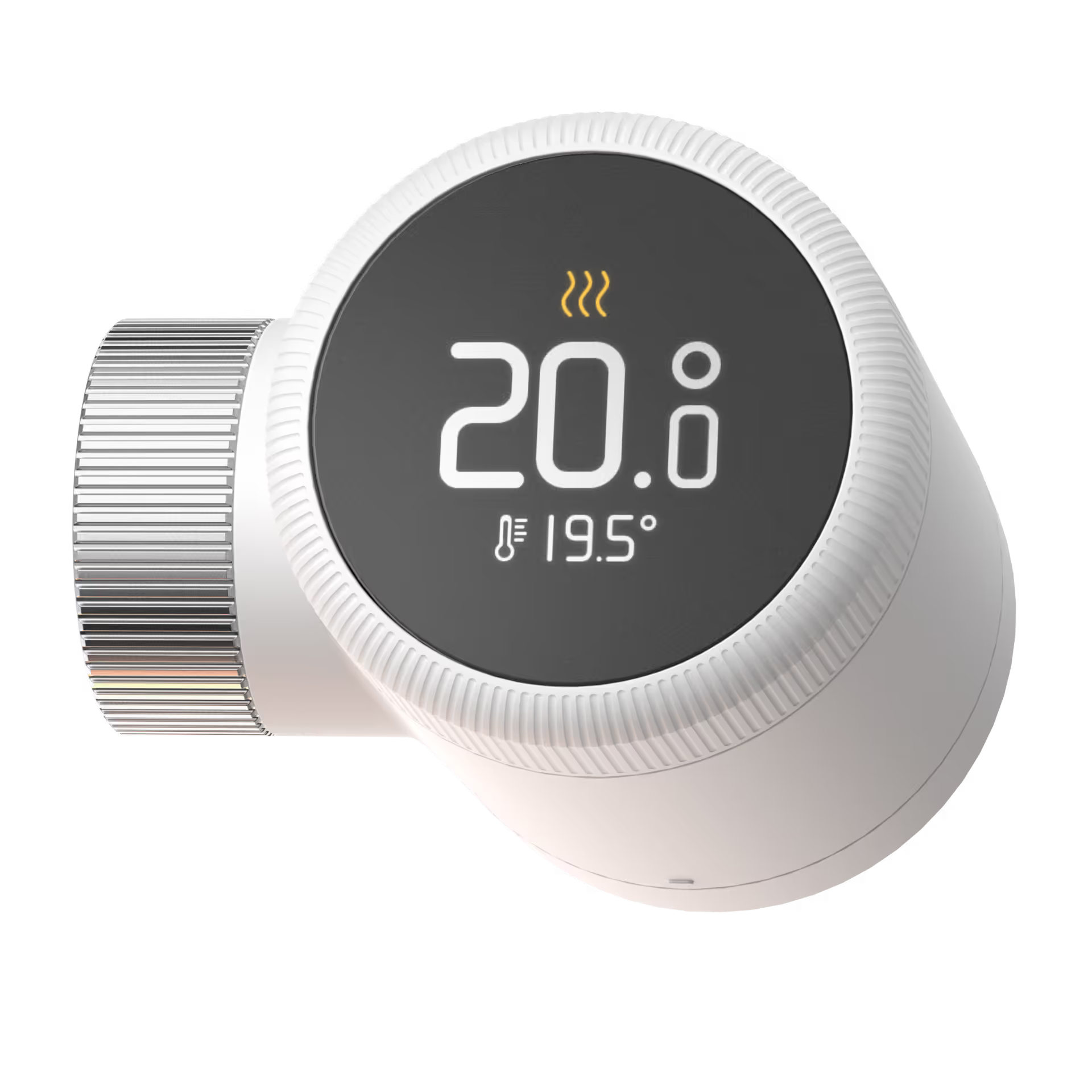
While it's out of stock, consider
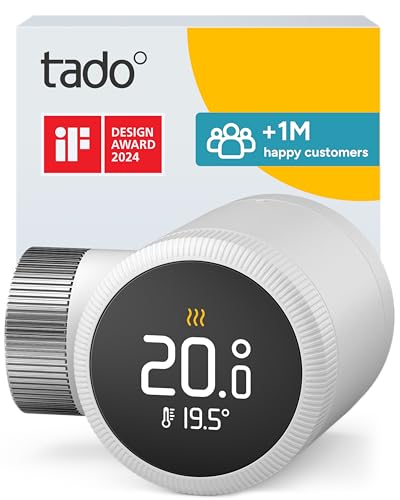

Price: about £55–60 a valve (£164.99 for a trio pack when we checked on 18 September 2026) | Ecosystem: tado°, hub or thermostat required | Subscription: £3.99/month for the automatic features
The tado° is the smart TRV that everyone else is measured against, and for good reason. The app is the best in the business: clean, fast, genuinely pleasant to use. Per-room scheduling is intuitive: drag time blocks around a calendar, set target temperatures, done. Open window detection automatically drops the heating when it senses a sudden temperature fall (saves you from heating the street when you air out a room). Geofencing uses your phone's location to turn heating down when everyone's out and back up when you're heading home.
Installation is dead simple. Unscrew your old TRV head (it's hand-tight, no tools needed) and screw the tado° on in its place. The box includes adapters for all common UK valve bodies. Ten minutes per radiator, and you're not touching any water or pipes.
The catch? Two things. First, you need a tado° thermostat or Internet Bridge (the V3+ starter kit was £109.99 when we checked on 18 September 2026). Second, the automatic features sit behind a subscription. It used to be called Auto-Assist; as of September 2026 tado° publishes it as tado° AI Assist at £3.99 a month, with an annual plan it advertises as 37% cheaper (so roughly £30 a year instead of £48). Geofencing, pre-heating before you arrive, advanced open-window detection and the energy dashboards are all in that tier. Scheduling and per-room control work without it. Paying monthly for features that ought to be included is a legitimate gripe, and it is the single strongest argument for buying Wiser instead.
That said, if you're willing to live with the subscription (or just ignore the automatic features and tap notifications instead), the tado° TRV is the most refined, most reliable smart valve you can buy.
Pros:
- Best app and user experience of any smart TRV
- Open window detection and geofencing
- Wide compatibility with UK radiator valve bodies
- Reliable, accurate temperature control
Cons:
- Most expensive per valve
- Needs tado° ecosystem (thermostat or bridge)
- £3.99 a month (or about £30 a year) for the AI Assist features
Best Value
Drayton Wiser TRV
£49.00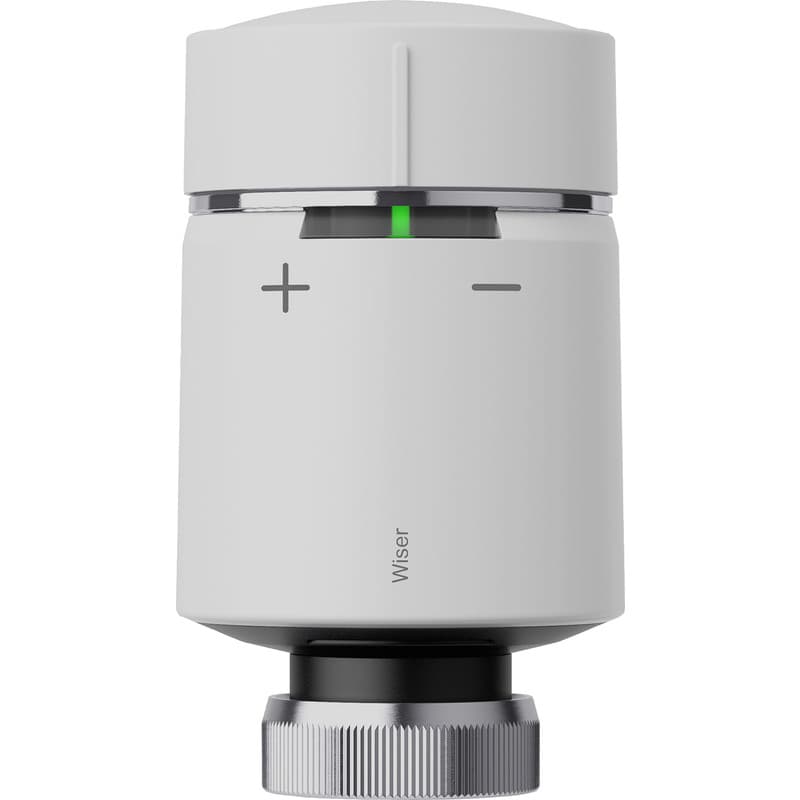
Price: about £49 a valve on Amazon, £56.50 from Drayton direct (checked 18 September 2026) | Ecosystem: Drayton Wiser, hub required | Subscription: none
The Wiser is the TRV I'd recommend to most people, and the reason is mostly the subscription. It is a few pounds cheaper per valve than tado° (about £49 on Amazon against £55–60 for a tado° X valve when we checked on 18 September 2026, though Drayton's own shop lists it higher at £56.50), and crucially there is no subscription fee, ever. Over five years that subscription is worth more than the entire price difference on a set of five valves.
Per-room scheduling works exactly as you'd expect. Set different temperatures for different times of day in every room. Boost mode bumps a room up by a couple of degrees for an hour when you want extra warmth. Away mode drops everything to a setback temperature when the house is empty. The Wiser app isn't quite as polished as tado° (it's functional rather than beautiful), but it does everything you need without fuss.
Drayton is a well-known UK heating brand (they've been making TRVs and thermostats for decades), and the Wiser hub integrates properly with your boiler rather than just controlling TRV heads. That means it can turn the boiler on and off intelligently, not just open and close valves.
The one thing Wiser lacks compared to tado° is on-valve open window detection. The system can detect open windows through the hub's temperature data, but it's not as instant or responsive as tado°'s per-valve detection. For most people, that's not a dealbreaker.
Pros:
- Usually the cheapest per valve of the major UK brands
- No subscription fees: everything works out of the box
- Good multi-room scheduling and boost mode
- Established UK brand with proper boiler integration
Cons:
- App is less polished than tado°
- Needs Wiser hub/thermostat kit
- No on-valve open window detection
Best Budget
Meross Smart TRV Starter Kit
£50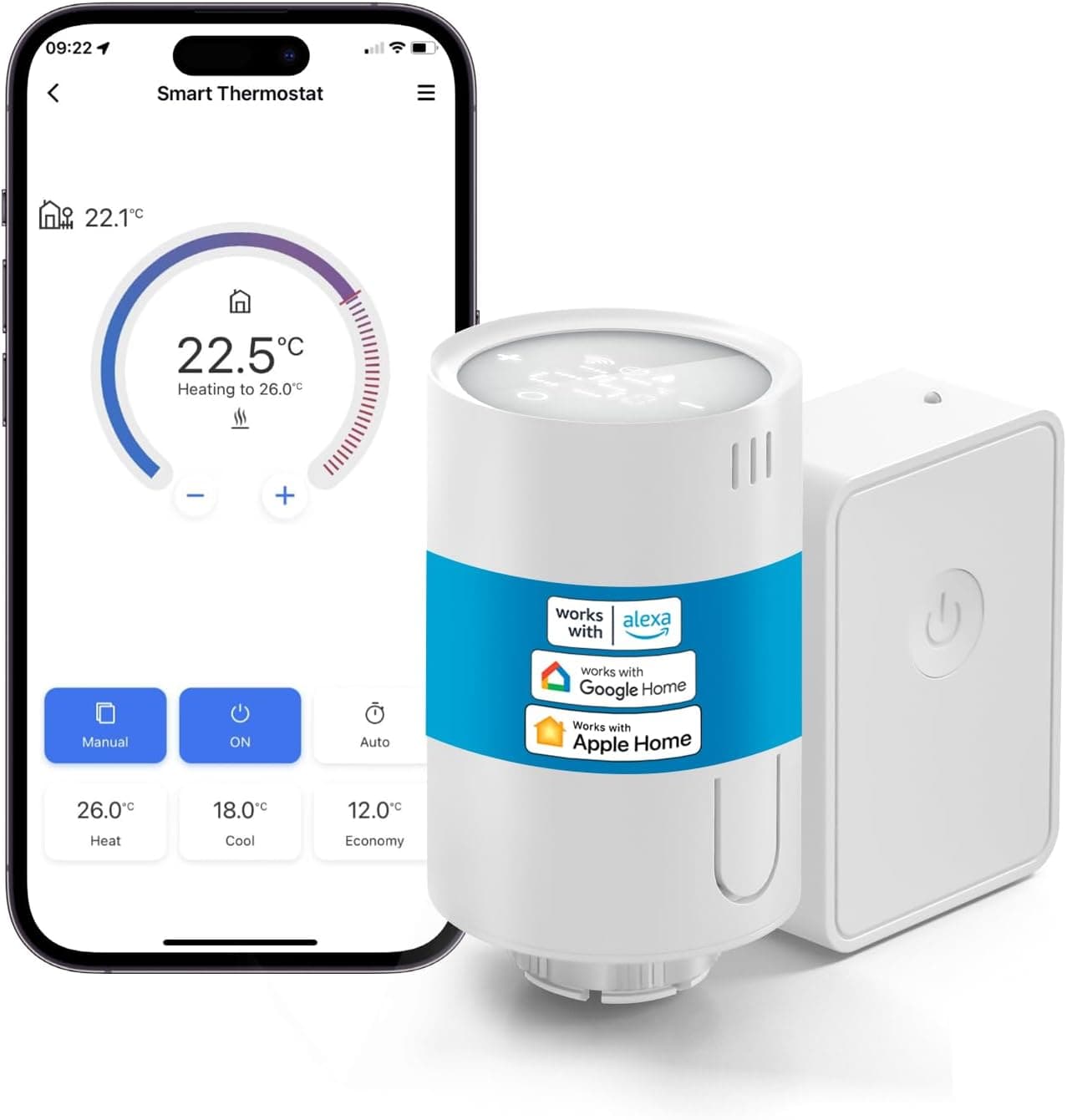

Price: starter kit with hub, one TRV and adapters | Ecosystem: Meross, hub required | Subscription: none
The Meross Starter Kit is normally the cheapest way into smart heating on this list: the Meross Hub, one smart TRV and a set of adapters to fit most UK radiator valve bodies, with add-on valves after that. Check the card above for the live price and stock, because this one comes and goes.
What makes Meross stand out is compatibility. It's the only smart TRV here that works with Apple HomeKit, Amazon Alexa, Google Home, and Samsung SmartThings. If you've got a mixed smart home rather than being locked into one ecosystem, that flexibility is genuinely useful. The app supports 7-day scheduling, open-window detection, and multi-room control.
Reviewers consistently praise the easy installation (about 15 minutes per valve) and the HomeKit integration. The main complaints are about the app being less polished than tado° or Wiser, and occasional connectivity drops. Star ratings and review counts move week to week, so we have stopped printing them in the text; the figure in the product card above is pulled live.
For a whole-house smart heating system with the slickest app, tado° or Wiser are still the picks. But if you want the cheapest entry point and the broadest smart home compatibility, Meross is hard to beat.
Pros:
- Usually the cheapest starter kit of the six
- Works with HomeKit, Alexa, Google, and SmartThings
- One hub handles a whole house of valves
- Open-window detection
- Works out of the box with no subscription
Cons:
- Hub required (included in starter kit, but add-on TRVs need it)
- Add-on valves are not the cheapest per valve once you are past the kit
- App not as polished as tado° or Wiser
Best for Hive Users
Hive TRV
£55.49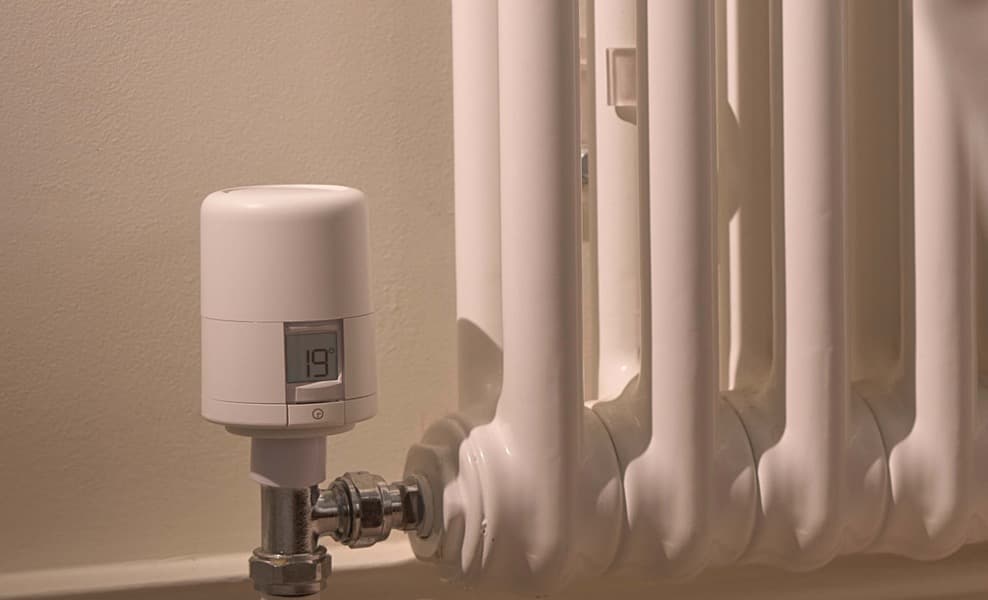
Price: about £55 a valve (checked 18 September 2026) | Ecosystem: Hive, hub required | Subscription: none
If you've already got Hive Active Heating (thermostat, hub, maybe some smart plugs or lights), adding Hive TRVs is a no-brainer. They slot straight into your existing ecosystem and show up in the same app you're already using. Per-room scheduling, boost mode, and the whole setup integrates with your Hive thermostat for proper boiler control.
Hive's big advantage is simplicity and support. The app is clean and easy, designed for people who aren't tech enthusiasts. And because Hive is backed by British Gas, you've got a major company behind the product: phone support, online help, even in-home installation if you want it. For non-techy households or anyone who just wants it to work without fiddling, that's genuinely valuable.
Open window detection works by spotting sudden temperature drops and adjusting accordingly. Scheduling is straightforward: set your times and temperatures per room, and the system handles the rest.
The reason Hive doesn't top the list: it's mid-price (more expensive than Wiser, similar to tado°) but the feature set sits below both. You don't get tado°'s geofencing polish or Wiser's value-for-money. It's a solid product, not a standout one, and that's fine if you're already in the Hive world.
Pros:
- Seamless integration with existing Hive ecosystem
- British Gas backing: good support for non-techy users
- Simple, clean app
- Open window detection
Cons:
- Mid-price without standout features
- Needs Hive Hub (comes with Active Heating kit)
- Fewer advanced features than tado° or Wiser
Best for Large Homes
Honeywell Evohome TRV
£57.00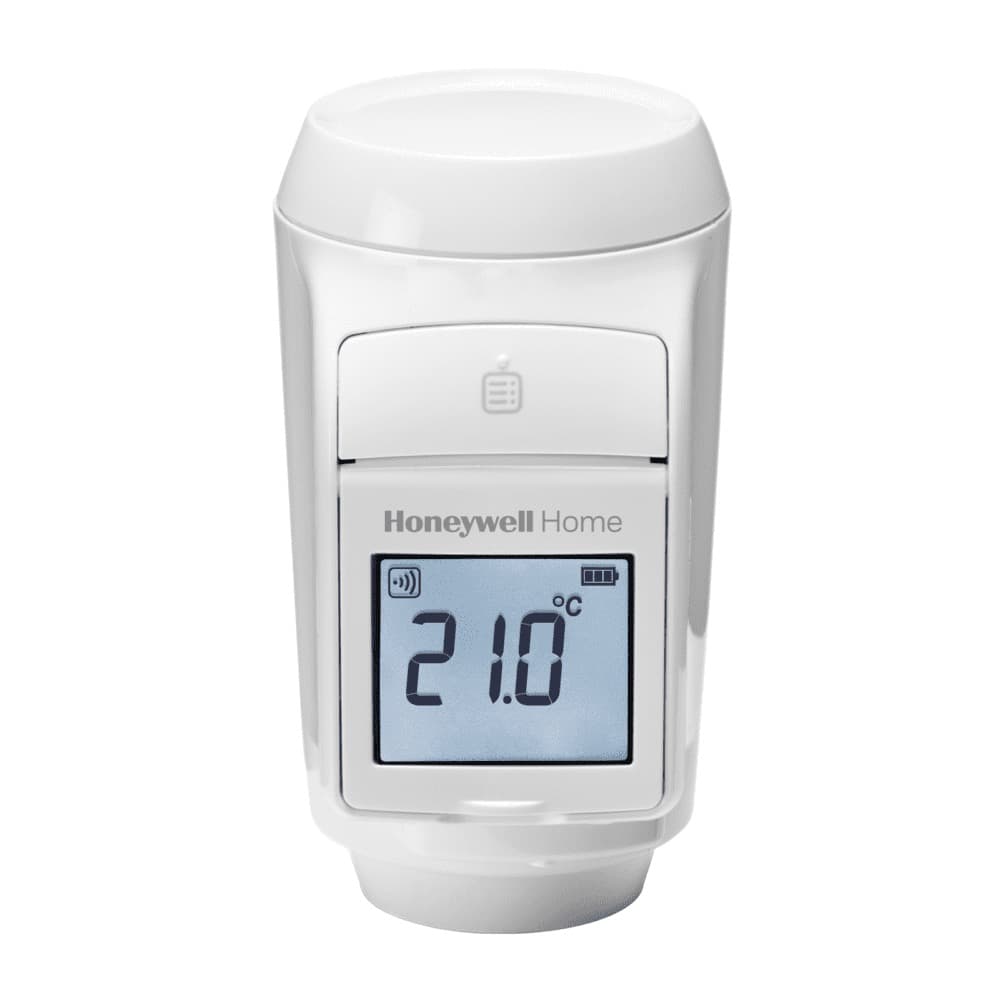
Price: about £57 a valve (checked 18 September 2026) | Ecosystem: Evohome, controller required | Subscription: none
The Evohome system has been around for years, and it shows, in a good way. This is the most mature, most battle-tested multi-zone heating system available, and it is the one built from the start for a large house with a lot of separately controlled rooms. Honeywell's current UK product pages don't publish a single headline zone limit, so if you're planning a ten-room system, confirm the number with Honeywell before you buy rather than trusting a figure off a comparison table (ours included, which is why we've taken it out).
It's also the system that professional heating engineers know best. If you ask an installer about smart zoning, there's a good chance they'll recommend Evohome; it's been the industry standard for multi-zone retrofit heating for years. The controller itself is a touchscreen unit that sits on a table or mounts on a wall, and it can operate independently of the app if your internet goes down.
The downsides are real, though. The controller is the expensive part, costing a multiple of a single valve before you buy any valves at all. The app feels dated compared to tado° and Wiser. And the initial setup is more complex than the competition; it's designed with professional installation in mind, not necessarily DIY. If you're comfortable with tech, you can absolutely do it yourself, but expect to spend a Saturday on it rather than an hour.
For a 2-bed flat, Evohome is overkill. For a 5-bed detached with multiple heating zones and 10+ radiators to control, it's the right tool for the job.
Pros:
- Built for large multi-zone retrofits, more so than any other system here
- Mature, reliable product with years of proven use
- Installer favourite: widely supported by heating engineers
- Works without internet via the touchscreen controller
Cons:
- Expensive controller before you buy a single valve
- Dated app interface
- More complex setup: better suited to professional installation
Best Looking
Aqara Radiator Thermostat E1
£30–40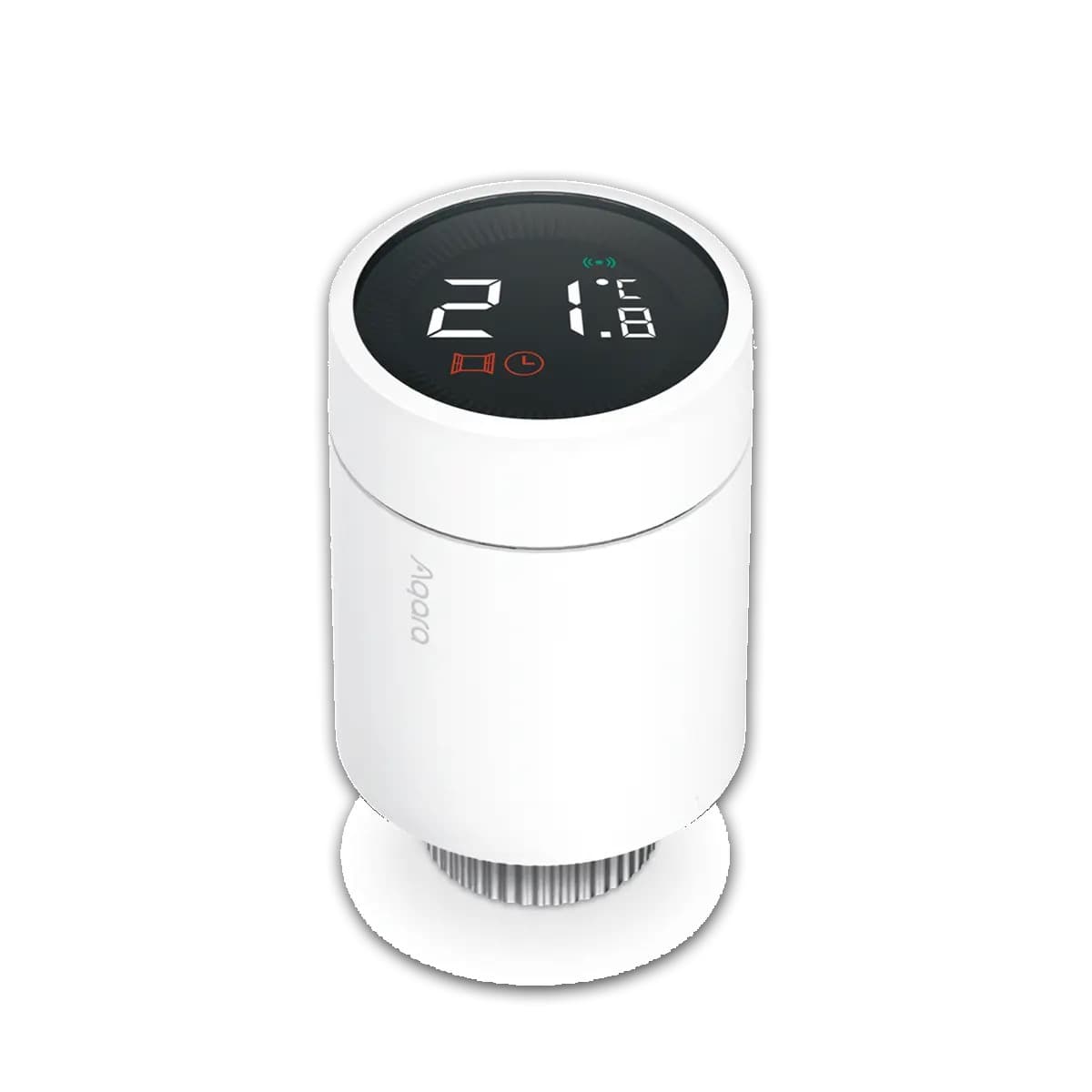
Price: the budget option of the six | Ecosystem: Aqara or Apple HomeKit, Zigbee hub required | Subscription: none
Let's be honest: most smart TRVs look like chunky plastic lumps stuck to the side of your radiator. The Aqara E1 is the exception. It's compact, minimal, and genuinely good-looking: closer to something you'd see in a Scandinavian design catalogue than a plumbing supplies website. If aesthetics matter to you (and in a visible room like a living room or kitchen, they probably do), the Aqara wins hands down.
It connects via Zigbee, which means you need either an Aqara Hub or an Apple HomeKit setup. If you're an Apple household (iPhones, HomePods, Apple TV), this integrates beautifully with your existing setup. You can control heating with Siri, set automations through the Home app, and it all just works within the Apple ecosystem.
Scheduling through the Aqara app is decent, and the valve itself is accurate and responsive. It is normally the cheapest valve here by some margin, which is the other half of its appeal.
The limitation: if you're not in the Apple or Aqara ecosystem, the setup is less compelling. Without HomeKit, the scheduling options are more basic, and you'll need to buy an Aqara Zigbee hub to get started. It's also a smaller brand in the UK than tado° or Wiser, so the community support and troubleshooting resources are thinner.
Pros:
- Best-looking smart TRV available: compact, minimal design
- Excellent Apple HomeKit integration
- Competitive pricing
- Zigbee connectivity (reliable, low power)
Cons:
- Needs Aqara hub or Apple HomeKit setup
- Limited scheduling without HomeKit
- Smaller brand: less UK support and community
Smart TRV Comparison Table
All 6 Products Compared
As an Amazon Associate we earn from qualifying purchases. Prices correct as of 25 September 2026, checked against Amazon every few hours.
| TRV | Price per valve (18 Sep 2026) | Hub required? | Subscription | Open window detection | Best for |
|---|---|---|---|---|---|
| tado° X | ~£55–60 | Yes (tado° bridge or thermostat) | £3.99/mo for AI Assist | Yes (advanced version needs the subscription) | Best overall experience |
| Drayton Wiser | ~£49 (Amazon), £56.50 direct | Yes (Wiser hub) | None | Via the hub, not on the valve | Best value whole-house |
| Meross | Check the live price | Yes (Meross hub) | None | Yes | Budget / broadest compatibility |
| Hive | ~£55 | Yes (Hive hub) | None | Yes | Existing Hive users |
| Honeywell Evohome | ~£57 | Yes (Evohome controller) | None | Yes | Large homes / installers |
| Aqara E1 | Check the live price | Yes (Aqara/HomeKit) | None | No | Design / Apple users |
Prices are the cheapest we could see on 18 September 2026 and they move constantly, so treat the live price on each product card above as the real one. We have dropped the maximum-zones and battery-life columns that used to sit here: neither figure is published on the manufacturers’ current UK product pages, so we were quoting numbers we could not stand behind.
The Payback, With the Working Shown
Estimated Annual Savings by Number of TRVs
How much you save by not heating empty rooms. Based on a typical 3-bed semi spending £1,000/yr on heating.
As an Amazon Associate we earn from qualifying purchases.
Start from the only published number: the Energy Saving Trust's £100 a year in GB (£110 in NI) for a complete set of heating controls, programmer and thermostat and TRVs on every radiator. That is the ceiling for the controls side of your system, and it assumes you are starting from nothing.
Now the cost. Most 3-bed homes want 4 or 5 valves. At the prices above, that is £200 to £300 for the valves, plus the hub or thermostat if you don't already have one, which is another £100 or so. There's no plumber: the heads screw onto the valve bodies you already have.
So a realistic sum for someone who already has a smart thermostat and is adding valves: £200–300 spent, against some share of that £100 a year. Even if the valves are doing most of the work, you are looking at a payback measured in three to five years, not eighteen months. If you are on tado° and paying £48 a year for AI Assist, it is longer again.
Where the sum improves sharply: if your radiators currently have no thermostatic valves at all, or you genuinely keep half the house at 21°C for no reason. That is the scenario Drayton's "up to 19%" is measured against, and in a house like that the valves earn their keep quickly. If you already turn the spare room valve down by hand, be honest with yourself: you are buying convenience.
Loft insulation on a bare loft still beats this comfortably on payback, and it's a fraction of the faff. See our loft insulation guide if you haven't done that one yet.
With a heat pump, the savings are potentially even larger. Heat pumps run most efficiently at low flow temperatures, and every room you're overheating forces the system to work harder. Smart TRVs keep each room at exactly the right temperature, which means your heat pump runs at its optimal efficiency point more of the time.
Build Your System: What Will It Actually Cost?
A thermostat on its own is only part of the picture. Use the calculator below to see total cost, estimated savings, and payback for a complete system: thermostat plus TRVs.
Build Your System: Total Cost Calculator
Choose a brand and number of TRVs to see total cost, estimated savings, and payback period.
Best value. No subscription ever. Cheapest TRVs.
Savings estimates based on Energy Saving Trust data. Actual savings depend on your home, heating habits, and how many rooms you leave unoccupied. As an Amazon Associate we earn from qualifying purchases.
What You Don't Need
Smart TRV manufacturers would love you to put one on every single radiator. You don't need to. Here's what to skip:
- Don't put a TRV on the radiator in the room with your thermostat. The thermostat controls the boiler based on that room's temperature. If you also put a TRV on that radiator, the two fight each other: the TRV closes the valve, the thermostat thinks the room is cold, the boiler keeps firing. It's a mess.
- Don't buy TRVs from a different brand to your thermostat hoping they'll be compatible. They won't. This is the number one mistake people make, and it's an expensive one to fix.
- You don't need TRVs in rooms you always heat. If your living room is heated every evening and you never want it cooler, a TRV there adds cost but not much value. TRVs save the most money in rooms you don't always use: spare bedrooms, dining rooms, home offices.
- Skip the expensive starter kits if you already have the thermostat. Starter kits bundle the hub/thermostat with a TRV or two. If you've already got the hub, just buy individual TRV add-ons; they're much cheaper.
Installation: Genuinely Easy DIY
This is one of the few smart home products that's genuinely DIY-friendly, and I mean genuinely: not "DIY-friendly if you're already comfortable with wiring and plumbing." Smart TRVs require zero plumbing, zero wiring, and zero tools in most cases.
Here's the process: unscrew your existing TRV head (it's hand-tight, just grip and twist anti-clockwise), screw on the smart TRV in its place, put batteries in, pair it in the app. Done. Ten minutes per radiator. You're not touching any water, pipes, or electrics. Nothing drains, nothing leaks.
The one exception: if your radiator has an old-style wheelhead valve (the manual type without a numbered dial, just a plain knob), you'll need an adapter. Most smart TRVs include adapters for the most common UK valve bodies in the box. The standard fitting is M30x1.5mm, which covers about 90% of UK radiators. Check your valve type before ordering, and if in doubt, the manufacturer's compatibility checker will tell you what adapter you need.
If your radiators don't have any TRV at all (just a manual on/off valve), you will need a plumber to fit a TRV valve body first. That's a quick job (about 30 minutes per radiator), but it does involve draining down the system.
Do Smart TRVs Work with Heat Pumps?
Yes, and they're arguably more important with a heat pump than with a gas boiler.
With a gas boiler, overheating a room wastes gas. With a heat pump, overheating a room wastes electricity, and under the current Ofgem cap electricity is 26.32p/kWh against 7.97p for gas, so about 3.3 times the price per unit. A heat pump claws most of that back through its efficiency, but every unnecessary degree still costs you more than it would on a boiler.
Smart TRVs solve this by making sure each room gets exactly the heat it needs and no more. The spare bedroom stays at 16°C instead of 21°C. The home office only heats on workdays. The bathroom warms up for an hour in the morning and evening. Your heat pump doesn't need to work as hard, its COP stays high, and your electricity bills stay low.
If your installer says the heat pump handles weather compensation on its own and you don't need TRVs, that's half right. Weather compensation adjusts the overall flow temperature based on outside conditions. TRVs adjust individual room temperatures based on occupancy and schedule. They're doing different jobs, and they work best together.
One important note: some smart thermostats designed for heat pumps (like Homely) have their own room sensor strategy and may not need traditional TRVs. Check your thermostat's capabilities before buying.
For most heat pump installations with standard radiators, though, smart TRVs are one of the best additions you can make.
Frequently Asked Questions
Our Top TRV Picks
These smart TRVs give you per-room control and pay for themselves within two to three years.
tado° Smart Radiator Thermostat (4-Pack)
£180–£250 (4-pack)Per-room temperature control reduces heat pump energy waste. Only heat rooms you are using.
Drayton Wiser Smart TRV (2-Pack)
£49.00Budget-friendly smart TRVs. Zone your heating so the heat pump only works as hard as it needs to.
As an Amazon Associate we earn from qualifying purchases. Prices and stock are checked against Amazon every few hours and may have changed since.
