
The Short Answer
For most homes switching to a heat pump, oversized Type 22 steel panel radiators are the answer. They're affordable (£60–150 each), widely available, and put out enough heat at low flow temperatures to keep every room warm. You'll probably need radiators rated 1.5–2x what your current ones are rated at ΔT50. In a typical 3-bed semi, budget £1,300–2,250 for a full house of steel panels including labour, which is the sum we work through further down.
But here's the thing: you might not need to replace them all. If your home was built after 1990 or has had a boiler upgrade in the last 10 years, some of your existing radiators may already be oversized enough. A few rooms (small bedrooms, bathrooms, hallways) often have radiators that are already bigger than needed. Check before you spend.
Our top picks:
- Stelrad Compact K2 Type 22: the UK's most-fitted radiator, every plumber knows it, every supplier stocks it, and it's the cheapest per BTU.
- Reina Casina aluminium: for a premium look, heats up in minutes and looks genuinely good.
- Quinn Forza: for period homes where column radiators are non-negotiable, it does the job without completely destroying your output.
Why Heat Pumps Need Different Radiators
This is the single biggest thing people misunderstand about heat pumps, so let's get the physics out of the way.
A gas boiler pushes water around your radiators at 60–75°C. A heat pump pushes at 35–50°C. That's a massive difference, and it directly affects how much heat your radiators kick out.
Radiators are rated at something called ΔT50: that's the heat output when there's a 50°C difference between the water temperature and the room temperature. With a boiler running at 70°C in a 20°C room, ΔT is 50. Perfect. The radiator delivers its full rated output.
With a heat pump running at 45°C in a 20°C room, the ΔT drops to 25. And here's the kicker: radiator output doesn't scale linearly. At ΔT25, a radiator puts out roughly 40% of its ΔT50 rating. At ΔT30, it's about 50%.
So a radiator rated at 5,000 BTU at ΔT50 only delivers about 2,000–2,500 BTU at heat pump temperatures. If your room needs 4,000 BTU to stay warm, that radiator is now undersized by half. You need a radiator with roughly double the ΔT50 rating to compensate.
This isn't a design flaw; it's just physics. Heat pumps are fantastically efficient because they run at lower temperatures. The trade-off is that you need bigger heat emitters. Bigger radiators, better insulation, or ideally both.
Can You Keep Your Existing Radiators?
Possibly. And if you can, it'll save you a decent chunk of money. Here's how to think about it.
Your installer will do proper room-by-room heat loss calculations as part of the design process. But you can get a rough idea yourself by following this framework:
- Check the ΔT50 BTU rating on your existing radiator (usually on a label underneath or on the side). Halve it. That's roughly your output at heat pump temperatures.
- Compare against the room's heat demand. A small bedroom might only need 1,500–2,000 BTU. A large living room might need 6,000–10,000 BTU.
- If the halved rating still covers the room's heat demand, keep it.
Rooms that often have already-oversized radiators you can keep: bathrooms (excluding towel rails), small single bedrooms, hallways, and cloakrooms. These rooms don't need much heat, and builders often fitted standard-size radiators that are overkill.
Rooms that almost always need upgrading: large living rooms, open-plan kitchen-diners, and any room with big windows or poor insulation. These are the rooms where heat demand is highest and the shortfall at low temperatures is most obvious.
Use our sizing checker below to get a quick estimate for each room.
Radiator Size Checker
Enter your room details to see what size radiator you need for a heat pump.
Type 11 vs Type 21 vs Type 22: What Do the Numbers Mean?
Radiator type numbers look confusing but they're dead simple once you know the code. The first digit is the number of panels, the second is the number of convector fins.
- Type 11: Single panel, single convector fin. The thinnest and lightest, with the lowest heat output. Fine for small rooms with low heat demand: cloakrooms, small en-suites, understairs cupboards if you're feeling generous.
- Type 21: Double panel, single convector. More output than a Type 11, moderate depth, about 37% more on the same published tables. A decent middle ground for medium-sized bedrooms where wall depth matters.
- Type 22: Double panel, double convector. The highest output for its physical size. This is what you want for heat pumps. Close to double a Type 11 of the same width and height. On Stelrad's published BS EN 442 tables a 600x1200mm Type 22 gives 2,078W against 1,176W for the same-size Type 11, which is 77% more. At 450mm high the gap is wider, about 81%.
- Type 33: Triple panel, triple convector. Exists, but rarely needed in UK homes. Very deep, very heavy, and expensive. Only consider it if you've got a massive room and limited wall width.
For heat pumps, Type 22 is the default. Only drop down to Type 11 or 21 in small rooms where heat demand is genuinely low, and even then, err on the side of going bigger. A slightly oversized radiator on a heat pump system just means the water temperature can run a degree or two lower, which makes the heat pump more efficient. There's no penalty for oversizing.
Steel vs Aluminium vs Column Radiators
The material matters more than people think, especially with heat pumps.
Steel panels
The cheapest, the most popular, and honestly the best value for 90% of rooms. A steel Type 22 panel gives you the most heat output per pound spent. They're a bit slow to warm up (maybe 15–20 minutes to reach full temperature), but that's actually fine with a heat pump. Heat pumps are designed to run continuously, keeping rooms at a steady temperature rather than blasting heat for an hour then switching off. Steel's thermal mass works with that approach, not against it.
Aluminium
Heats up in minutes: literally 3–5 minutes from cold to warm. Lighter than steel, looks more premium, and gives excellent output for its size. The downside? They're three to four times the price of equivalent steel panels. The Reina Casina we link to is a case in point: check the live price and then compare it with a £100 steel panel of similar output. They're worth considering for rooms where you want fast response, say a spare bedroom with smart TRVs that you only heat when guests stay. But for the main living spaces where the heat pump runs all day, the speed advantage is largely wasted.
Column radiators
Beautiful in period homes. Awful value for heat pumps. Column radiators have significantly lower output per size compared to panels. To get the same BTU output, you need a column radiator that's physically much larger. They're also expensive. If aesthetics genuinely matter more than budget (Victorian terrace, visible hallway, feature wall), the Quinn Forza column range is the best compromise. Otherwise, fit a steel panel and spend the difference on something useful.
Cast iron
Avoid for heat pumps. Massive thermal mass means they take an age to warm up and an age to cool down. They were designed for high-temperature boiler systems. On a heat pump running at 40°C, they'll feel barely warm and take forever to heat a room. Yes, they look gorgeous. No, they don't work well with modern low-temperature heating.
The verdict: steel Type 22 panels for 90% of rooms. Aluminium if you want premium or need fast response. Column only if aesthetics matter more than budget. Cast iron: don't.
Our Top Picks
Best Overall
Stelrad Compact K2 Type 22
£70–150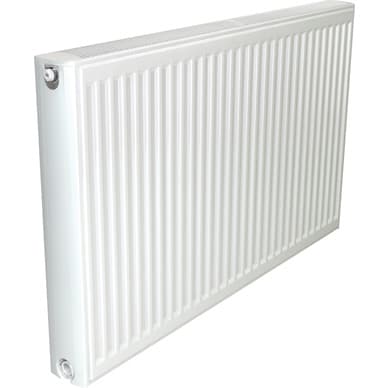
The Stelrad K2 is the UK's most-fitted radiator range, and for good reason. It comes in dozens of sizes: from 300mm high to 900mm, and 400mm wide to 2000mm+. Every plumber in the country has fitted hundreds of them. Every plumber's merchant stocks them. If you need a replacement in 10 years, you'll walk into any trade counter and find one.
Output is solid across all sizes. Stelrad publishes 2,078W (7,092 BTU) at ΔT50 for a 600x1200mm K2, which gives you roughly 2,900 BTU at heat pump temperatures: enough for a decent-sized bedroom or a small living room. Scale up to 600x1600mm and it is 2,770W (9,455 BTU) at ΔT50.
They're not fancy. The finish is functional rather than beautiful: white powder coat, rounded top profile, nothing you'd photograph for Instagram. But they work, they're cheap, and they're everywhere. That's exactly what you want when you're fitting 7 or 8 radiators across a house.
Where to buy it, honestly: panel radiators are a builders' merchant product, not an Amazon one. Stelrad sells the Classic Compact direct from stelrad.com and every plumbers' merchant stocks it. The Amazon buttons on this page are searches rather than specific listings, because there isn't a dependable single Amazon listing for most of these radiators. Get a trade price before you order anything online; merchants discount hard off list.
Price: £70–150 (depending on size) | Type: Steel Type 22 | Warranty: 10 years
Pros: Cheapest per BTU, massive size range, universally available, every plumber knows them, proven reliability
Cons: Basic looks, slower warm-up than aluminium (irrelevant for heat pumps running continuously)
Best Finish
Henrad Premium Type 22
£80–170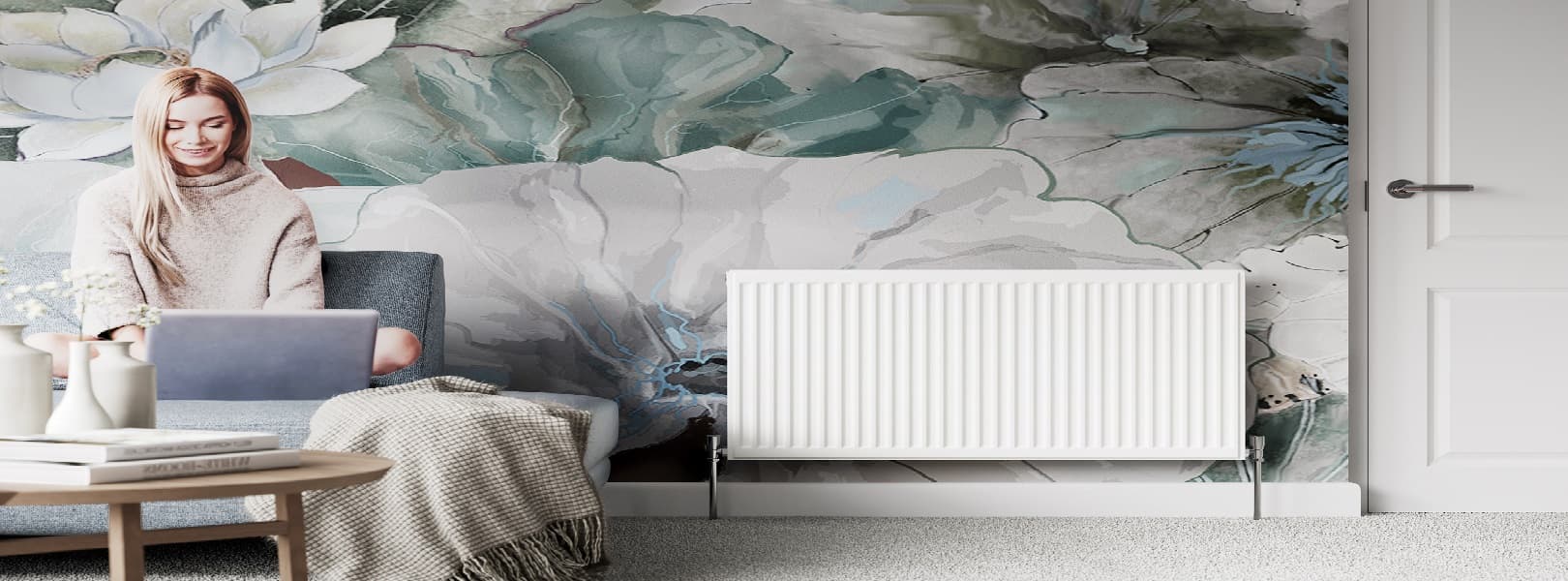
Henrad is the Stelrad's cousin, and we mean that literally: the two brands sit in the same group and publish identical output tables. Pick any size and the figures match to the watt. A 600x600mm Type 22 is 1,039W / 3,546 BTU at ΔT50 in both catalogues; a 450x1200mm Type 22 is 1,645W / 5,613 BTU in both. If anyone tells you one of these outperforms the other, they have not read the tables.
What you are actually choosing between is finish and availability. Henrad's Compact has a smoother rounded top and slightly cleaner lines, which is worth something in a room where people sit and look at the radiator. It is a Belgian-designed range with a strong UK presence, stocked by most trade suppliers.
Where to buy it: not Amazon. Henrad sells through merchants and lists prices on henrad.co.uk (£201.84 excluding VAT for that 600x1200 Type 22 at list, and nobody pays list). The Amazon button here is a search and it will mostly turn up other brands.
Price: £80–170 (depending on size) | Type: Steel Type 22 | Warranty: 10 years
Pros: Better finish than Stelrad, strong output, competitive pricing, good size range
Cons: Slightly pricier than Stelrad, fewer size options at the extremes
Best Aluminium
Reina Casina Aluminium
£368.00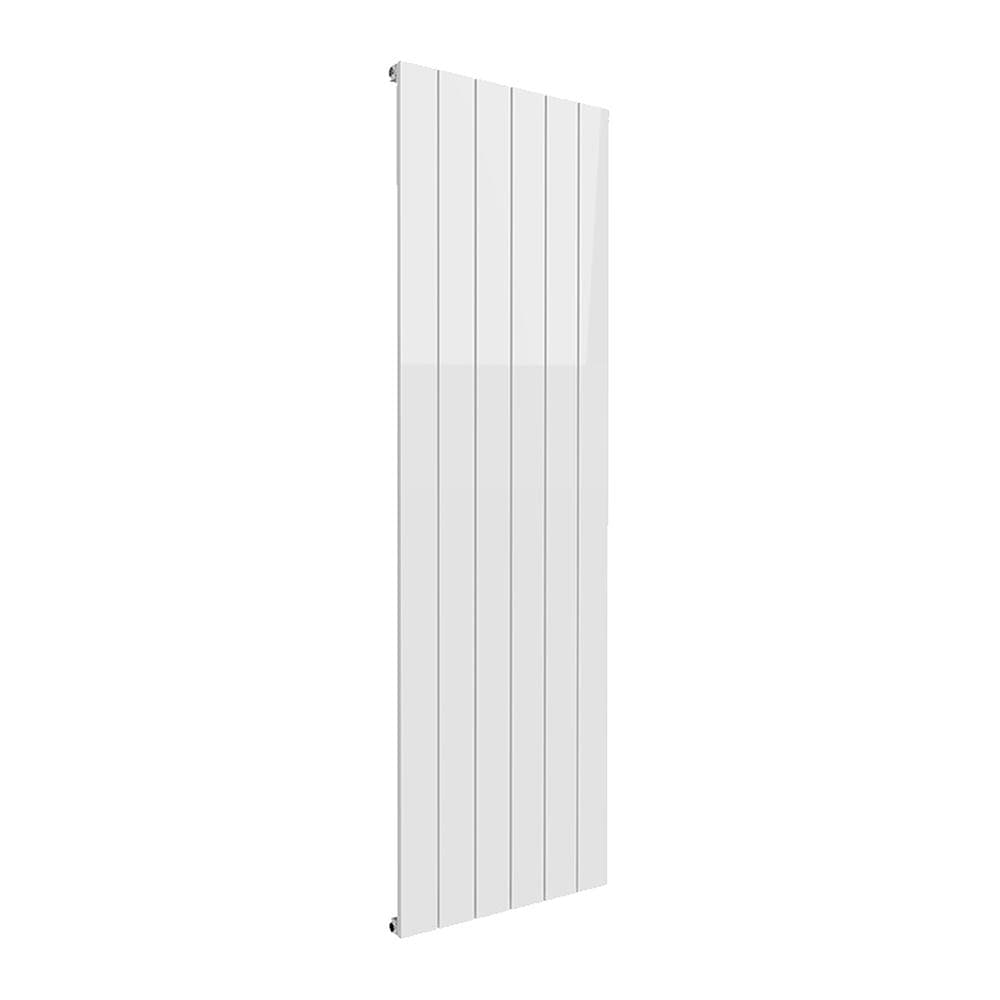
If you want radiators that heat up fast and look genuinely good, the Reina Casina is the one. It's an aluminium radiator that goes from cold to warm in 3–5 minutes, compared to 15–20 minutes for a steel panel. That responsiveness makes it ideal for rooms with smart TRVs doing zoned heating, where you want quick warm-up when someone walks into the room.
The output is excellent for its size. Aluminium is inherently a better conductor than steel, so you get more heat from a slimmer, lighter radiator. The Casina comes in horizontal and vertical options, with a clean modern design that won't look out of place in a contemporary kitchen or living room.
The catch is price. You're paying three to four times what a steel panel costs for comparable output. In a full house, that adds up to thousands of pounds extra. For most people, one or two aluminium radiators in the main living spaces (where you'll actually appreciate the fast response and nicer looks) combined with steel panels everywhere else is the smart move.
One practical note: aluminium radiators need careful system balancing. Because they heat up so fast, they can draw flow away from slower steel radiators elsewhere in the house. Your installer needs to set the lockshield valves properly. Not a big deal, but something to flag.
Price: £200–450 (depending on size) | Type: Aluminium | Warranty: 5–10 years
Pros: Fast heat-up (3–5 minutes), lightweight, modern look, high output for size, horizontal and vertical options
Cons: Expensive (three to four times steel), needs careful system balancing, fewer sizes than steel ranges
Best for Period Homes
Quinn Forza Column
£150–350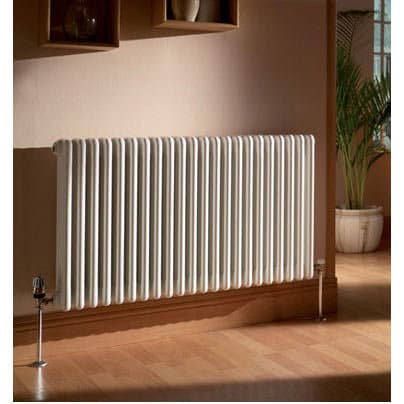
If you're renovating a Victorian terrace or an Edwardian semi and you'd rather chew glass than fit white panel radiators in your hallway, the Quinn Forza is your best option for heat pump compatibility. It's a modern steel column radiator that looks traditional but performs considerably better than actual cast iron.
Column radiators inherently have lower output per physical size than panels; there's no getting around that. But the Forza range is available in 2-column, 3-column, and 4-column options, and in heights from 300mm to 1800mm. By going tall (say, 1800mm x 600mm in a hallway) you can get surprisingly decent output even at low flow temperatures.
They come in white, anthracite, and a range of RAL colours if you want something specific. The anthracite finish looks particularly good in period homes with dark woodwork.
The honest truth: you'll pay more and get less heat compared to a panel radiator. A Quinn Forza that costs £250 might deliver the same output as a £90 steel Type 22. If looks matter in specific rooms (hallway, living room, dining room), buy them there and fit panels in bedrooms, bathrooms, and anywhere hidden. That's the pragmatic approach.
Price: £150–350 (depending on size/columns) | Type: Steel Column | Warranty: 10 years
Pros: Traditional looks for period homes, decent low-temp output for a column, various heights and widths, colour options including anthracite
Cons: Lower output per size than panels, more expensive for equivalent heat, heavier than steel panels
Best Vertical
Stelrad Vita Deco Vertical
£200–400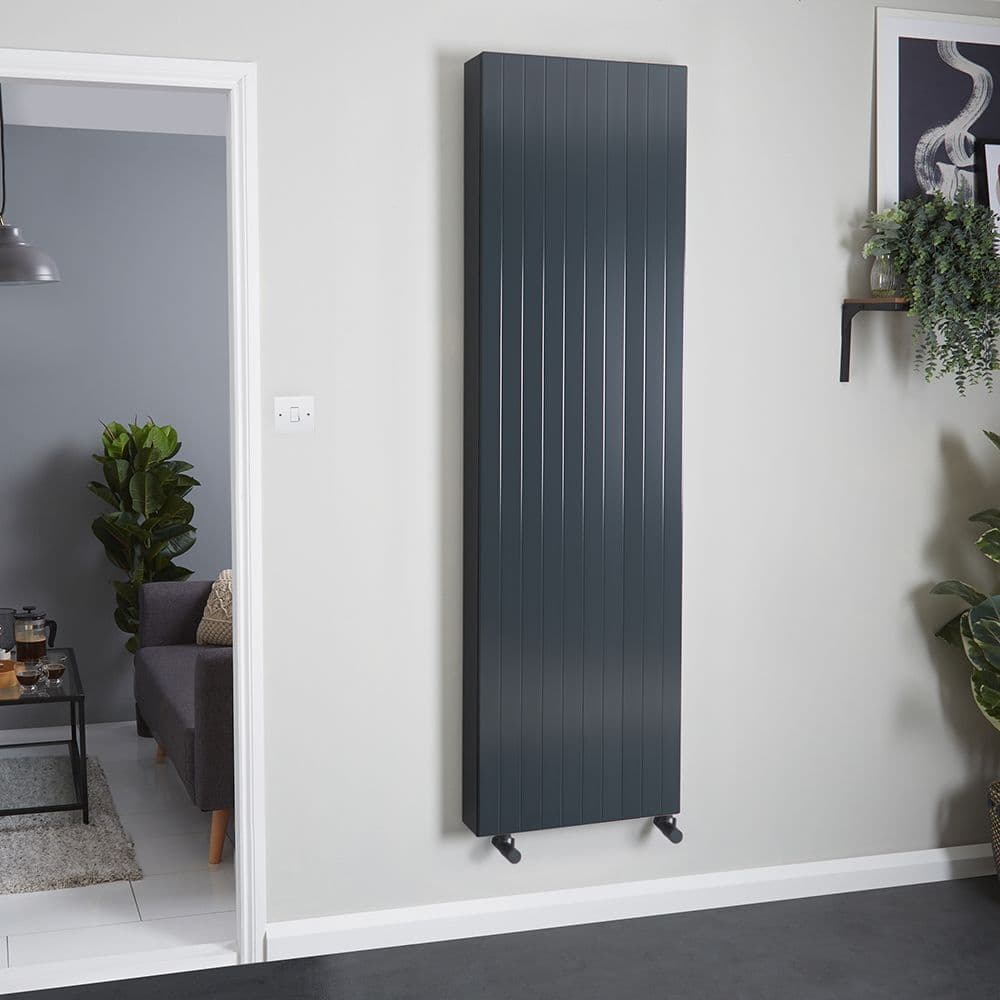
Some rooms just don't have enough wall space for a wide horizontal radiator. Kitchens with full-length units, hallways with doors on every wall, living rooms where every wall has furniture: these are where a vertical radiator earns its keep.
The Stelrad Vita Deco is a vertical flat-panel design available from 1400mm to 2000mm tall. It mounts in narrow spaces (as little as 400mm wide) and delivers surprisingly good output for a vertical. A 1800x500mm unit puts out roughly 5,000–6,000 BTU at ΔT50, giving you 2,400–3,000 BTU at heat pump temperatures. Not enough for a large living room on its own, but perfectly adequate for a kitchen, hallway, or medium bedroom.
The flat-panel design looks clean and modern, a big step up from the chunky horizontal panels aesthetically. It works well in contemporary homes and open-plan spaces.
Two practical downsides: vertical radiators are harder to bleed (you'll need a longer reach or step-stool), and they're inherently less efficient than horizontal panels. Hot air rises, so a horizontal radiator at skirting height distributes heat more evenly across the room. A vertical radiator concentrates heat at the top of the wall. It still works; it's just not quite as efficient.
Price: £200–400 (depending on size) | Type: Steel Vertical Panel | Warranty: 10 years
Pros: Saves wall space, modern flat-panel looks, good output for a vertical, multiple height options
Cons: More expensive than horizontal panels, harder to bleed, slightly less efficient heat distribution
Best Budget
Quinn Compact Type 22
£50–120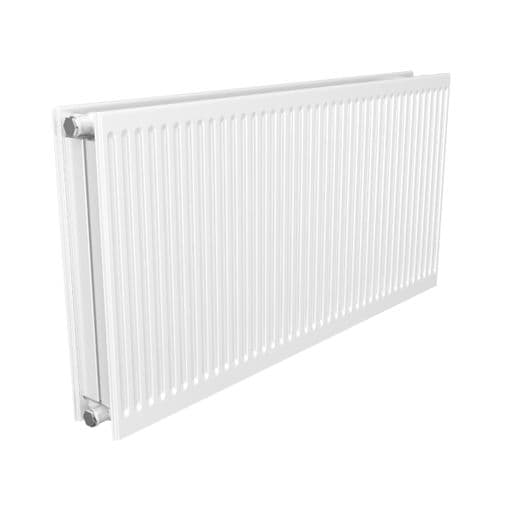
If you're on a tight budget and you need to replace radiators across the whole house, the Quinn Compact is the cheapest Type 22 that's still reliably good quality. Trade suppliers will usually do a 600x1000mm for under £60. It isn't reliably listed on Amazon, so ring a merchant.
Quinn is an established manufacturer (Irish, actually) with a solid reputation in the UK trade market. The Compact range is their bread-and-butter line: no frills, no fancy finishes, just a functional white steel Type 22 that does the job. Output figures are on par with Stelrad, maybe 5–10% lower on some sizes, but the price difference more than makes up for it.
The trade-off is fewer size options compared to Stelrad or Henrad. You'll find the popular sizes (600x800, 600x1000, 600x1200, 600x1400) easily, but if you need an unusual height or very long length, you might need to step up to Stelrad. The finish is also noticeably more basic; it's fine, but you can see the difference side-by-side with a Henrad.
For bedrooms, bathrooms, and utility areas where nobody's admiring the radiators, the Quinn Compact is the smart money choice.
Price: £50–120 (depending on size) | Type: Steel Type 22 | Warranty: 10 years
Pros: Cheapest decent Type 22, reliable quality, widely stocked by merchants, good for whole-house replacement on a budget
Cons: Very basic finish, limited size range compared to Stelrad, slightly lower output at some sizes
Best Towel Rail
Stelrad Classic Towel Rail
£80–150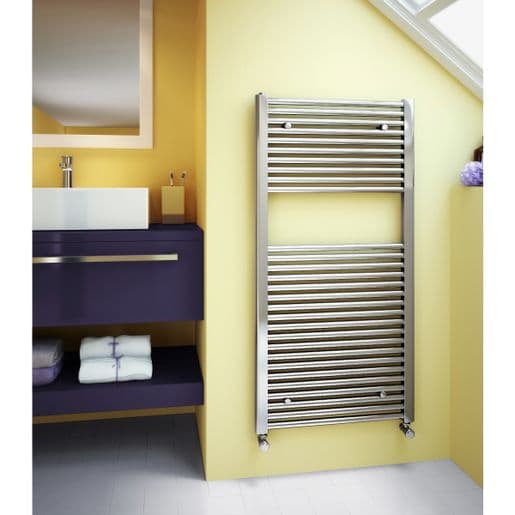
Here's the thing most people don't realise: standard towel rails are useless on a heat pump. A typical chrome ladder towel rail puts out 2,000–3,000 BTU at ΔT50. Halve that for heat pump temperatures and you're looking at 1,000–1,500 BTU, barely enough to dry a flannel, let alone heat a bathroom.
The Stelrad Classic is different. It's designed as a proper heat emitter that happens to also dry towels, not a towel rack that happens to be warm. The wider bars and denser spacing give it meaningfully higher output than typical chrome rails. A 1200x500mm model puts out around 3,500–4,000 BTU at ΔT50, which gives you roughly 1,700–2,000 BTU at heat pump temperatures, enough to genuinely warm a small to medium bathroom.
It comes in white (best output) and chrome (looks better, slightly lower output). If you need both decent bathroom heating AND warm towels, get the white version and a separate towel hook. If towel aesthetics matter more, go chrome and accept you might want a small panel radiator in the bathroom as well for particularly cold days.
If your bathroom is large (more than about 6m²), you'll probably need a small panel radiator AND a towel rail. No towel rail on its own will heat a large bathroom adequately at heat pump temperatures. Plan for two emitters.
Price: £80–150 (depending on size) | Type: Steel Towel Rail | Warranty: 10 years
Pros: Actually works at heat pump temperatures, warms towels AND heats bathroom, available in white and chrome
Cons: Still less output than a proper panel radiator, won't heat a large bathroom alone, white version looks more utilitarian
All 7 Products Compared
As an Amazon Associate we earn from qualifying purchases. Prices correct as of 25 September 2026, checked against Amazon every few hours.
What a Full House Costs
Let's work through a realistic budget for a typical 3-bed semi-detached house switching to oversized radiators for a heat pump. This assumes steel Type 22 panels throughout, the most common and cost-effective approach.
Radiator costs (supply only)
- Living room: 1 large Type 22 (600x1400mm or similar): £120–150
- Kitchen/diner: 1 large Type 22 (600x1200mm): £100–140
- Bedroom 1 (double): 1 medium Type 22 (600x1000mm): £80–100
- Bedroom 2 (double): 1 medium Type 22 (600x1000mm): £80–100
- Bedroom 3 (single): 1 smaller Type 22 (600x800mm): £60–80
- Bathroom: 1 towel rail: £80–150
- Hallway: 1 small Type 22 or vertical panel: £60–120
Total radiators (supply): £580–840
Installation labour
A professional plumber typically charges £100–200 per radiator for a straightforward swap on existing pipework. That covers draining down, removing the old radiator, fitting the new one, refilling, and bleeding. For 7 radiators, budget £700–1,400.
If pipework needs modifying (moving a radiator to a different wall, upsizing from 15mm to 22mm pipe), add £100–200 per radiator affected.
Full House Radiator Replacement Cost
Typical cost for a 3-bed semi-detached house (7 radiators including towel rail). Supply + professional installation.
As an Amazon Associate we earn from qualifying purchases.
Total for steel panels (supply + install): £1,280–2,240, so call it £1,300 to £2,250.
With some aluminium or column radiators in main rooms: £2,000–3,500
Many heat pump installers include radiator upgrades in the overall heat pump installation quote. It's worth asking; some roll it into one package at a better rate than hiring a separate plumber.
One thing to be clear about, because plenty of sites get this wrong: the Boiler Upgrade Scheme is not a radiator grant. gov.uk describes it as £7,500 towards an air source heat pump, and it is a fixed amount rather than a share of your bill. What it does in practice is come off the installer's total, so if the radiators sit inside that quote the grant softens the whole job. Nobody is going to hand you £7,500 for radiators on their own.
What You Don't Need
The radiator market is full of products that sound great in marketing copy but aren't worth the money for a heat pump system. Save yourself some cash.
Cast iron radiators. Yes, they're beautiful. No, they don't work well with heat pumps. The massive thermal mass means they take ages to warm up at low flow temperatures, and they were designed for boiler systems running at 70°C+. Unless you're prepared to oversize them enormously (and pay accordingly), avoid them.
Fan convectors. These blow air across a heated element, like a warm-air unit. They work fast but they're noisy, expensive, and unnecessary if you just buy big enough panel radiators. The noise alone makes them a bad choice for bedrooms and living rooms. The only scenario where they make sense is if you physically cannot fit a large enough panel radiator, and that's rare.
"Low temperature" branded radiators at premium prices. Some companies sell radiators specifically marketed for heat pumps at a hefty mark-up. Here's the truth: any Type 22 panel radiator works at low temperatures. It just needs to be big enough. A £90 Stelrad K2 does exactly the same job as a £250 "heat pump optimised" radiator if both have the same output rating. Don't pay for marketing.
Underfloor heating everywhere. UFH is genuinely the ideal heat emitter for a heat pump: massive surface area, low flow temperature, even heat distribution. But retrofitting it into an existing house costs £2,000–5,000 per room when you factor in floor removal, insulation boards, pipe laying, screed, and new floor covering. For a whole house, that's £15,000–35,000 against £1,300–2,250 for oversized radiators. UFH makes sense in new extensions, ground-floor renovations where you're replacing the floor anyway, or new builds. For the rest of us, oversized panels are the pragmatic answer.
Room-by-Room Strategy
Here's how to approach each room when planning your radiator upgrade. Think of this as the priority order for your budget.
Living room: upgrade first. This is usually the biggest room with the highest heat demand. Fit the largest Type 22 panel that'll physically fit on the wall. If it's open-plan or has large windows, consider two radiators on separate walls rather than one massive one, as you'll get better heat distribution. This room is also where column or aluminium radiators make the most aesthetic sense if you want to spend extra.
Kitchen/diner. Wall space is often limited by cupboards and worktops. A vertical panel (like the Stelrad Vita Deco) can be a good solution if you've only got a narrow gap between units. Otherwise, fit the widest Type 22 you can manage.
Bedrooms. Type 22 panels are the default. Check whether existing radiators are already big enough; in smaller bedrooms, they often are. If you're replacing, there's no need to spend on aluminium or column radiators here. Save the budget for the living room.
Bathroom. Don't rely solely on a towel rail. In any bathroom bigger than about 6m², fit a small panel radiator (Type 22, 400x600mm or similar) plus a towel rail. The panel does the heating; the towel rail dries the towels. In a small en-suite, the Stelrad Classic towel rail on its own is usually adequate.
Hallway. Often has very limited wall space. A vertical panel or a small Type 22 tucked under the stairs works well. Hallways also benefit from reduced draughts; if the front door is the main source of heat loss, fix that first.
And don't forget: add smart TRVs to every radiator for per-room temperature control. On a heat pump system, zoning individual rooms saves meaningful energy: you can dial bedrooms down during the day and living rooms down at night. Budget an extra £45–60 per radiator for smart TRVs, which is roughly what the Drayton Wiser, Hive and tado° valves cost right now.
Installation Notes
Can you reuse existing pipework? Usually yes, if you're doing like-for-like panel replacements in the same location. Most UK homes have 15mm copper microbore or 15mm copper pipe runs to radiators, which is fine for standard-sized replacements. If you're significantly upsizing (say, going from a small Type 11 to a large Type 22 with double the output), your installer may want to upgrade some pipe runs from 15mm to 22mm to maintain adequate flow rates. This adds cost and time but isn't always necessary. Let your installer assess it.
System flush. Get your installer to do a full system flush (powerflush or chemical flush) before fitting new radiators. Old heating systems accumulate magnetite sludge that reduces efficiency and can damage new radiators and heat pump components. Budget £300–600 for a powerflush, or ask whether it's included in the heat pump installation quote. A magnetic system filter (like a MagnaClean) on the return pipe is also essential: the filter itself is about £90, plus an hour of a plumber's time.
Time per radiator. A professional swap (drain, remove old, fit new, refill, bleed) takes about 1–2 hours per radiator on existing pipework. A full house of 7 radiators is typically a day's work, maybe a day and a half if pipework modifications are needed.
DIY or professional? Swapping a same-size panel on existing valves is doable if you're handy with plumbing: drain down, remove old, hang new, reconnect, refill. Plenty of YouTube guides for this. But if you're changing pipe sizes, moving radiators to different walls, or fitting new valves, get a professional. Mistakes with heating systems mean leaks, and leaks mean damage. It's not worth the risk.
One final tip: if you're getting a heat pump installed, ask the installer to quote for radiator upgrades as part of the same job. Many heat pump installers subcontract the radiator work or do it themselves, and bundling it often costs less than hiring a separate plumber. The heat pump savings calculator can help you work out the overall costs.
Frequently Asked Questions
Radiators We Recommend
The most commonly used radiator types for heat pump upgrades: reliable, high-output, and widely available.
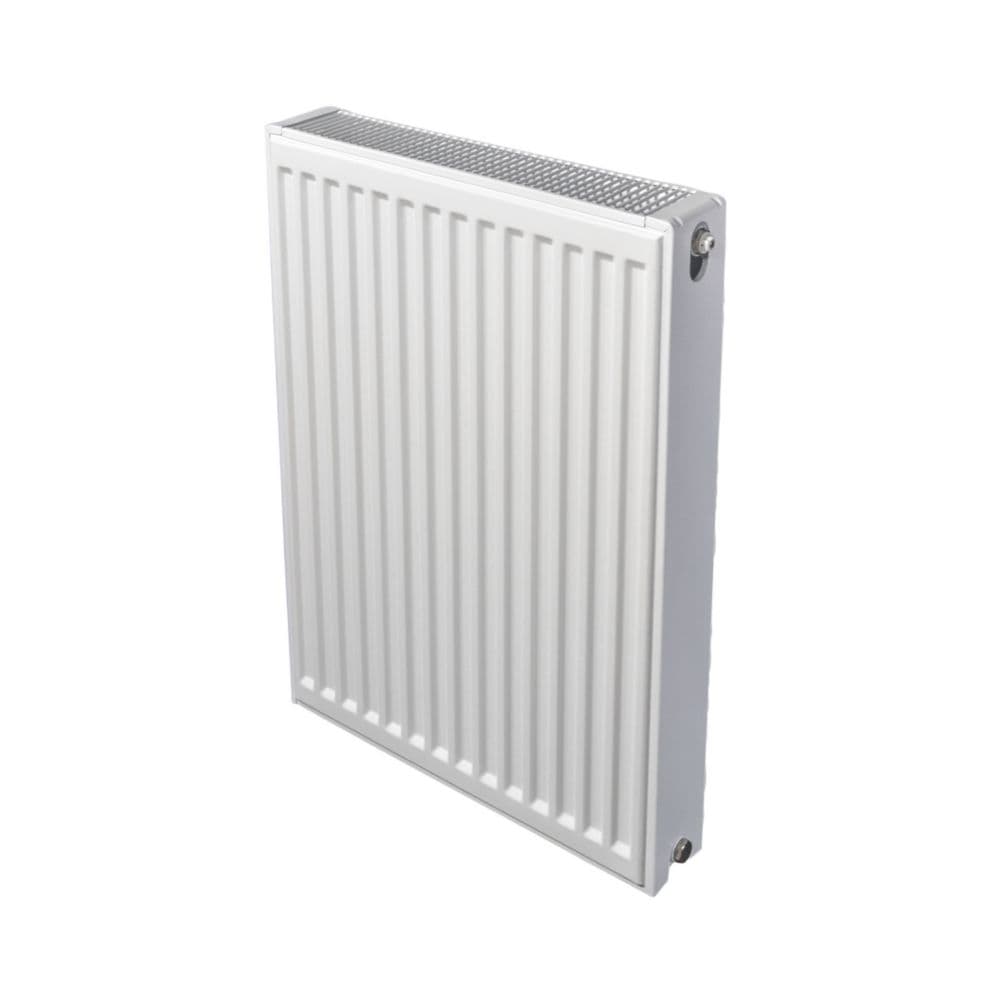
Stelrad Compact K2 Double Panel Radiator
£60–£180 (varies by size)The standard radiator upgrade for heat pumps. Double-panel design delivers enough heat at lower flow temperatures.
Henrad Premium Compact Radiator
£70–£200 (varies by size)Slightly higher output per square metre than standard panels. Useful where wall space is limited.
As an Amazon Associate we earn from qualifying purchases. Prices and stock are checked against Amazon every few hours and may have changed since.
