
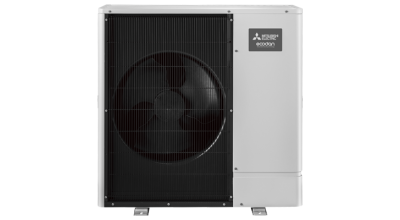
The Mitsubishi Ecodan is the Toyota Corolla of heat pumps. Not the flashiest. Not the highest COP on paper. But it just works, and there's a qualified installer near you who knows it inside out. For a lot of households, that matters more than headline specs.
The Short Answer
If you want a heat pump that's proven, well-supported, and installed by more UK engineers than any other brand, the Ecodan is the safe choice. You'll pay £9,000–£14,000 installed (£1,500–£6,000 after the BUS grant), get a real-world seasonal COP of around 3.3 on the R290 models, and have no trouble finding someone to service it. On running cost alone it's roughly £110 a year better than a modern gas boiler, so buy it for the grant, the support network and the 20-year life, not for the bill. The R290 range (PUZ-WZ) is the one to buy now. Mitsubishi is phasing out R32.
Why your installer has probably already fitted one
We've seen "20% of the UK market" quoted for the Ecodan all over the place, including on this page until today. Nobody publishes a source for it and we couldn't find one, so we've dropped it. What we can say without inventing a number: Mitsubishi Electric has been selling heat pumps in the UK for longer than most of its competitors have been paying attention to the market, it builds the R290 range at its own factory in Livingston, and the whole Ecodan line-up is MCS certified. That longevity means a huge installer base, well-developed training programmes, robust spare parts availability, and a long track record of real-world performance data.
Most MCS-certified heat pump installers have fitted Ecodans. Many of them prefer it precisely because they know the system, the controls, and what to do when something unusual happens. That familiarity translates into better-quality installs, which translates into better real-world performance.
When something goes wrong (and eventually, something always needs attention), finding someone who can fix it quickly is genuinely valuable. With the Vaillant Arotherm Plus, you might wait weeks for an R290-qualified engineer in some parts of the country. With an Ecodan, there's probably someone within 30 minutes of your house.
The full Ecodan range
The Ecodan isn't one product. It's a family of models. Mitsubishi is actively transitioning the entire range from R32 to R290 refrigerant, so what's available is shifting. Here's the current lineup:
| Model | Refrigerant | Type | Capacity | SCOP (at 35°C) | Noise (sound power, LwA) | Installed price |
|---|---|---|---|---|---|---|
| PUZ-WZ (R290) | R290 (propane) | Monobloc | 5–12kW | 4.49–4.62 | 40–58 dB(A) | £9,500–£13,000 |
| PUZ-WM (R32 Standard) | R32 | Monobloc | 5–11.2kW | 3.9–4.2 | 49–58 dB(A) | £9,000–£12,000 |
| PUZ Zubadan (R32) | R32 | Monobloc | 14kW | n/a | 62 dB(A) | £12,000–£14,000 |
| SUZ-SWM (R32 Split) | R32 | Split | 3–8kW | n/a | Varies | £8,000–£11,000 |
Which model should you pick?
- PUZ-WZ (R290): the one to buy in 2026. This is Mitsubishi's flagship. Natural refrigerant (GWP of just 3 vs 675 for R32), made at Mitsubishi's factory in Livingston, Scotland. Mitsubishi's own product page gives it an A+++ heating efficiency rating at 35°C, a guaranteed operating range down to -25°C and flow temperatures up to 75°C, and lists exactly five sizes: 5, 6, 8.5, 10 and 12kW (product codes PUZ-WZ50, WZ60, WZ85, WZ100, WZ120). That handles everything from a new-build flat to a large semi. If your installer offers it, go R290.
- PUZ-WM (R32 Standard): the outgoing workhorse. Still widely available and thoroughly proven, but Mitsubishi is phasing it out in favour of R290. If you're quoted an R32 model, it's not a bad choice. Just know the R290 is the newer, more efficient option.
- Zubadan (14kW): the heavy-duty option for large, poorly insulated homes. Uses flash injection technology to maintain output in very cold weather. Currently R32 only, with no R290 equivalent yet at this capacity. You'd only need this for a big detached house or a Victorian property with high heat loss.
- SUZ-SWM (Split): the outdoor unit connects to a separate indoor hydrobox instead of a cylinder. Useful for tight spaces or where you want the hydraulics indoors. Less common than the monobloc range.
Real-world running costs
Manufacturer COP figures come from a lab bench. In a real house, with defrost cycles, changeable weather and hot water on top, a well-installed R290 Ecodan lands at a seasonal COP of around 3.2 to 3.4. That's the number to plan on.
Here's one worked example. We use the same one all the way down this page, and the calculator below runs on the same assumptions, so the numbers agree with each other. A 1930s three-bed semi needing 12,500 kWh of heat a year, replacing a gas boiler running at 90% seasonal efficiency, with the 8.5kW R290 Ecodan at a seasonal COP of 3.3:
| Gas boiler | Ecodan R290 8.5kW | |
|---|---|---|
| Annual heat demand | 12,500 kWh | 12,500 kWh |
| Efficiency | 90% | Seasonal COP 3.3 |
| Energy needed | 13,889 kWh gas | 3,788 kWh electricity |
| Unit rate | 7.97p/kWh | 26.32p/kWh |
| Annual cost | £1,107 | £997 |
So the Ecodan comes out about £110 a year cheaper to run. That's a recent change and a modest one. Under the April and July 2026 caps the two were level or the heat pump was slightly worse. The October cap pushed gas up 8.7% while electricity rose 0.8% and lost its VAT until March 2027, and that flipped it. Break-even against a 90% gas boiler is a seasonal COP of 2.97, so a good install now wins and a sloppy one still doesn't.
Now be honest about what £110 a year is worth. Against £3,500 net after the BUS grant that's a payback of roughly 32 years, which is longer than the machine will live. Nobody should rip out a working gas boiler for an Ecodan on running costs alone. The numbers that actually make the case are these:
- The £7,500 grant, spent at the right moment. It turns an £11,000 heating system into a £3,500 one. A replacement combi is about £2,750, so if your boiler is going anyway the genuine extra cost of choosing a heat pump instead is under a thousand pounds. That pays back in well under a decade.
- Losing the gas standing charge. If the Ecodan is your only heat source and you move off gas for cooking too, you stop paying 29.68p a day for a meter you don't use. That's £108 a year, which roughly doubles the saving above.
- A heat pump tariff. Shifting most of the heating load into the cheap windows on something like Cosy Octopus takes the running cost clearly below gas. That's where the real money is, not in the standard-tariff comparison in the table.
- Twenty years of design life against roughly ten from a combi, and 60–70% less carbon.
If you're replacing oil, LPG or electric heating rather than mains gas, none of this hedging applies. The gap is large and immediate. Use the calculator to see your own case.
Pick your house type, current heating, and Ecodan model to see running costs and payback. We'll recommend a model based on your house, but you can change it.
Current annual cost
£1,107
With R290 8.5kW
£997
Seasonal COP 3.3
Annual savings
+£110
Simple payback period
31.8 years
Based on £3,500 net cost and £110/yr savings
Estimates based on the Ofgem price cap for 1 October to 31 December 2026 (gas 7.97p/kWh, electricity 26.32p/kWh). Seasonal COP varies by model and conditions. Your actual costs will depend on your property, insulation, and usage patterns.
What size Ecodan do you need?
This is the single most important decision, and it's one your installer should make based on a room-by-room heat loss calculation, not a back-of-envelope guess. But here's a rough guide:
| House type | Typical heat demand | Recommended Ecodan |
|---|---|---|
| Victorian terrace | 12,000–18,000 kWh/yr | 8.5–11kW |
| 1930s semi | 10,000–15,000 kWh/yr | 8.5kW |
| 1950s/60s house | 8,000–13,000 kWh/yr | 5–8.5kW |
| Detached house | 12,000–20,000+ kWh/yr | 11–14kW |
| Bungalow | 7,000–12,000 kWh/yr | 5–8.5kW |
| New build | 4,000–7,000 kWh/yr | 5kW |
| Terraced house | 7,000–12,000 kWh/yr | 5–8.5kW |
| Flat | 4,000–8,000 kWh/yr | 5kW |
Oversizing is the most common installer mistake. A 14kW unit in a well-insulated 3-bed semi will cycle on and off constantly, killing efficiency and shortening the compressor's life. If your installer recommends a unit much bigger than the table above suggests, ask them to show you the heat loss calculation.
Noise levels: what the numbers actually mean
Every review quotes noise figures but nobody explains what they actually sound like in practice. Here's the Ecodan range in context, with the 37.0 dB(A) MCS 020 a) planning limit that your installer needs to meet at the assessment position, 1m outside your nearest neighbour's habitable-room window:
Noise Levels in Context
For permitted development in England and Wales, MCS 020 a) requires the calculated sound pressure to be no more than 37.0 dB(A) at the assessment position, which is 1 metre outside the nearest neighbour’s habitable-room door or window. Scotland and Northern Ireland still use the older MCS 020 and its 42 dB(A) figure. The bars below are sound pressure measured at 1 metre, which is the number you would actually hear standing next to the unit. Sound power, the figure manufacturers publish on the energy label, has no distance attached to it and is always higher. Sound pressure falls away with distance, so at 3 metres the 5kW model is typically below 35 dB(A).
The key takeaway: the assessment doesn't compare the unit's sound power straight against the limit. MCS 020 a) starts from the sound power level, then accounts for the distance to the assessment position and any barrier in the way, and what has to come in under 37.0 dB is the result at that point. So the quiet 5kW models clear it comfortably in most gardens, while the 58 dB(A) end of the range needs real distance or acoustic screening. In England the permitted development rules now point directly at the MCS Planning Standards rather than naming a number of their own, and Wales has followed. Scotland and Northern Ireland are still on the older 42 dB(A) version. Your installer does this assessment as part of MCS certification, so ask to see it.
R32 vs R290: honest assessment
R32 is a synthetic HFC with a global warming potential (GWP) of 675. That's much lower than the old R410A (GWP 2,088), but it's still subject to the ongoing F-gas phase-down. R290 (propane) has a GWP of just 3, essentially zero climate impact.
This isn't just an environmental talking point. Mitsubishi is actively phasing out the entire R32 Ecodan range in favour of R290. The R290 models are made at their Livingston factory in Scotland and reach flow temperatures of up to 75°C, high enough to work with existing radiators in most homes without upgrades.
Our take: if your installer offers the R290 PUZ-WZ, go for it. It's the newer, more efficient, more future-proof option. If you're quoted an R32 model at a meaningful discount, it's still a solid choice. The installed base is enormous and servicing won't be a problem for years. But given the direction of travel, R290 is the smarter buy.
Installation: what actually happens
A typical Ecodan installation takes 2–3 days. Here's what to expect:
Day 1: The outdoor unit is positioned on a concrete base or wall brackets. Pipework is run from the outdoor unit to the indoor cylinder location. If you're keeping existing radiators, the installer checks flow rates and may upgrade a few key radiators.
Day 2: The hot water cylinder is installed (typically 150–200 litres, replacing your existing one). The system is connected, pressurised, and tested. Electrical connections are made to a dedicated circuit.
Day 3 (if needed): Commissioning, controls setup, MELCloud app configuration, and handover. The installer walks you through the system and weather compensation settings.
Disruption is moderate: you'll be without hot water for a day and the house may be cold during changeover. Most installers can keep one heating circuit running during the transition if it's winter.
Maintenance and servicing
Annual servicing is recommended and typically costs £100–£200 per visit. Some installers offer service plans for £12–£15/month. A service includes:
- Refrigerant pressure check
- Electrical connection inspection
- Filter cleaning (the outdoor unit's coil collects leaves and debris)
- Controls and sensor calibration
- Hot water cylinder anode check
Between services, the main thing you need to do is keep the area around the outdoor unit clear. Don't let plants, bins, or garden furniture restrict airflow. A blocked coil makes the system work harder and wastes electricity.
The warranty depends entirely on who fits it
This is the bit worth reading before you sign anything, because the length you get is decided by your installer's status with Mitsubishi, not by the machine. Mitsubishi's own Ecodan Residential Warranty page sets out three tiers:
- Standard installer: up to 3 years
- Accredited Ecodan Installer: up to 5 years
- Ecodan Business Solutions Partner: up to 7 years, plus Fast Track Warranty claims
Note the "up to" on all three, and that Mitsubishi's page points at terms and conditions for each. So the honest comparison isn't "Mitsubishi gives you 7 years". It's "a Business Solutions Partner can get you 7 years". Ask your installer which tier they're in, get the term in writing on the quote, and check afterwards that the registration actually went through. Two installers quoting the same PUZ-WZ85 at the same price can leave you with a four-year difference in cover.
The other half of a warranty is whether the company will still be there to honour it, which stopped being a theoretical question after GivEnergy Ltd went into administration in April 2026. So we checked all five heat pump brands on this page against Companies House on 18 September 2026: Mitsubishi Electric Air Conditioning Systems Europe Ltd (SC191805, the Livingston company), Vaillant Group UK Limited (00294316), Daikin Airconditioning UK Limited (04616794) and Grant Engineering (UK) Limited (03196757) were all active, with no insolvency filings against any of them. None of these is a company we'd worry about outliving your compressor.
Costs after the BUS grant
The Boiler Upgrade Scheme gives you £7,500 off the installed price. Here's what that looks like by model:
| Model | Installed price | After BUS grant |
|---|---|---|
| R290 5kW (PUZ-WZ) | £9,500 | £2,000 |
| R290 8.5kW (PUZ-WZ) | £11,000 | £3,500 |
| R290 12kW (PUZ-WZ) | £13,000 | £5,500 |
| R32 5kW (PUZ-WM) | £9,000 | £1,500 |
| R32 8.5kW (PUZ-WM) | £10,500 | £3,000 |
| R32 Zubadan 14kW | £13,500 | £6,000 |
In Scotland, Home Energy Scotland offers grants and interest-free loans. In Wales, the Nest scheme covers eligible households. Check our grant eligibility checker to see what you qualify for.
How the Ecodan compares
Here's the Ecodan against the other major brands available in the UK:
| Mitsubishi Ecodan | Vaillant Arotherm Plus | Daikin Altherma 3 | Samsung EHS Mono | Grant Aerona3 | |
|---|---|---|---|---|---|
| Refrigerant | R290 (flagship) / R32 | R290 | R32 (Altherma 4 R290 available) | R290 (R32 HT Quiet outgoing) | R32 (Aerona 290 R290 available) |
| Headline efficiency | SCOP 4.49–4.62 (R290), A+++ at 35°C | COP up to 5.4, no test point stated | A+++ label only, no COP or SCOP published | COP up to 5.0 (R32) / 5.10 (R290), brochure only | SCOP 4.54–5.40, COP 4.79–5.28 |
| Capacity | 5–12kW (R290) / 14kW Zubadan | 3.5–12kW | 4–16kW | 5–16kW | 6–17kW |
| Noise (sound power, LwA) | 40–58 dB(A) | 51–60 dB(A) | Not published (43–50 dB(A) pressure, distance not stated) | 56 dB(A) | 60.8–65.2 dB(A) R32, 48–54 Aerona 290 |
| Installed price | £9,000–£14,000 | £10,000–£15,000 | £9,000–£14,000 | £7,000–£10,000 | £8,000–£12,000 |
| Warranty | Up to 3yr standard / 5yr accredited / 7yr Business Solutions Partner | 2yr (up to 7 with a Vaillant cylinder + a Platinum/Renewable Partner installer) | 2yr (5yr reg. / 7yr SHE) | 2yr standard, longer via a Samsung-accredited installer (term not published on Samsung's UK site) | 2yr (7yr with a G1 Installer) |
| UK installer base | Largest | Growing fast | Good | Growing | Strong in West/rural |
| Best for | Reliability + support | Max efficiency | Cold climates | Budget | Oil boiler replacement |
Read that efficiency row with care, because the five manufacturers are not answering the same question. Grant publishes both a seasonal SCOP and a single-point COP, clearly labelled, with the test standard named. Mitsubishi publishes SCOP and an A+++ rating at 35°C on the product page itself. Vaillant publishes one COP with no test condition attached. Samsung publishes its numbers in brochures rather than on per-model pages. Daikin publishes neither a COP nor a SCOP, only an energy label. Don't read across them.
In a real British house every one of these lands somewhere around 3.2 to 3.5, and the difference is made by the install, not the badge. Daikin is the only manufacturer here honest enough to say so out loud: its own blog puts its standard heat pumps at a 3.6 SCOP, which is roughly a third lower than the numbers its competitors are advertising.
Same discipline on noise: compare sound power against sound power, never against a sound pressure figure at 1 or 3 metres. The two differ by roughly 11 dB, which is enough to turn a pass into a fail on an MCS planning noise assessment.
Our take: The Vaillant has the better hardware. The Samsung is cheaper. The Daikin holds up better in the cold. But none of them match the Ecodan's combination of installer familiarity, parts availability and long-term support. If you're in a rural area, or you simply want the least-risk option, the Ecodan is still the one to buy.
Controls and smart features
The Ecodan comes with the MELCloud system for remote monitoring and control via app. It's functional rather than beautiful. Don't expect Hive or tado° levels of polish, but it does what you need: set schedules, adjust temperatures, monitor energy consumption, and check the system's running status.
Weather compensation is built in, which means the system automatically adjusts its output temperature based on outside conditions. This is the biggest efficiency lever on any heat pump. Make sure your installer sets it up properly and doesn't just leave it on a fixed flow temperature.
For smarter control, consider adding a heat pump-compatible smart thermostat like tado° or Hive. These can learn your heating patterns and use weather forecasts to optimise efficiency further.
Who should buy the Ecodan
- Anyone who prioritises installer availability: especially in rural areas or regions where specialist engineers are thin on the ground.
- Anyone who values a proven track record over cutting-edge specs. The Ecodan has more real-world data behind it than any other heat pump in the UK.
- Anyone replacing an oil or LPG boiler: the savings are substantial and the BUS grant makes the numbers very attractive.
- Anyone who wants solid manufacturer support from a company that will clearly still be in business in 15 years.
Who should look elsewhere
- If you want the highest possible efficiency and are willing to pay for it, the Vaillant Arotherm Plus has a higher ceiling and R290 as standard.
- If budget is the primary concern, the Samsung EHS Mono offers comparable performance at £2,000–£3,000 less.
- If you're in Scotland, northern England, or an exposed location with harsh winters, the Daikin Altherma 3 holds its output better at low ambient temperatures and publishes performance data further down the scale.
The verdict
The Ecodan is a safe bet in the best sense of the phrase. You're not leaving meaningful performance on the table: the gap between the headline efficiency figures in that table narrows to almost nothing once installation quality is factored in, and installation quality is the one variable you can actually influence. What you're buying is reliability, support, and the confidence that comes from the most widely installed heat pump in the UK.
What you aren't buying is a cheaper heating bill of any size. At the current cap it's about £110 a year better than the gas boiler it replaces. Go in with that expectation and you won't be disappointed.
For the full brand-by-brand comparison, see our best heat pumps UK guide. For costs and grant details, see our heat pump costs guide and BUS grant guide.