
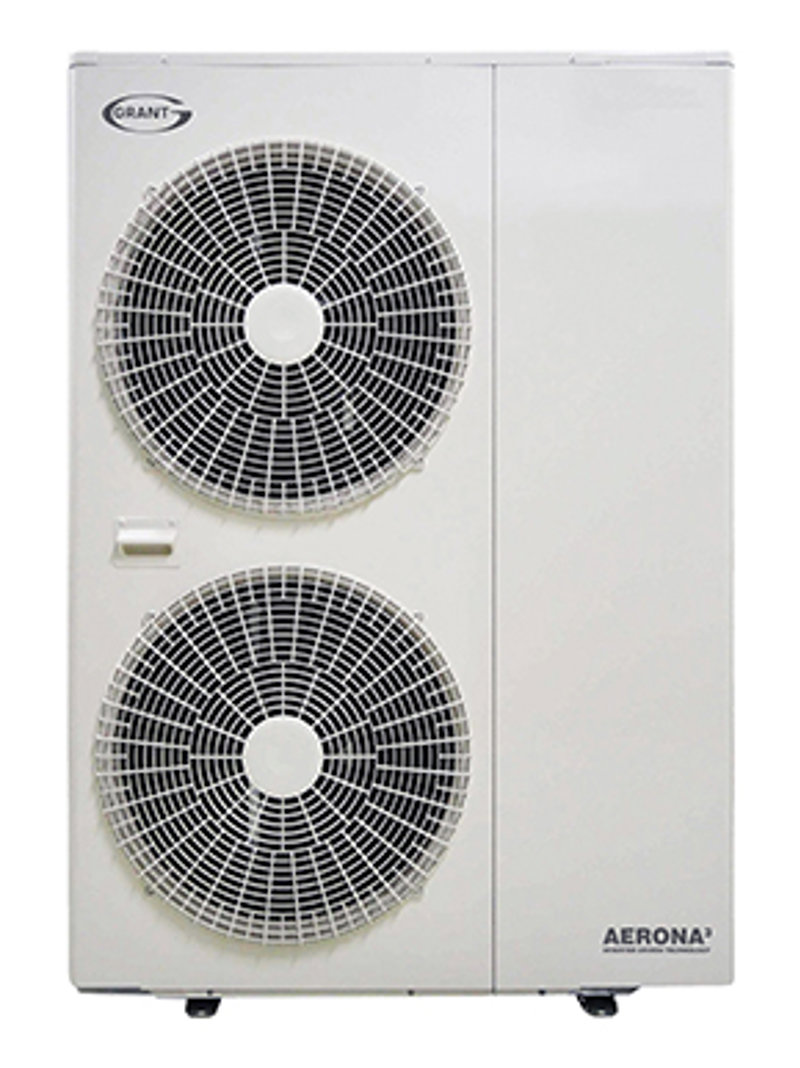
Grant isn't a name that comes up first when people start researching heat pumps. But if you're in Ireland, the west of England, or anywhere with a strong traditional plumbing and heating culture, your plumber almost certainly knows them. That familiarity counts for more than it gets credit for.
Who Grant are
Grant Engineering is an Irish company that's been making heating products since 1979. They built their UK and Irish reputation on oil boilers, specifically the Vortex range, which is still one of the most-installed oil boilers on the island of Ireland. The Aerona3 is their air source heat pump, and it carries the same design philosophy: build it robust, support it properly, make sure the people who fit it can actually get it working.
That heritage matters in markets where oil boilers are being replaced. An installer who's been fitting Grant boilers for 20 years and now also does Grant heat pumps is a meaningfully better prospect than someone who only learned heat pumps last year.
The specs
| Spec | Detail |
|---|---|
| Refrigerant | R32 (Aerona 290 R290 also available) |
| COP (A7/W35) | 4.79–5.28 across the R32 range (5.28 on the 10kW) |
| SCOP (35°C water) | 4.54–5.40 across the R32 range (5.40 on the 13kW) |
| Noise level | 60.8–65.2 dB(A) sound power; 49.8–54.2 dB(A) sound pressure at 1m |
| Capacities | 6–17kW |
| Installed price | £8,000–£12,000 |
| Warranty | 2yr standard / 7yr when a G1 Installer registers it |
Where it performs well
The Aerona3 has a strong reputation for cold-weather performance and robustness. The build quality is solid. Grant designs products knowing they'll be serviced by plumbers and heating engineers who need to get inside them and understand what they're looking at. The construction reflects that: accessible, logical, well-made.
The Aerona³ R32 range is four models, 6kW, 10kW, 13kW and 17kW, all rated A+++ on the ErP label. The 17kW upper limit is one of the highest on this list, which makes it suitable for larger detached homes, farmhouses, or properties with higher heat loss: the kind of property common in rural Ireland and western UK where Grant has its strongest installed base. The gap between 13kW and 17kW is a wide one, though, so if your heat loss calculation lands at 15kW make your installer justify which way they're rounding.
The warranty is 7 years, but only when a G1 Installer registers the appliance through Grant's G1 Portal or Click App. The standard guarantee without that is 2 years, the same starting point as Vaillant, Daikin and Samsung. Nobody in this market gives you a long warranty for free. What matters is which hoop you have to jump through, and Grant's is the simplest of the four: one installer accreditation and one registration, with no requirement to buy the manufacturer's cylinder as well.
It's more efficient than people expect
Worth saying up front, because it surprises almost everyone: the Aerona3's published efficiency is competitive with the premium brands, and Grant is the only manufacturer here that publishes it properly. The R32 data sheet gives both numbers, clearly separated and with the test standard named. SCOP at 35°C water: 4.61 (6kW), 5.20 (10kW), 5.40 (13kW), 4.54 (17kW). COP at A7/W35: 4.91, 5.28, 5.25, 4.79. That's better disclosure than Vaillant, which publishes one unsourced COP, or Daikin, which publishes neither.
People assume Grant is the sensible mid-range option and price it in their heads accordingly. On the spec sheet it isn't.
Treat all of those figures the way you should treat any brochure number, though. Headline COP is a single test point, headline SCOP is a lab season, and what you actually get is decided by flow temperature, radiator sizing and commissioning. A well-installed Grant will beat a badly installed Vaillant every time, and the reverse is also true.
The honest downsides
Noise on the R32 range. Grant publishes both measurements on the Aerona3 data sheet. Sound power is 60.8 to 65.2 dB(A) across the range (65.2 on the 6kW, 60.8 on the 13kW), and sound pressure at 1 metre is 49.8 to 54.2 dB(A). The two sets are consistent with each other, roughly 11 dB apart, as you'd expect. This is not the quietest unit here. If the outdoor unit is going anywhere near a boundary, look at this properly rather than glancing at one number.
The Aerona 290 really is much quieter, and we owe it a correction. We previously flagged its figures as a probable sound-power/sound-pressure mix-up, because a 12 dB improvement between two generations of the same manufacturer's product looked too good. Having gone to Grant's own data sheet: it's genuine. Sound power on the Aerona 290 is 48 to 54 dB(A), and the sound pressure figures sit below it at 40 to 46 dB(A) at 1 metre and 31 to 36 dB(A) at 3 metres, exactly as they should. The labels are right.
One caveat before you put the two ranges side by side: they're measured to different standards (BS EN ISO 3743-1:2010 for the Aerona3, BS EN 12102-1 for the Aerona 290) and Grant quotes the pressure figures at different Q values, so the headline 12 dB gap isn't a like-for-like comparison. It's still a big real-world improvement. If noise is what's driving your decision, the R290 range is the one to look at.
Coverage outside the core region. Grant's profile is lower away from its strongholds. In the south-east of England or in Scotland you'll find fewer Grant-trained installers than you would for Mitsubishi or Vaillant, and with heat pumps the installer matters more than the badge.
The Aerona 290
Grant's fifth-generation Aerona 290 runs on R290 in 4, 6.5, 9, 12 and 15.5kW sizes, and on the published numbers it's the better buy on every axis that matters. SCOP at 35°C water is 5.00, 5.08, 4.74, 4.74 and 4.56 across the range; COP at A7/W35 is 4.99, 4.95, 4.93, 4.81 and 4.72. Sound power is 48 to 54 dB(A), which is quieter than the Vaillant aroTHERM plus range at 51 to 60, and Grant says every unit in the Aerona 290 range carries the Quiet Mark. It's rated to operate from -25°C, and like the R32 range it's A+++ on the ErP label.
And it's R290, so a global warming potential of 3 against 675 for R32, with no exposure to the F-gas phase-down. If you're buying a Grant new today, buy this one. The only reason to take the R32 Aerona3 instead is a genuinely better price or an installer who only works with it.
Who should buy this
- Anyone in Ireland where Grant's installer network is strongest and their brand trust is highest.
- Anyone in western UK: particularly those replacing a Grant oil boiler, where your existing installer may already be familiar with the product.
- Larger properties that need a unit at the upper end of the capacity range.
- Anyone who values a traditional heating brand with genuine UK and Irish manufacturing heritage.
Who should look elsewhere
- If noise is the deciding factor, don't take the R32 Aerona3. At 60.8–65.2 dB(A) sound power it's among the louder units here. Take the Aerona 290 instead, which at 48–54 dB(A) is quieter than anything else on this list including the Vaillant.
- If you're outside Grant's core installer network geography, the Mitsubishi's broader UK coverage is more practical.
- If you want R290 from Vaillant, Mitsubishi or Daikin instead, those options exist. Look at the Aerona 290's data sheet first, though, because on published efficiency and noise it holds its own against all three.
The Grant Aerona3 is a well-built machine from a company that has been heating British and Irish houses since 1979, its published efficiency is better than its mid-range reputation suggests, and it documents that efficiency more clearly than either Vaillant or Daikin manage. Where the R32 range loses is noise and installer coverage outside its core region, not performance, and the Aerona 290 fixes the noise. In the right location, with an installer who knows the product, it's an excellent choice and usually a cheaper one. For the full brand comparison, see our best heat pumps UK guide, and check our heat pump costs guide for what you'll pay after the £7,500 BUS grant.