
The Short Answer
For most UK buyers, the EcoFlow DELTA 3 Classic (£399) is the right pick: 1024Wh, 1800W output that covers a microwave, an air fryer or a 1500W oil-filled radiator, a 45-minute recharge, and a built-in 10ms UPS so it doubles as desk backup. It replaces the DELTA 2 we used to recommend, which Amazon no longer stocks. It won't boil a 3kW kettle, and nor will anything else at this price.
- BLUETTI Elite 30 V2 (£199): the budget pick, the cheapest LiFePO4 unit worth buying. (The Jackery Explorer 300 Plus is the other obvious candidate here, but it has been out of stock on Amazon for a while.)
- EcoFlow DELTA 3 Max (£999): for whole-house backup, 2kWh standalone, 2400W output and a 5-year warranty.
Whatever you do, don't buy a no-name station from Aliexpress: cheap lithium-ion fires are not a theoretical risk.
Do You Actually Need One?
Portable power stations are useful but rarely essential. Before you spend £200 to £1,200, work out which problem you're solving:
- Camping / festivals once or twice a year: a 300Wh unit covers phones, lights, a small fan, and a CPAP machine for a couple of nights. Don't go bigger than you'll use.
- Garden office or allotment shed: 1000Wh keeps a laptop, monitor, and lights running all day. Pair with a 200W solar panel for a self-sustaining off-grid setup.
- Motorhome / van conversion: 1000-2000Wh with a 1000W+ solar input. The expandable units (the BLUETTI AC200L, or EcoFlow's Smart Extra Battery range) make sense if you'll add capacity over time.
- UK power cut backup: 1000Wh covers most cuts. Ofgem's reliability reporting works out at roughly 0.4 interruptions per household per year and about 38 minutes of supply lost per household per year, which means a typical cut, when you get one, runs well over an hour. For storm-driven rural cuts that occasionally run 24+ hours, you want 2kWh+.
- Whole-house off-grid: these aren't really portable power stations any more. Look at a proper home battery paired with solar instead, starting with our Tesla Powerwall review.
One warning if you go down the home battery route: GivEnergy used to be the obvious British answer and we'd have named it here a year ago. Companies House now shows GivEnergy Ltd (company number 11571089) in administration, and GivEnergy Commercial Limited in liquidation. Existing kit carries on working, but treat the warranty as unreliable and don't buy new on the strength of it.
For most readers in the UK, the right answer is a single 1000Wh station that you use for occasional camping and keep charged at the back of a cupboard for power cuts. The £399 EcoFlow DELTA 3 Classic is built for exactly that buyer.
How Many Wh Do You Actually Need?
Watt-hours (Wh) tell you total energy storage. Watts (W) tell you how much you can pull at once. Both matter, and confusingly, marketing tends to lead with whichever number sounds bigger.
The rough rule:
- Phones, laptops, lights: 100-300Wh covers a weekend
- CPAP machine overnight: 200-400Wh per night (30W average)
- Fridge during a cut: 1000Wh gives about 5-6 hours, 2000Wh about 10-12 hours. That's on the pessimistic 150W the compressor pulls while it's actually running. Fridges cycle on and off, so in practice you'll usually get considerably longer
- Power tools on a day site: 1000-1500Wh, depending on how heavy the work is
- A kettle (because someone always asks): boiling a litre takes about 100Wh, so energy isn't the problem. Power is. A UK kettle pulls 3kW, and only the two 2kWh units here (the EcoFlow DELTA 3 Max and the BLUETTI AC200L) get near that, and only through X-Boost or Power Lifting, which throttles the voltage so the kettle boils slowly rather than not at all. Everything else on this page will refuse. (our energy-efficient kettle guide has the full cost-per-boil maths)
Use the calculator to see how long any station on this list will run a given device:
Runtime Calculator
Pick a power station and a device, see how long it'll actually run. Real-world efficiency (~85%) is applied by default.
Inverter and conversion losses typically cost 10-20%. 85% is a sensible default for pure sine wave inverters on LiFePO4.
Estimated runtime
5 hr 48 min
EcoFlow DELTA 3 Classic running domestic fridge-freezer (150W) on 870Wh of usable capacity.
Wattages are typical values for common UK devices. Your exact appliance may differ. check the rating plate. Real runtime drops further in cold weather (battery efficiency falls below 0C).
What Actually Matters in a Power Station
LiFePO4 (lithium iron phosphate) vs older lithium-ion
Every station on this list uses LiFePO4 cells, the newer battery chemistry. It's safer (won't thermal-runaway like older lithium-ion in a charging failure), lasts 5x as many cycles (3,000-6,000 vs 500-1,000), and tolerates UK temperature swings better. If a station doesn't say LiFePO4 explicitly, assume the worse chemistry and walk away. This rules out a lot of the cheap Aliexpress units.
Pure sine wave inverter
Mains power produces a smooth sine wave; cheap inverters produce a stepped approximation called "modified sine wave" that's fine for kettles and resistive loads but will damage or refuse to run sensitive electronics (laptops, CPAPs, medical devices) and motor-based appliances (fridges, fans, drills). Every brand on this list uses pure sine wave inverters. If you can't confirm pure sine wave on a no-name unit, that's an instant veto.
UPS / pass-through
UPS (uninterruptible power supply) mode means you can plug your fridge into the station, plug the station into the wall, and if mains drops the station takes over in under 30 milliseconds. The fridge never notices. This is genuinely useful for UK storm-related cuts. The BLUETTI Elite 30 V2 and EcoFlow RIVER 3 Plus both switch in 10ms; the Jackery Explorer 1000 V2 is slower at around 20ms, which is still fine for fridges and routers. PCs and certain medical devices need under 10ms. The Jackery Explorer 300 Plus has no UPS mode worth using, so don't buy it for that job.
Solar input
Solar input tells you how fast you can recharge from panels. The Jackery 300 Plus caps at 100W. The BLUETTI AC200L accepts 1200W. Why it matters: in a properly off-grid setup (van, allotment, prolonged power cut), the station has to recharge from the sun, and 100W of solar gives you about 6 hours of recharge time in good UK summer sun. 1200W of solar can fully recharge a 2kWh station in 2 hours.
Charge time from mains
The killer feature of newer LiFePO4 stations is fast mains charging. Older units took 6-8 hours; the Anker SOLIX C1000 Gen 2 manages a full charge in 49 minutes, EcoFlow's units in 50-60 minutes. This matters if you'll use it daily as a UPS or for camping trips you booked yesterday.
Value: Price per Wh
Value: Price per Wh (lower = better value)
Purchase price divided by usable capacity, in pence per watt-hour. Lower is better value. This is a price chart, not a running-cost one.
As an Amazon Associate we earn from qualifying purchases.
The small units cost roughly 2x per Wh because the inverter and electronics are a fixed cost regardless of battery size. The Jackery 1000 V2 and EcoFlow DELTA 3 Classic are the best raw value on the list; the BLUETTI AC200L is a premium for the expansion path. Don't optimise purely on price-per-Wh, though: a 300Wh unit you can carry is more useful than a 1000Wh unit gathering dust.
Our Picks
All 8 Products Compared
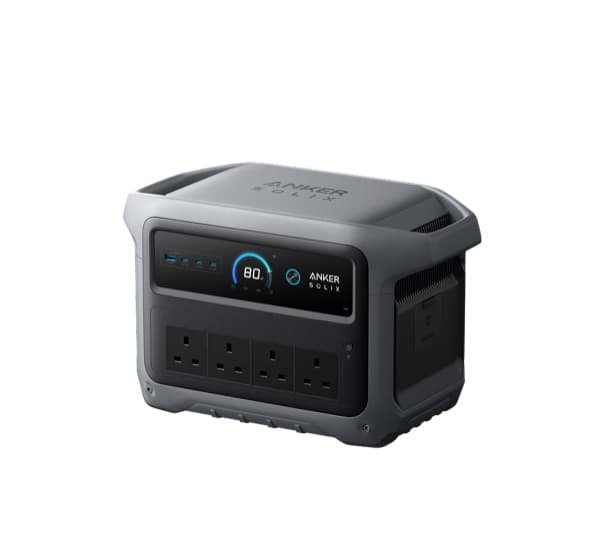
Anker SOLIX C1000 Gen 2
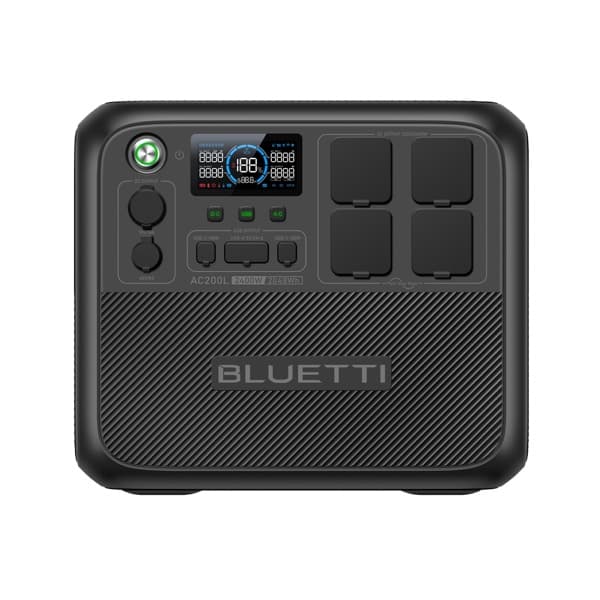
BLUETTI AC200L
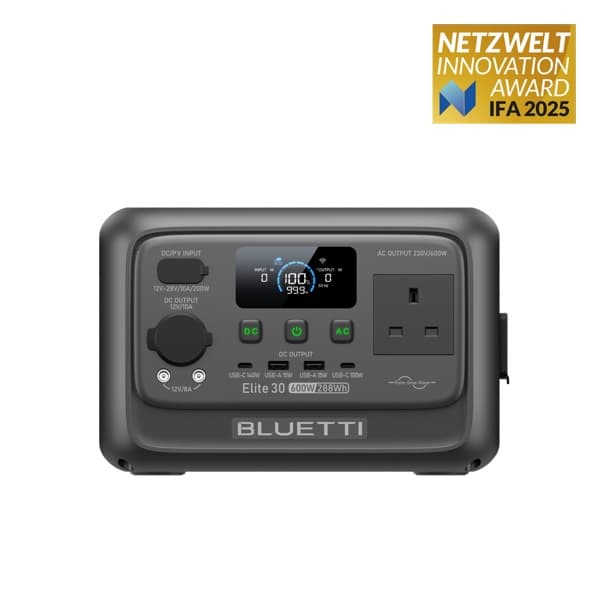
BLUETTI Elite 30 V2
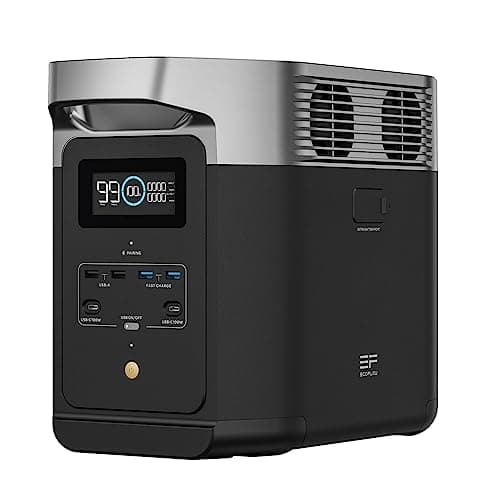
EcoFlow DELTA 3 Classic
EcoFlow DELTA 3 Max
Jackery Explorer 1000 V2
As an Amazon Associate we earn from qualifying purchases. Prices correct as of 22 October 2026, checked against Amazon every few hours.
Compact and Portable (Under £250)
Best Budget Entry
Jackery Explorer 300 Plus
£199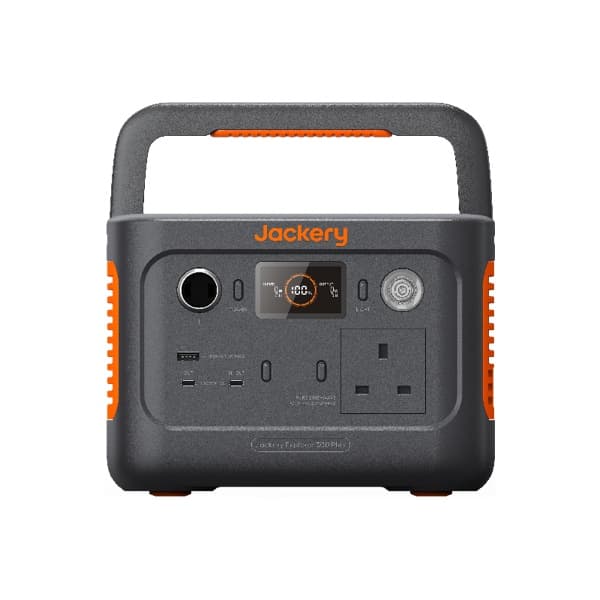
While it's out of stock, consider
 BLUETTI Elite 30 V2 Portable Power Station 288Wh LiFePO4 Battery 600W | Power Lifting 1500W, 10ms UPS, Emergency Backup Power for Home Blackout/Winter Storm, Solar Generator for Camping/Road Trip£239.00 on Amazon
 Jackery Explorer 240 v2 Portable Power Station, 7.7lbs Power On the Go | 256Wh LiFePO4 Battery with 300W AC & 100W USB-C Output, 1Hr Fast Charging, Versatile for Outdoors, Camping, Fishing, Picnics£219.00 on Amazon
This is the unit I'd recommend to a first-time buyer, with one catch: Amazon UK has had it out of stock for a while, so check before you get your hopes up. The BLUETTI Elite 30 V2 below is the same money and the sensible substitute. 288Wh of LiFePO4 capacity, 300W AC output, 3.75kg, and a 100W USB-C PD port that fast-charges laptops directly. The price is right at the floor for "actually worth owning". Jackery's UK warranty is the most established of the small brands, the BMS has 52 safety protections, and the build quality is genuinely good for the money.
The trade-offs are honest. 300W of AC output means you cannot run a hair dryer, kettle, or oil-filled radiator (anything above 300W). It's purely for phones, lights, laptops, small fans, CPAP machines, and chargers. The app is Bluetooth-only so no remote-control over WiFi. And there's no UPS mode worth the name.
Buy this if: you want a sensible camping/festival unit or a small backup for routers and phones during cuts. Don't buy if you think you might want to run a kettle one day.
Best Smart Small
EcoFlow RIVER 3 Plus
£219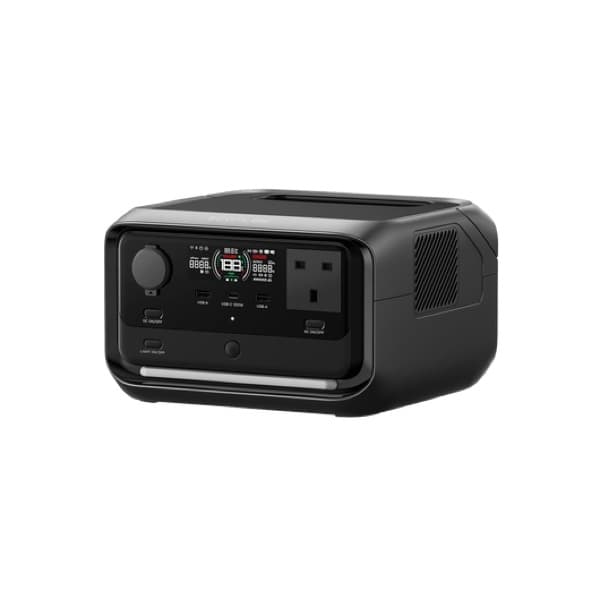
While it's out of stock, consider
- BLUETTI Elite 30 V2 Portable Power Station 288Wh LiFePO4 Battery 600W | Power Lifting 1500W, 10ms UPS, Emergency Backup Power for Home Blackout/Winter Storm, Solar Generator for Camping/Road Trip£239.00 on Amazon
- Jackery Explorer 240 v2 Portable Power Station, 7.7lbs Power On the Go | 256Wh LiFePO4 Battery with 300W AC & 100W USB-C Output, 1Hr Fast Charging, Versatile for Outdoors, Camping, Fishing, Picnics£219.00 on Amazon
EcoFlow's modular design gets a lot right. The RIVER 3 Plus has a snap-in 5,000mAh power bank that pops off when you want pocket power. The 600W AC output (with 1200W X-Boost mode) genuinely runs an air fryer or a 1000W heater, which the Jackery 300 Plus cannot. Not a kettle, though: nothing in this size class will do 3kW. The <10ms UPS is fast enough for PCs and routers. And it's expandable to 858Wh by snapping on an EB600 extra battery if you outgrow it.
It's also got the best app of the small class with proper WiFi rather than Bluetooth-only. Fan can ramp loud under heavy load, but on light use it's near-silent. The EcoFlow expansion accessories are pricey though: better to buy the right size up front than to plan on expanding.
Buy this if: you want X-Boost to handle brief 1200W loads, or you want the option to expand capacity later.
Best Small Home UPS
BLUETTI Elite 30 V2
£239.00Priced level with the Jackery 300 Plus at the time of writing, and the one of the three small units to buy for a specific job: home UPS. The 10ms switchover is fast enough to keep PCs, routers, and even some medical devices alive through a cut. The 1500W Power Lifting mode (a clever software trick that pulses the inverter) handles brief high-draw appliances like the start-up surge of a fridge or a hair dryer. And BLUETTI's 17-year lifespan claim, while marketing, reflects genuinely better-than-average cycle counts.
The 200W solar input is also the best of the small class, which matters if you're using this for an allotment shed or a small off-grid setup. At 4.3kg it's barely heavier than the Jackery 300 Plus despite the better features.
Buy this if: you specifically want a small home UPS, not just a camping battery.
Mid-Range (£400-500)
Best for Site / Tools
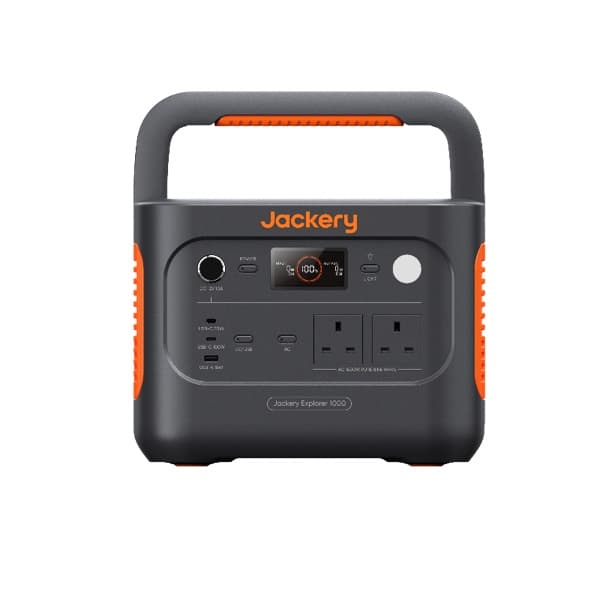
Jackery Explorer 1000 V2
£419.00This is the unit a sparky or carpenter would actually buy. 1500W output handles a 700W power drill or a 1500W circular saw. 3000W surge handles the inrush current of motor-based tools without tripping, which is the number that matters when a saw kicks in. What it won't do is the brew: a site kettle is 3kW continuous and this tops out at half that. 10.8kg is light enough to chuck in a van without throwing your back out. The fold-down handle (new on the V2) actually makes it transportable.
1070Wh is just enough for a working day on light tasks; for a heavy-load day you'll need it on charge between uses. The 1-hour fast charge from mains makes this realistic. No expansion option is the main downside; if you outgrow 1070Wh you're buying a second unit, not a battery.
Buy this if: you'll be running power tools, want a light unit, and don't want to think about app ecosystems.
Best Mid-Range All-Rounder
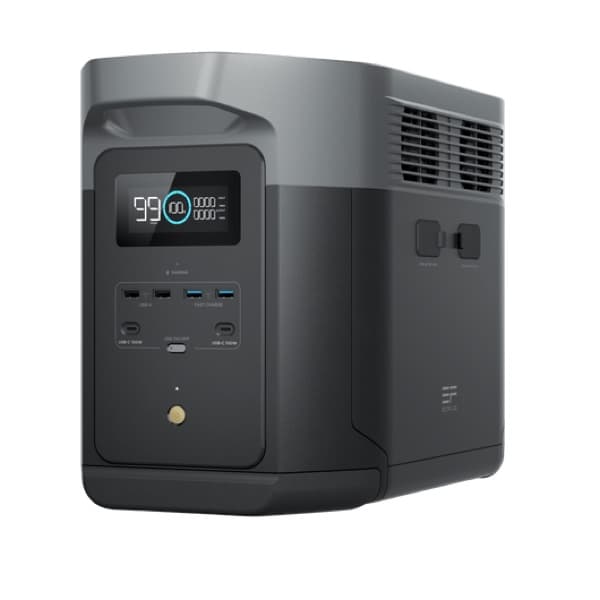
EcoFlow DELTA 3 Classic
£499.00The default recommendation for most buyers. 1800W AC output is the spec that matters: a microwave, a 1500W oil-filled radiator, an air fryer, most hair dryers. 4 AC outlets plus dual USB-C 100W, USB-A, and a 12V car port covers most everyday needs. X-Boost pushes it to 2400W on resistive loads. A 3kW kettle is still out of reach, so don't buy it expecting one. And the EcoFlow app is the most mature in the category with proper WiFi control, scheduling, and grid-aware features.
The one thing you give up against the old DELTA 2 is expansion: the Classic takes no extra batteries, so what you buy is what you get. If you know you'll want more capacity later, spend the extra on the DELTA 3 Plus, which does accept them, or go straight to the DELTA 3 Max. 12.1kg is slightly heavier than the Jackery 1000 V2 for the same capacity, which is the one mark against it. 3000 cycles to 80% means realistically a decade of use.
Buy this if: you want one unit that handles camping, power cuts, and the occasional run of a high-draw appliance.
Fastest Charge: Anker SOLIX C1000 Gen 2
Fastest Charge
Anker SOLIX C1000 Gen 2
£599.00The Anker Gen 2 is the latest in the 1kWh class and it's the most powerful one. 2000W continuous AC output, 3000W peak. Five AC outlets. And the headline feature: Anker's claimed full charge from mains in 49 minutes, which reviewers and owners broadly back up.
If you'll be using this daily, the fast charge is a meaningful win. If you only use it once a fortnight for camping, it doesn't matter as much. The other small win: Anker's customer service is genuinely good, with UK-based support and accessible warranty claims, which can't be said for every brand in this category. Cycle life is the longest of the 1kWh class too: Anker rates the LiFePO4 cells at 4,000 cycles to 80% capacity.
Lighter than the EcoFlow DELTA 3 Classic at 11.3kg vs 12.1kg, with the extra 200W of AC output. Neither unit takes expansion batteries, so the choice comes down to £100 and which app you'd rather live with. The EcoFlow one is the more polished of the two.
Buy this if: fastest mains-charge matters to you, or you specifically want Anker's customer support.
Whole-House Backup (£900+)
Best Whole-House Backup
EcoFlow DELTA 3 Max
£1199.00This is the sensible whole-house backup pick. 2048Wh standalone covers any typical UK cut several times over (Ofgem's reporting works out at about 38 minutes of lost supply per household per year, across roughly 0.4 interruptions). 2400W continuous output runs practically anything in the house, and X-Boost will drive a 3kW kettle at reduced voltage, so it boils slowly rather than not at all. 1000W solar input means it's a credible off-grid unit too.
The 51-minute recharge is the underrated bit. If a cut runs long enough to flatten it, an hour on a generator or a neighbour's socket puts most of it back. The sub-10ms switchover means it works as a true UPS: plug the router, the freezer and the home office through it and nothing so much as flickers when the street goes dark. You build out capacity over months instead of buying a £3000 unit upfront. The same mature EcoFlow app runs everything.
20.3kg means it's not really portable; this lives in a corner of the garage or utility room. It's 3kg lighter than the DELTA 2 Max it replaces, and the 5-year warranty is the longest on this page. Worth doing the maths against just buying the AC200L upfront.
Buy this if: you want serious home backup but want to build out capacity over time rather than spend big upfront.
Biggest Expansion Path: BLUETTI AC200L
Biggest Expansion Path (to 8kWh)
BLUETTI AC200L
£1,199While it's out of stock, consider
 EF ECOFLOW DELTA 3 Max Portable Power Station, 2048Wh LiFePO₄ Battery | 2400W X-Boost Output, Ultra-Fast 0–80% Charging in 51 mins, Solar Generator for Home Backup, Power Outages, RV & Outdoor Use£1199.00 on Amazon
 Anker SOLIX C1000 Gen 2 with AC charging cable, 2000W 1024Wh Power Station | 49 Min Fast Charge, Peak 3000W, Full Charge in 49 Min, Solar Generator for Home Backup, Power Outages and Camping£599.00 on Amazon
The serious off-grid pick, and currently out of stock on Amazon UK, so check before you plan around it. Same 2048Wh standalone as the DELTA 3 Max but with a big expansion path (to 8192Wh), 1200W solar input, and Power Lifting mode that drives brief 3600W loads. There's also a 30A RV output if you're wiring this into a motorhome or van.
The premium over the DELTA 3 Max is £200 for those extra capabilities. Worth it if you'll genuinely use the expansion path (most buyers won't), the 1200W solar input (likely if this is for an off-grid setup), or the RV output (very specific). Otherwise the DELTA 3 Max is the better-value choice.
28.3kg means this is a two-person lift. BLUETTI's UK customer service has been historically mixed, though it's improved over the past 18 months and the brand is now firmly mainstream in the UK.
Buy this if: you're building a serious off-grid or motorhome system over time, or you want the biggest expansion path on Amazon UK.
What About the Really Big Stations?
The 3-4kWh tier (EcoFlow Delta Pro 3 at 4096Wh, Anker SOLIX F3800 at 3840Wh) is mostly out of stock on Amazon UK at the time of writing. Both are excellent products, and both are firmly in four-figure territory: the Delta Pro 3 is a properly serious unit, the F3800 is an off-grid system in a box. We're not quoting prices for either because with no live Amazon UK listing there's nothing to check them against. If you genuinely need 3kWh+ standalone, check direct from the manufacturer rather than Amazon UK, or wait for stock to return. For most buyers, the expandable approach (DELTA 3 Max or AC200L plus extra batteries as needed) gets you there in stages without the up-front hit.
What Real Owners Say
Patterns from thousands of Amazon UK reviews across these eight units:
- The universal Jackery 300 Plus complaint: "It can't run my kettle." This isn't a defect, it's 300W of output. People who don't read specs are perpetually surprised. Manage expectations.
- The universal EcoFlow praise: "The app is excellent." EcoFlow's app ecosystem is meaningfully better than the competition, especially for monitoring solar input over time.
- The Anker C1000 reaction: "Full charge faster than I expected" is the single most common review phrase. The 49-minute charge claim is the real win.
- The BLUETTI compatibility pattern: some reviewers report the older AC200L expanding properly to BLUETTI B300 batteries, others report compatibility issues with newer B300K models. Stick to BLUETTI's compatibility chart rather than guessing.
- The cold-weather complaint: "Capacity dropped 20% in the van overnight at -2C." Expect 20-30% capacity loss between 0-10C and up to 40-50% loss below 0C with any LiFePO4 station. The loss is recoverable once the cells warm up; it's chemistry, not a defect.
- The fan noise pattern: all stations on this list ramp the cooling fan loudly under heavy load. None of them are silent at 1500W draw. Plan placement accordingly.
Solar Pairing: What's Worth It
The "solar generator" marketing on all these units is half-true. They can charge from solar panels, but the manufacturer's matched panel sets are usually overpriced. A generic 100-200W solar panel from Amazon (Renogy, Allpowers, EcoWorthy) will work fine if the voltage is in the station's accepted range (typically 11-60V DC) and the connectors match (usually MC4 or XT60). Adaptor cables are cheap.
Realistic UK summer yield is around 4-5 hours of useful generation per day from a properly angled panel. A 200W panel typically delivers 600-900Wh on a clear UK summer day. That's enough to top up the BLUETTI Elite 30 V2 twice over, or put most of a charge back into an EcoFlow DELTA 3 Classic. In winter, expect roughly a quarter of that with shorter days and more cloud cover.
If you want a proper solar-paired setup that actually keeps a station charged, you need 400W+ of panels and a station with at least 400W solar input. The Jackery 1000 V2 (400W in), EcoFlow DELTA 3 Classic (500W in), Anker C1000 Gen 2 (600W in), DELTA 3 Max (1000W in), and BLUETTI AC200L (1200W in) all qualify. The small units don't.
We've compared the folding panels and 12V kits worth buying, with a month-by-month output calculator for UK regions, in our best portable solar panel guide. Also worth pairing with our solar panel accessories guide if you're going down this route.
What NOT to Buy
- No-name Aliexpress power stations. The price difference between a £150 unbranded "1000W power station" and a £399 EcoFlow DELTA 3 Classic is what you're paying for: a real LiFePO4 cell (not relabelled lithium-ion), a pure sine wave inverter, a BMS that won't catch fire if it overcharges, and a UK warranty that exists. Lithium-ion fires are not theoretical.
- Petrol generators for indoor or flat use. Loud, smelly, illegal to run indoors, need fuel storage, require annual servicing, and produce carbon monoxide. For UK power cut backup, they're the wrong tool. Only consider one if you need sustained whole-house power for days, in which case a generator plus a power station to filter the output is the proper combination.
- Lead-acid leisure batteries. Tempting because they're cheap (£100 for 100Ah / 1.2kWh) but they're 30kg, lose 50% of nominal capacity if you actually use it (lead-acid can only safely discharge to about 50%), and last 200-300 cycles before they're toast. The £399 EcoFlow DELTA 3 Classic is the better value over its lifetime, by a wide margin.
- The 200Wh "ultra-portable" tier. Some units below 250Wh are sold as "USB power banks" with a small AC outlet bolted on. Capacity too small to be useful, AC output too weak to run anything that justifies the AC outlet. Stick to 280Wh+ for actual power station duties.
Power Station vs Petrol Generator vs UPS
| Power Station | Petrol Generator | Desktop UPS | |
|---|---|---|---|
| Indoor use? | Yes | No (CO risk) | Yes |
| Noise | 30-55 dB | 70-90 dB | Silent |
| Maintenance | None | Annual servicing | Battery every 3-5 yrs |
| Refuel | From mains (~1 hr) or solar | Petrol storage | Not applicable (always plugged in) |
| Sustained output | Limited by battery capacity | As long as you have fuel | 5-15 minutes typically |
| Use case | Camping, occasional cuts, off-grid | Multi-day off-grid, contractor work | PC ride-through during brief cuts |
| Cost | £200-£3,000 | £300-£2,000 | £100-£500 |
For 95% of UK domestic buyers, a power station is the right answer. Generators are for contractors and off-grid prepper scenarios; desktop UPSes are for keeping a single PC alive through brief brown-outs.
UK-Specific Considerations
Power cut frequency and duration
UK power cuts are rare, and the headline number gets misread constantly, including by us until we checked. Ofgem's Interruptions Incentive Scheme reports two things: Customer Interruptions, "the average number of supply interruptions per 100 customers", and Customer Minutes Lost, the duration customers lose across the year. So the roughly 38 minutes you see quoted is minutes lost per household per year, not the length of an average cut, and the 0.4 figure is interruptions per household per year. Divide one by the other and a cut, when you actually get one, is closer to an hour and a half. Ofgem's own long-run series (2001-02 to 2024-25) shows both numbers falling steadily. Storm-driven cuts (Arwen, Eunice) can still run 24-72 hours in rural areas, which is why a 2kWh+ unit is worth it if you're rural or coastal. For most urban and suburban households, 1000Wh handles the realistic worst case.
UK plug standards
Every station on this list has UK 3-pin sockets, not Schengen or American 2-pin. Don't import from a US Amazon listing without checking: some sellers ship US plugs even to UK buyers.
Customs and warranty
Buy from Amazon UK or directly from the brand's UK site. Stations bought from US/EU listings can have warranty refused in the UK, and customs charges can add 20-30% to the price.
Cold-weather UK use
UK winters reliably hit 0C in van conversions, sheds, and garages. LiFePO4 cells lose capacity below 10C and can be damaged by charging below 0C. The BLUETTI Elite 30 V2 and AC200L have built-in battery heaters; the Jackery units don't. Worth knowing before buying for a winter motorhome.
Frequently Asked Questions
Our Top Picks
The eight portable power stations in stock on Amazon UK that are actually worth buying, from the £199 budget LiFePO4 entry to the £1,199 expandable whole-house pick.
Jackery Explorer 300 Plus
£199Cheapest LiFePO4 power station on Amazon UK from a brand that actually backs the warranty. The sensible starting point.
EcoFlow RIVER 3 Plus
£219Modular design (snap-in extra battery), built-in UPS, and an X-Boost mode that drives 1200W appliances. The most feature-rich small unit.
BLUETTI Elite 30 V2
£239.0010ms UPS switchover (faster than most competitors) makes this the small unit to buy if you actually want it to keep a fridge or router alive during a cut.
Jackery Explorer 1000 V2
£419.001500W output runs most power tools without complaint, 10.8kg is light enough to lug to a site, and Jackery's UK warranty is the most established of the bunch.
EcoFlow DELTA 3 Classic
£499.00The all-rounder. 1800W runs a microwave or an oil-filled radiator, though not a 3kW kettle, it refills in under an hour, and the 10ms UPS means it doubles as a desk backup. The DELTA 2 it replaces is gone from Amazon.
Anker SOLIX C1000 Gen 2
£599.00Fastest full charge on this list (49 minutes) and the highest sustained AC output at this capacity. The pick if you'll be topping it up between uses.
EcoFlow DELTA 3 Max
£1199.00The sensible whole-house backup pick now the DELTA 2 Max has gone. 2kWh covers any typical UK cut, it refills in under an hour, and the sub-10ms switchover means the router and the freezer never notice.
BLUETTI AC200L
£1,199The biggest expansion path on Amazon UK (up to 8kWh) and the highest solar input. The pick if you're building a serious off-grid or backup system over time.
As an Amazon Associate we earn from qualifying purchases. Prices and stock are checked against Amazon every few hours and may have changed since.
