
The Short Answer
Buy the Dreo 20dB Silent Tower Fan, around £80. It hits the same 20 dB low-speed performance as the cult-favourite MeacoFan for two-thirds the price, has a proper DC motor, and it's Amazon UK's bestseller in the category.
- Levoit 20dB Silent Tower: the other 20 dB DC fan in stock, with a temperature sensor and auto mode, for about a tenner more.
- Duux Whisper Flex 2 Smart: if pure bedroom silence matters more than money, 13 dB Quiet Mark certified and genuinely the quietest tower-style fan you can buy. Often out of stock by the end of summer.
Skip Dyson: it's twice the price for worse performance.
Do You Need a Tower Fan, Or a Portable AC?
Before you buy anything, work out which problem you're actually solving. Air movement and air cooling are different things, and tower fans only do the first one.
- Hot for under 25 days a year, sleep most nights with the window open? A tower fan. Spend £80 to 150 on a quiet DC-motor unit, run it through the season for about £3 of electricity, store it under the bed in winter.
- Top-floor flat under a hot roof, bedroom that stays above 24C all night, struggle to sleep in heatwaves? A fan won't be enough. Read our best portable air conditioner UK guide instead.
- Hot for 30+ days a year and you own your home? Look into an air-to-air heat pump (£1,500 to 3,500 installed). It cools in summer, heats in winter, and lasts 12+ years. A fan is a holding pattern.
Most people in the UK want a fan, not AC. A good tower fan in a bedroom with the window cracked open after midnight handles 90% of British summers, and the energy bill is a rounding error. The rest of this guide assumes you've made that call.
What Actually Matters in a Tower Fan
Most listicles obsess over speed counts and oscillation angles. Those barely matter. What matters is the motor and the noise floor.
DC motor vs AC motor: the only spec that really matters
AC-motor fans (the cheap supermarket type) control speed by varying voltage to the motor itself. The motor whines at different pitches at different speeds, can't run below a certain minimum, and uses 40 to 60W even when "low". DC-motor fans (Duux, Meaco, Dreo, Levoit) control speed electronically: the motor spins smoothly and quietly, and minimum speed can be 5W or below. That's why DC fans can hit 20 dB and AC fans can't. If you want a bedroom-quiet fan, only buy a DC-motor model. The savings in electricity over a few summers also wipe out the price difference.
Noise (in real units, not marketing)
Decibels are logarithmic. A 30 dB fan isn't "twice as loud" as a 20 dB fan, it's about three times as loud to the human ear. Anything claiming to be a "silent" or "whisper-quiet" fan above 30 dB is using the word loosely. The Quiet Mark certification scheme is the one to trust: it actually measures fans in an anechoic chamber, and the badge means something. Duux, Meaco, and Levoit fans on this list all carry it.
Height, oscillation, and reach
A 36 to 40 inch tower fan is the right height to push air across a seated body in a living room or across a standing person in a kitchen. A 54 cm desk fan covers a desk or a bed nicely but won't cool a whole room. 90 degrees horizontal oscillation is standard; vertical oscillation (Meaco, Duux) is the underrated feature that lets the fan push air up at you on the sofa rather than across the floor.
Sleep mode, properly defined
Every fan claims a sleep mode. What it actually means varies wildly. A proper sleep mode does three things: dims or switches off the LED display, ramps the speed down over time, and ideally has a timer that turns it off in the early hours when outdoor temperatures drop. The Duux and the Dreo do all three. Cheaper fans just dim the display.
Running Costs: Why Fans Are Essentially Free
People massively overestimate what fans cost to run. At the current Ofgem price cap rate (26.32p/kWh, average direct debit, 1 October to 31 December 2026), a DC-motor fan on its quiet bedroom setting uses about 5W: that's roughly an eighth of a penny per hour, or 1p for eight hours of overnight running. Even on full speed at 26W, you're looking at 0.7p per hour. Running a Dreo 20dB Silent on full speed eight hours a day for forty days costs about £2.19 for the entire summer.
Compare that to a portable AC at 1,130W, which costs about £95 for the same usage pattern. Fans win on running cost by a factor of roughly forty.
Wattage on Full Speed (lower = cheaper to run)
Costed at the Ofgem price cap rate of 26.32p/kWh (1 October to 31 December 2026).
As an Amazon Associate we earn from qualifying purchases.
Compare any two units (including a portable AC for context) with our calculator:
Fan vs Fan (or Fan vs AC) Running Cost
Pick two units and compare what they actually cost to run over a UK summer. Default values are a quiet bedroom fan on low vs a 9,000 BTU portable AC.
MeacoFan 1056 desk (low, 4W)
Per hour
<1p
Per day
<1p
Per summer
34p
Portable AC: Pro Breeze 9000 BTU (1,130W)
Per hour
30p
Per day
£2.38
Per summer
£95.17
Difference: £94.84 over the summer. MeacoFan 1056 desk is the cheaper one to run, by a factor of 282.5x.
Based on the Ofgem price cap rate for 1 October to 31 December 2026 (26.32p/kWh, average direct debit). Fan figures assume the listed wattage is sustained; in practice DC-motor fans cycle and use less.
Our Picks
All 8 Products Compared
ANSIO 36-inch Tower Fan
Pro Breeze OmniAir 41-inch
As an Amazon Associate we earn from qualifying purchases. Prices correct as of 22 October 2026, checked against Amazon every few hours.
Quiet Bedroom Picks (DC Motor, 20 dB or Below)
Best Value Quiet
Dreo 20dB Silent Tower
£79.99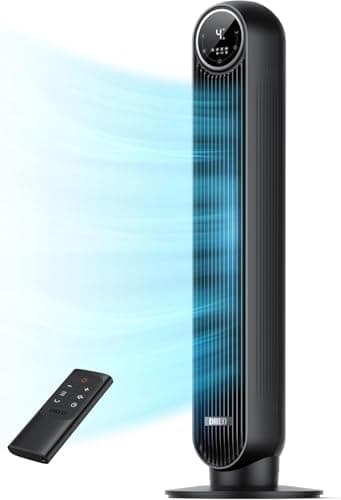
This is the one I'd buy and the one I keep recommending to friends. The Dreo is Amazon UK's bestseller in tower fans for a reason: it hits the same 20 dB low-speed performance as the MeacoFan that costs £50 to 70 more, has a proper DC motor with 8 speeds, and the 28 ft/s airflow at full speed is actually punchier than the Meaco when you need it. The LED display dims at night. The remote is small but works. The 105 cm tower height reaches a seated body in a living room or a bedside in a bedroom without needing to be on a stand.
The trade-offs are honest: the plastic build feels cheaper than the Duux or Meaco, the warranty is one year not five, and there's no app. None of those would stop me buying it. The Meaco's 5-year warranty is genuinely better, but in five years of running a Dreo at 5W on low, you're either going to be fine or you're not, and the price difference covers a replacement either way.
Buy this if: you want bedroom-quiet performance and the best value on this list.
Best for Bedrooms
Duux Whisper Flex 2 Smart
£200 to 250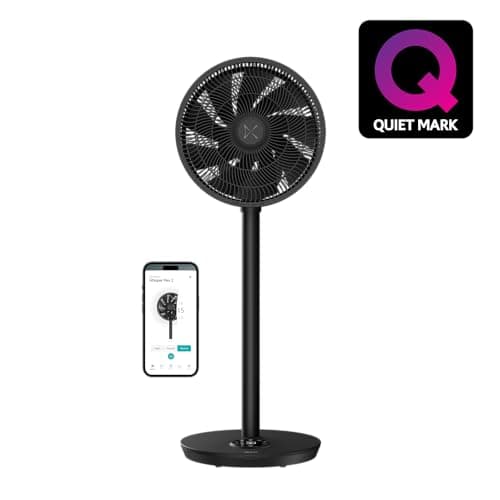
While it's out of stock, consider
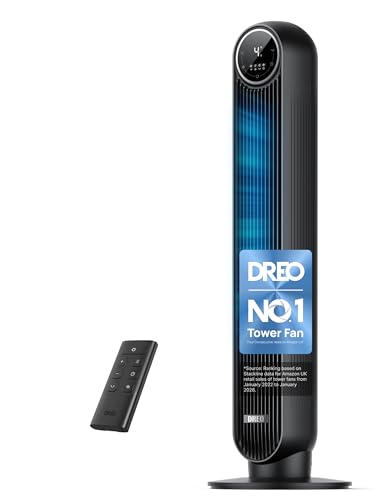 DREO 20dB Silent Tower Fan, 28 ft/s Velocity Electric Cooling Fan with Remote, 90° Oscillating 8 Speeds 4 Modes 8H Timer LED Display, 220-240V, Black£79.99 on Amazon
 Levoit 20dB Silent Tower Fan, 5.5W-26W Energy Saving Fan for Bedroom & Home | Powerful Cooling with DC Motor, 4 Modes 12 Speeds, Advanced Sleep Mode, 90° Oscillation, Remote Control, White&Black£89.99 on Amazon
If quiet bedroom sleep is your single non-negotiable requirement, this is the fan to buy. The Duux runs at 13 dB on its lowest setting (Quiet Mark certified), which is genuinely below the threshold of hearing for most people. I sat next to it at night and could not tell it was on. The Dreo at 20 dB is also quiet, but you know it's running. The Duux you don't.
It also does things other fans don't. It transforms from a 54 cm desk fan to a 92 cm standing fan by lengthening the column, which is genuinely useful in a household where one person wants it in the bedroom and another wants it on the desk. 30 speeds (yes, 30) gives you preposterous granularity. WiFi with Alexa and Google Assistant means you can voice-control it without buying a smart plug. And there's an optional battery pack (sold separately, about £50) that gives you 11 hours of cordless use, which is the killer feature for taking it out into the garden or onto a patio.
The price is the issue. £200+ for a fan is a lot. If your bedroom is genuinely too hot to sleep and noise from your current fan is the reason you're not sleeping, it's worth it. For most people, the Dreo is enough.
Buy this if: you'll pay anything to sleep through a heatwave, or you want one fan that works as desk fan, standing fan, and patio fan.
Best Desk Fan
MeacoFan 1056 (Desk)
£110 to 140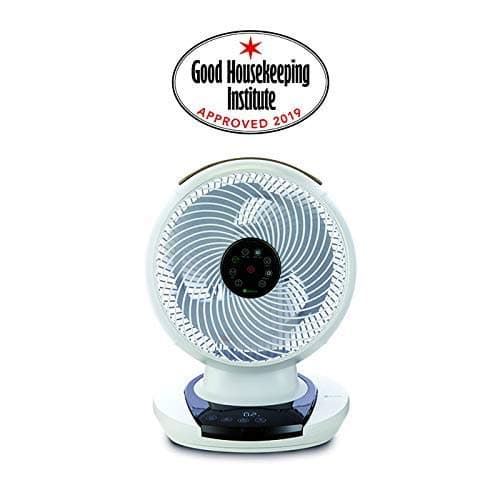
While it's out of stock, consider
 Honeywell TurboForce Power Fan (Quiet Operation Cooling, 90° Variable Tilt, 3 Speed Settings, Wall Mount Feature, Table Fan) HT900E£35.32 on Amazon
 MBSM Air Circulator Desk Fan for Bedroom, 25 dB Quiet Fan with Touch Control & Remote, 3 Speed Table Fan for Home & Office, 70° Auto Oscillation, 90° Manual Tilt, 2 Smart Airflow Modes (Black & White)£42.49 on Amazon
The cult favourite for a reason. The MeacoFan 1056 is a desk-height air circulator, not a full tower fan. It sits on a desk, a bedside table, or the floor next to the sofa. The DC motor is 20 dB on low, 12 speeds, Quiet Mark certified, with both horizontal AND vertical oscillation, which is something most fans skip. That vertical oscillation lets it push air up at your face from a low position, which is great for desk use.
It's the only fan on this list with a 5-year warranty, and Meaco UK customer service is genuinely good. (Worth saying: there's also a MeacoFan 1056P pedestal version, which is a taller standing version of the same fan. Both Meacos price well above the Dreo, which is why the Dreo wins the headline pick. Check the live price on whichever you're looking at, because the gap moves around a lot through the season.)
Buy this if: you want a desk-height fan and you value British support and a long warranty.
Quietest with a Quiet Mark
Levoit 20dB Silent Tower (LTF-F362)
£89.99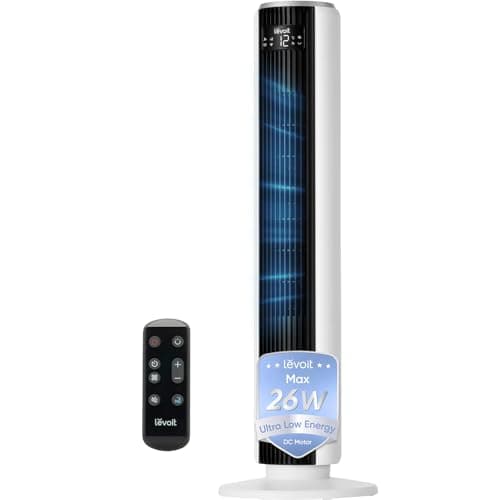
If you want a 20 dB DC-motor fan and the Dreo isn't in stock, this is the next-best option. Same Quiet Mark certification, 12 speeds (more granularity than the Dreo's 8), 5.5W on low (a whisker above the Dreo's 5W), and a built-in temperature sensor with auto mode that adjusts speed as the room warms or cools.
It used to undercut the Dreo, which is why we called it the price-per-decibel pick. It doesn't any more: at the time of writing it's about a tenner more. The build feels slightly less premium than the Dreo and Levoit's UK brand support isn't as well-established as Meaco's. On raw spec it's a Dreo with a temperature sensor bolted on, so buy it for the auto mode rather than for the price, and check both live prices before you commit.
Buy this if: the Dreo is sold out, or you want the auto mode and 12-speed granularity.
Whole-Room and Specialist Picks
Best Budget
ANSIO 36-inch Tower Fan
£35 to 45While it's out of stock, consider
- DREO 20dB Silent Tower Fan, 28 ft/s Velocity Electric Cooling Fan with Remote, 90° Oscillating 8 Speeds 4 Modes 8H Timer LED Display, 220-240V, Black£79.99 on Amazon
- Levoit 20dB Silent Tower Fan, 5.5W-26W Energy Saving Fan for Bedroom & Home | Powerful Cooling with DC Motor, 4 Modes 12 Speeds, Advanced Sleep Mode, 90° Oscillation, Remote Control, White&Black£89.99 on Amazon
This is the fan you buy if your maths is "fan or no fan, and I want to spend under £50." It's an AC-motor fan, so it's louder (54 dB on full, audible across a quiet room) and uses more electricity than the DC fans above (45W vs 5 to 26W). But £40 is £40, it has a big pile of Amazon reviews behind it, the 7-hour timer works, and the "taper" wind mode gradually winds the speed down as you fall asleep, which is a nicer feature than its price tag suggests.
The buttons beep when pressed, which several reviewers find irritating during night-time adjustments. And the AC motor whine is real on the higher settings. For the lounge or a spare bedroom where you'll mostly run it on low and aren't trying to sleep next to it, this is a no-brainer purchase. For a primary bedroom, spend the extra £40 on the Dreo.
Buy this if: you need a working tower fan and £40 is the budget. Don't expect bedroom silence.
Best Budget Bladeless
Pro Breeze 40-inch Bladeless
£70 to 100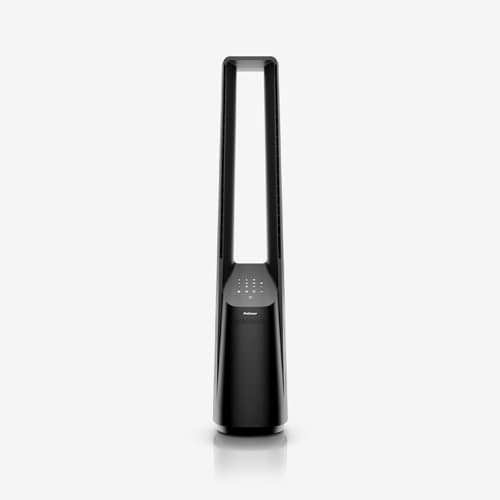
While it's out of stock, consider
- Levoit 20dB Silent Tower Fan, 5.5W-26W Energy Saving Fan for Bedroom & Home | Powerful Cooling with DC Motor, 4 Modes 12 Speeds, Advanced Sleep Mode, 90° Oscillation, Remote Control, White&Black£89.99 on Amazon
- DREO 20dB Silent Tower Fan, 28 ft/s Velocity Electric Cooling Fan with Remote, 90° Oscillating 8 Speeds 4 Modes 8H Timer LED Display, 220-240V, Black£79.99 on Amazon
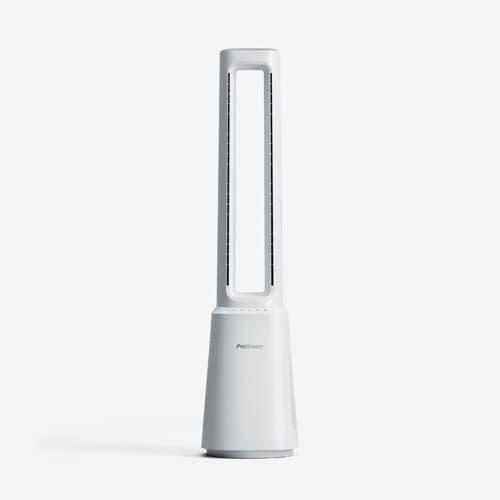
Bladeless fans (Dyson-style) hide the impeller inside the base and amplify airflow through a ring or vents. The benefits are real: safer with toddlers and pets (no exposed blades), easier to clean (wipe with a damp cloth, no taking the front off and dusting plastic vanes), and the look is undeniably better than a traditional tower fan in a modern flat. The downside is that the impeller in the base can still be noisy, and the airflow comes out in a tall, narrow column rather than a wide front.
The Pro Breeze 40-inch is the cheapest bladeless tower fan worth buying. 48 dB on the lowest setting means it's not bedroom-quiet (the DC fans above all beat it), but for a living room or open kitchen it's plenty quiet enough, and the bladeless look gets you most of what people pay Dyson money for, at a fraction of it. Eco, Natural, Fan, and Night modes do roughly what you'd expect; the 15-hour timer is generous.
Buy this if: you have kids or pets and want the bladeless safety, or you just like how it looks.
Best 2-in-1 (Fan + HEPA Purifier)
Pro Breeze OmniAir 41-inch
£120 to 150While it's out of stock, consider
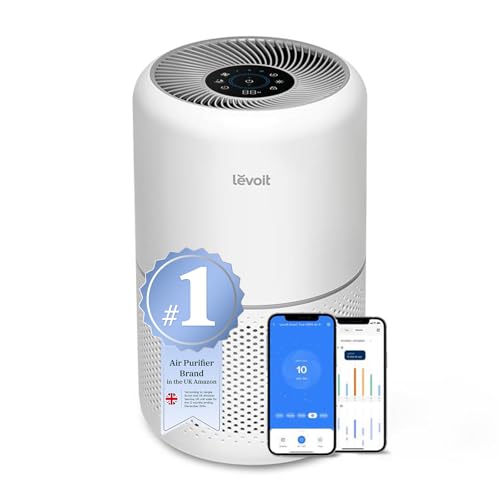 Levoit Smart HEPA Air Purifier for Bedroom Home, 258m³/h, 108m², Core 300S | Laser sensor with Auto Mode, App control, For allergy & pet homes, remove 99.97% Pollen/Dust/Odour£126.87 on Amazon
- Levoit 20dB Silent Tower Fan, 5.5W-26W Energy Saving Fan for Bedroom & Home | Powerful Cooling with DC Motor, 4 Modes 12 Speeds, Advanced Sleep Mode, 90° Oscillation, Remote Control, White&Black£89.99 on Amazon
This is the pick if you have hay fever, pets, or live somewhere with poor outdoor air quality. The OmniAir is a bladeless tower fan with a built-in HEPA 13 filter. A standalone HEPA air purifier of this quality is £100 to 150 on its own; a decent tower fan is £80 to 150 on its own. The OmniAir gives you both for £120 to 150, which is genuinely good value.
The DC motor runs at 38 dB on low (quieter than the Pro Breeze 40-inch above, not as quiet as the DC tower fans), and 10 speeds give you fine control. The 4 mm vents are wider than the 2 mm vents on most Dyson-copy bladeless fans, which Pro Breeze claims means quieter airflow. In practice, it does feel less hissy than the cheaper Pro Breeze bladeless.
The catch: replacement HEPA filters are £20 to 30 every six months. Over five years that's £150 to 250 in filters, which is real money. If you don't actually have an air quality problem, just buy the OmniAir's cheaper sibling and skip the running filter cost.
Buy this if: you have hay fever, asthma, pets, or want fan + purifier in one unit.
Best Premium / Most Powerful
Shark TurboBlade TF200SUK
£175 to 250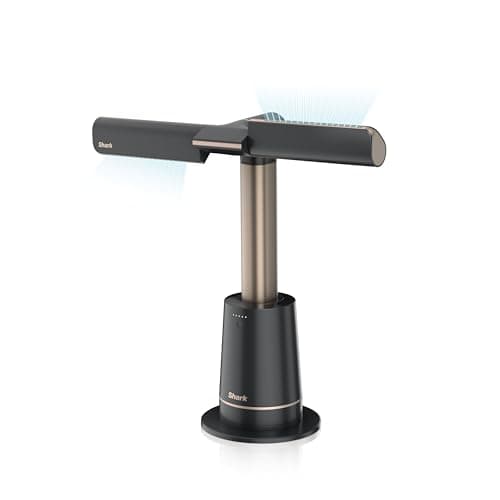
While it's out of stock, consider
- Levoit 20dB Silent Tower Fan, 5.5W-26W Energy Saving Fan for Bedroom & Home | Powerful Cooling with DC Motor, 4 Modes 12 Speeds, Advanced Sleep Mode, 90° Oscillation, Remote Control, White&Black£89.99 on Amazon
- DREO 20dB Silent Tower Fan, 28 ft/s Velocity Electric Cooling Fan with Remote, 90° Oscillating 8 Speeds 4 Modes 8H Timer LED Display, 220-240V, Black£79.99 on Amazon
The novelty pick that actually delivers. The TurboBlade has two pivoting vents on a height-adjustable column, can throw air up to 20 metres (no other tower fan comes close), and pivots horizontally to create what Shark calls a "cooling blanket" across a sofa or bed. The 180 degrees oscillation plus pivot covers a whole open-plan room from one corner.
It's loud at full speed (51 dB) and big enough to be a feature in any room you put it in. But for a large living room or open-plan kitchen/diner where one fan needs to cover the whole space, this is the only one on the list that can actually do it. It swings between about £175 and £250 depending on the season, and it's only properly worth buying at the bottom of that range. At the top of it, the Dreo does most of what you need for a third of the money.
Buy this if: you have a large open-plan room and want one fan to cover the whole space.
What Real Owners Actually Say
I cross-referenced thousands of Amazon UK and Mumsnet reviews across these eight fans. Here are the patterns that repeat:
- The universal MeacoFan complaint: "Why is it so expensive?" People love the fan, hate the price. The Dreo and Levoit get bought specifically as "MeacoFan dupes" and reviewers consistently report being happy with the swap.
- The universal AC-motor complaint: "It's louder than I expected." This applies to the ANSIO, the Pro Breeze 40-inch, and any non-DC fan. Manage expectations: AC-motor fans are not bedroom-quiet at any setting.
- The Dyson regret: A surprising number of reviewers mention buying a Dyson, returning it (or keeping it but resenting it), and switching to a MeacoFan or Dreo. The Dyson AM07 in particular gets reviews like "Looks nice, sounds like a hairdryer."
- The Duux Whisper Flex 2 reaction: Reviewers genuinely struggle to confirm it's on. The phrase "can't believe it's running" comes up repeatedly. The premium feels worth it for light sleepers.
- The Shark TurboBlade reaction: Divided. People who love the bladeless multi-direction concept rave; people who wanted a normal tower fan find it gimmicky and too loud. Read your room.
Noise Levels: What 20 dB Actually Feels Like
Marketing decibel numbers mean nothing without context. Here's what each level feels like in a real room:
| dB Level | Feels Like | Fans at This Level |
|---|---|---|
| 13 dB | Below the threshold of hearing for most people | Duux Whisper Flex 2 (lowest) |
| 20 dB | Rustling leaves at a distance | MeacoFan 1056, Dreo 20dB Silent, Levoit 20dB Silent (all on low) |
| 30 dB | A quiet whisper at 1 metre | Shark TurboBlade (low) |
| 38 dB | A quiet office hum | Pro Breeze OmniAir (low) |
| 48 dB | A quiet library or background traffic | Pro Breeze 40-inch Bladeless (low) |
| 51 dB | Normal conversation at 1 metre | Shark TurboBlade (high) |
| 54 dB | A running dishwasher in the next room | ANSIO 36-inch (high) |
The British Standard BS 8233 recommends a maximum of 30 dB for bedrooms at night. Of the fans here, only the Duux and the three 20 dB DC fans meet that on their lowest setting. Everything else is, strictly speaking, too loud for a bedroom by the standard, even if you adapt to the noise within a night or two.
What NOT to Buy
- Dyson tower fans (the AM07 and the Cool range, both comfortably into three figures and the Cool well past £300). Worse noise performance than the £80 Dreo, higher electricity use, much higher price. The design is lovely. The product, as a fan, is overpriced. The exception is the Pure Cool series with HEPA, but the Pro Breeze OmniAir does the same job for less.
- Evaporative coolers (aka "air coolers"). Sold as a low-cost alternative to AC at £40 to 80. They work by passing air over a wet pad, which only cools when humidity is below about 50%. UK summer humidity is 70 to 85%. On the days you actually need cooling, they barely work. A tower fan does the same job better.
- Cheap supermarket tower fans (sub-£25). AC motors that buzz, plastic bases that wobble, no warranty worth mentioning. The ANSIO at £40 is the floor for "actually worth owning."
- Anything claiming "ice-cooled airflow" without a refrigeration cycle. If it's not an actual AC unit with a compressor, it's a fan with a tray for ice cubes, and the cooling effect lasts about 15 minutes. Don't fall for the marketing.
Tower Fan vs Pedestal Fan vs Desk Fan vs Portable AC
| Tower Fan | Pedestal Fan | Desk Fan | Portable AC | |
|---|---|---|---|---|
| Price | £40 to 250 | £30 to 200 | £20 to 150 | £200 to 900 |
| Running cost/summer | £1 to £5 | £1 to £5 | £0.50 to £3 | £30 to £190 |
| Noise (quiet model) | 13 to 20 dB | 20 to 35 dB | 20 to 40 dB | 47 to 65 dB |
| Actually cools room? | No (cools you) | No (cools you) | No (cools you) | Yes |
| Footprint | Small (vertical) | Medium | Tiny | Large |
| Setup | Unbox, plug in | Some assembly | Unbox, plug in | Window venting needed |
| Best use | Bedroom, living room | Open-plan, garden | Desk, bedside | Top-floor bedroom that won't cool |
The honest takeaway: for most UK summers, a tower fan or a desk fan is the right answer. A pedestal fan trades a bit of footprint for a bit of reach. A portable AC is the answer only when room temperature itself is the problem, not just air movement.
Where to Place Your Tower Fan
Most placement advice is generic. Here's what actually works:
- Point it at you, not at the room. Fans cool people through evaporation, not spaces. A fan blowing across an empty sofa is wasted electricity.
- At night, place it by an open window. Set the fan blowing out of the window for the first hour after bedtime. It pushes hot indoor air out and creates a slight vacuum that pulls cool outdoor air in through other open windows or doors. After the room equalises, turn it around to blow on you.
- During the day, close blinds and curtains first. A fan won't cool a room that the sun is actively heating. Pre-cool the room before the heat hits and the fan can keep it bearable.
- For a baby's room, oscillate, don't point. A direct stream of cool air on a small body for hours can drop their temperature too low. Set the fan to oscillate gently across the room.
- Use the timer. Outdoor temperatures drop after midnight in most UK summers. Setting the fan to turn off at 2 to 3am saves you the energy and the noise once you no longer need it.
When to Buy: Seasonal Price Patterns
UK tower fan prices follow the same pattern as portable ACs:
- March-April: Full stock, lowest prices. The best window to buy.
- May: Prices start creeping up. The Dreo and Levoit are still usually stable; MeacoFan starts spiking earlier than the rest.
- June-July: Heatwave-driven price spikes. MeacoFan stock thins. Dreo holds price better because Amazon's algorithms keep bestseller prices stable.
- August: Patchy stock for the popular models. You'll get what you can get.
- September onwards: Discounts return but selection narrows as models get retired.
Practical tip: if you're reading this in June or later and your preferred fan has spiked in price, the Dreo 20dB Silent has the most stable pricing of the bunch through the summer. It's also Amazon's bestseller in the category, so stock rarely runs out.
Common Myths
- "Fans cool a room": They don't. They move air, which cools your skin through evaporation. If you're not in the room, you're heating it slightly (the motor produces a small amount of heat). Turn the fan off when you leave.
- "Closing the windows makes the fan more efficient": Only sometimes. If outdoor temperature is below indoor, opening the windows and pointing the fan to push hot air out is more effective. If outdoor temperature is hotter than indoor (rare in the UK), closing windows traps the cooler air.
- "Bladeless is automatically quieter and safer": Safer around kids, yes. Quieter, not necessarily; bladeless fans have a hidden impeller that can be just as noisy. The Pro Breeze OmniAir is genuinely quiet because it uses a DC motor; the Dyson AM07 is not because it doesn't.
- "A more expensive fan moves more air": Often the opposite. The £40 ANSIO moves more air at full speed than the £200 Duux on its highest setting. Premium fans price for quiet, not raw airflow. Decide which you're paying for.
- "You need a tower fan, a desk fan, and a pedestal fan": No. One DC-motor unit will handle most rooms. If you need cooling in two rooms at once, get two cheap fans rather than one expensive one.
Frequently Asked Questions
Our Top Picks
The eight tower fans in stock on Amazon UK that are actually worth buying, from the £40 budget pick to the 13 dB premium quiet champion.
Duux Whisper Flex 2 Smart
£200 to 250Quieter than the MeacoFan at 13 dB. The pick if bedroom silence matters more than anything else and you can stretch the budget.
Dreo 20dB Silent Tower Fan
£79.99Same 20 dB low-speed performance as the MeacoFan for two-thirds the price. The smart-money pick.
MeacoFan 1056 Air Circulator (Desk)
£110 to 140Quiet Mark certified, British brand with 5-year warranty. The benchmark for desk-height circulator fans.
Levoit 20dB Silent Tower Fan (LTF-F362)
£89.99A very quiet DC-motor tower fan. Compare it on price against the Dreo, which undercuts it.
ANSIO 36-inch Tower Fan
£35 to 45The honest budget pick. Louder than the DC-motor fans, but at this price you can buy three of them.
Pro Breeze 40-inch Bladeless Tower Fan
£70 to 100The cheapest bladeless tower fan worth buying. Pick this over Dyson if you like the bladeless look but not the £400 price tag.
Pro Breeze OmniAir 41-inch Bladeless Tower Fan + HEPA
£120 to 150The hay-fever pick. Buys you a fan and an air purifier in one unit for less than each would cost separately.
Shark TurboBlade Bladeless Multi-Directional Fan
£175 to 250The novelty pick that actually delivers. If you have a large open-plan room or want one fan to cool an entire living space, this is the only one that can.
As an Amazon Associate we earn from qualifying purchases. Prices and stock are checked against Amazon every few hours and may have changed since.
