
The Short Answer
Buy the Dreo 1500W ceramic heater (£40). It has a thermostat that genuinely holds a temperature rather than clunking on and off, it's quiet, and it has one of the biggest review piles of any heater on Amazon UK behind it. At 39p an hour flat out it's cheaper to run than the 2kW heaters everyone reaches for, and in most rooms you will not notice the difference.
- EMtronics 2kW oil-filled (£33): the budget pick, silent, and the cheapest heater here we'd leave running in a room.
- Ballu 2kW smart WiFi panel (£127): silent, and the app scheduling is the one feature that actually cuts a bill.
- Bedsure heated throw (£40): 3p an hour against 53p for a 2kW heater. For an evening on the sofa this is the best-value thing on the page by a distance.
The thing nobody selling you a heater will say: every mains electric heater is 100% efficient. A £33 oil-filled radiator and a £300 "eco infrared" panel both turn one kilowatt-hour of electricity into exactly one kilowatt-hour of heat. There is no such thing as a more efficient electric heater. All that varies is the wattage, whether it switches itself off, and whether it heats the room or just you.
One-off change this winter: no VAT on electricity
The government has removed VAT from domestic electricity between 1 October 2026 and 31 March 2027. It's already included in the 26.32p/kWh price cap rate we've used throughout this page, so there's nothing to claim. It does mean electric heating is slightly less punishing against gas than usual this winter, and Ofgem warns you can't compare this cap period directly with earlier ones because of it.
The 100% Efficiency Trap
Walk into any shop or scroll any retailer's blog and you'll be told one type of electric heater is cheaper to run than another. Infrared is the usual claim. Sometimes it's ceramic, or "low energy" panels, or tube heaters.
It isn't true, and the physics is not subtle. Every one of these devices is a resistor. You put electricity in, you get heat out, and essentially all of it ends up in the room. A 2kW halogen heater, a 2kW oil-filled radiator, a 2kW fan heater and a 2kW designer glass panel all consume 2kW and all produce 2kW of heat. At the current price cap that is 53p an hour, whichever one you buy.
Compare that with a gas boiler, which loses about 10% up the flue, or a heat pump, which moves three or four times more heat than the electricity it consumes. Those genuinely differ. Electric heaters do not.
So when a listing says "energy saving", what it actually means is one of three things, and only one of them is worth paying for:
- A lower wattage. Real, and it's the main lever. A 600W panel costs 16p an hour because it's 600W, not because it's clever.
- A thermostat and timer. Also real, and the thing worth spending money on. A heater that shuts off when the room is warm, and never runs in an empty room, is the only genuine saving on offer.
- Directional heat. Infrared warms you rather than all the air, so you might be comfortable at a lower setting. That's a real effect, but the saving comes from running fewer watts for less time, not from efficiency.
Everything else is marketing. If a heater costs £250 and the cheap one costs £33, you are buying quietness, looks, controls and build, not cheaper heat.
What Will Your Electric Heater Actually Cost?
Pick the heater and how you'd really use it. Every electric heater is 100% efficient, so this is just wattage multiplied by hours: the answer is the same whatever the box claims.
e.g. EMtronics 9-fin, full power
Cap is 26.32p to 31 Dec 2026
Swapping this heater for a heated throw on the evenings you're sat still would save about £296.89 over the season. It won't heat the room, which is exactly the point: you only pay to warm the person.
Electricity 26.32p/kWh and gas 7.97p/kWh are the Ofgem price cap rates for 1 October to 31 December 2026 (average direct debit, England, Scotland and Wales). Electricity carries no VAT from 1 October 2026 to 31 March 2027; the gas figure includes 5% VAT. Gas comparison assumes a 90% efficient condensing boiler, the heat pump assumes a seasonal COP of 3.5. Your standing charge is payable either way, so it is not included.
What Each Heater Actually Costs
Here's every heater on this page ranked by what it costs to run, at the Ofgem cap rate of 26.32p/kWh. Note how little the type matters and how much the wattage does.
What Each Heater Costs Per Hour
At the Ofgem price cap of 26.32p/kWh (1 October to 31 December 2026). Every one of these is 100% efficient, so the only thing that changes the cost is the wattage.
As an Amazon Associate we earn from qualifying purchases.
The two at the top are the interesting ones. A tube heater and a heated throw cost pennies because they draw almost nothing. Neither of them heats a room. That is the trade, and for a lot of people it's a trade worth making.
Electric Heater vs Central Heating vs Heat Pump
This is the question behind the question. People buy electric heaters to avoid putting the central heating on, so it matters whether that actually works.
| Source | Fuel cost | Efficiency | Cost per kWh of heat |
|---|---|---|---|
| Electric heater (any type) | 26.32p/kWh | 100% | 26.3p |
| Gas boiler | 7.97p/kWh | ~90% | 8.9p |
| Air source heat pump | 26.32p/kWh | ~350% (SCOP 3.5) | 7.5p |
Gas heat costs about a third of electric heat. A heat pump costs slightly less again. So on a straight per-unit basis, the central heating wins every time.
The reason an electric heater can still be cheaper is that it heats one room. Firing the boiler warms the whole house, radiators and all, including the three rooms nobody is in. If you're working from home in one room on a mild day, a 1.5kW heater at 39p an hour genuinely can beat running the boiler for the same hours.
Where it stops working is scale. Two heaters running most of the day through a real winter will cost more than the central heating they were meant to replace, and you'll have a cold house as well. If that's the situation you're in, the honest answer is that no plug-in heater fixes it: the house needs draught proofing and insulation first, and possibly a look at replacing the heating system.
Get free quotes for your home upgrades
Match with approved installers for heat pumps, solar, or insulation and get personalised quotes. Free, no obligation, takes about 60 seconds.
Get free quotesWhat Size Heater Do You Need?
Most people buy too much wattage. It feels like insurance, but a bigger heater doesn't warm a room meaningfully faster: it just costs more per hour whenever it's running, and trips the thermostat sooner. Measure the room and buy for it.
What Size Heater Does Your Room Need?
Buying too much wattage is the most common mistake. Measure the room and you'll usually find you need less than the shop is trying to sell you.
A 1kW to 1.5kW heater is plenty here, which is most of the popular models on their middle setting. Resist buying 2.5kW 'just in case': the extra wattage costs you every hour it runs and warms the room no faster in any way you will notice.
Based on the usual trade rules of thumb: roughly 40W per m³ for a draughty room, 30W average, 20W well insulated. Running costs at the Ofgem cap of 26.32p/kWh (1 October to 31 December 2026). This sizes a heater to hold a room at temperature, it is not a substitute for a proper heat loss survey if you are designing a whole heating system.
Our Picks
All 10 Products Compared
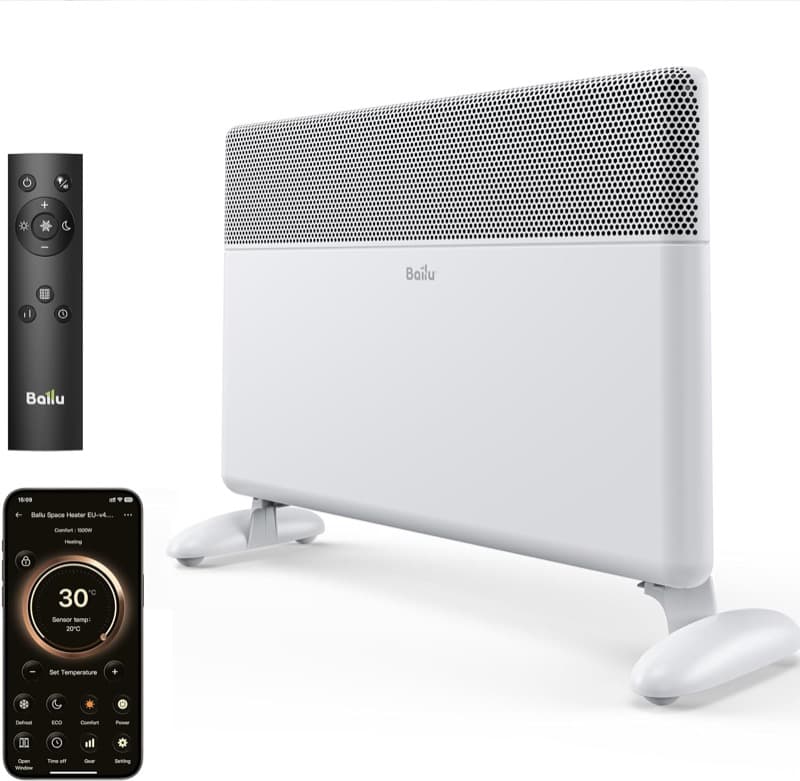
Ballu 2kW Smart WiFi Panel Heater
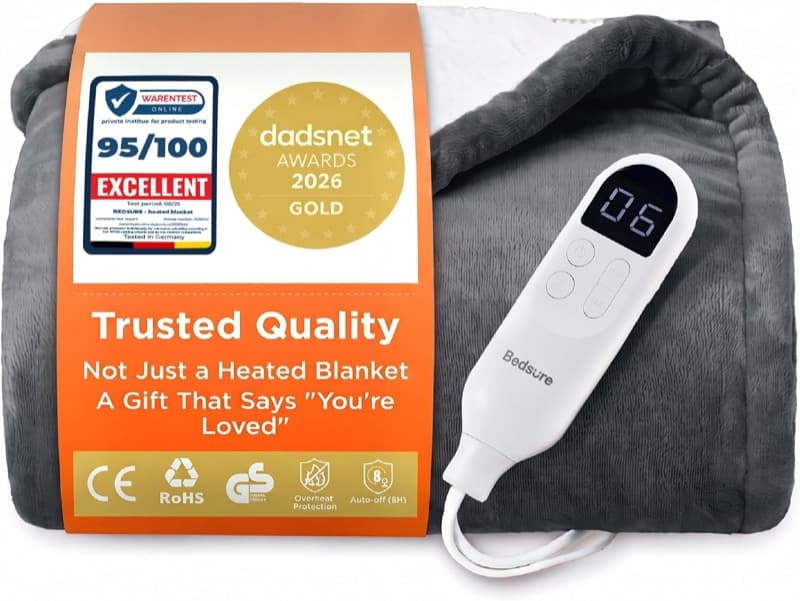
Bedsure 120W Electric Heated Throw
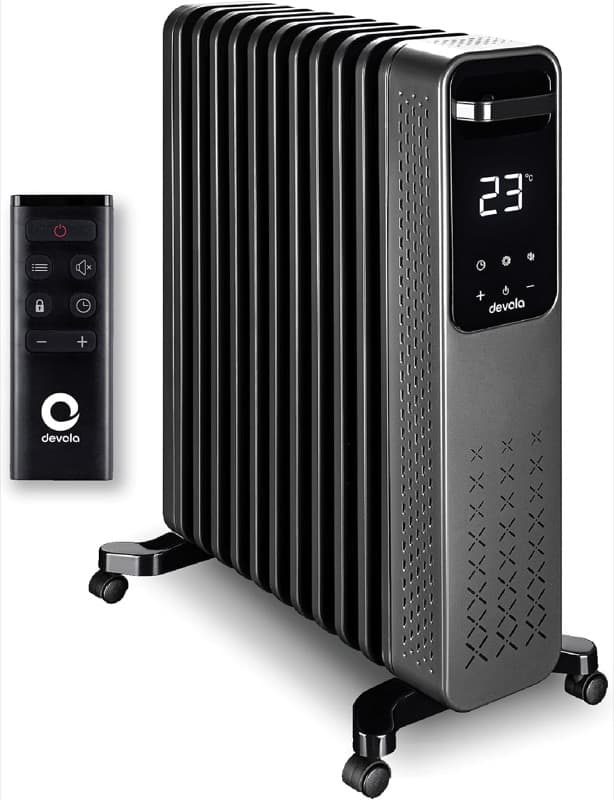
Devola 2.5kW 11-Fin Oil-Filled Radiator
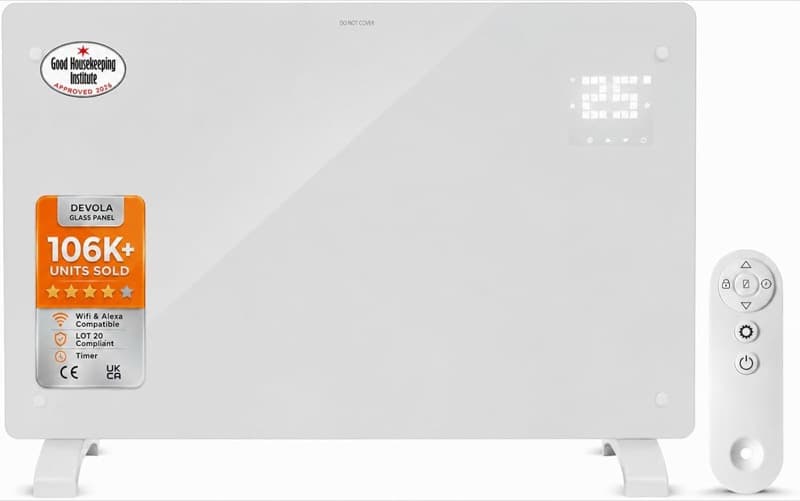
Devola 2kW Smart Glass Panel Heater
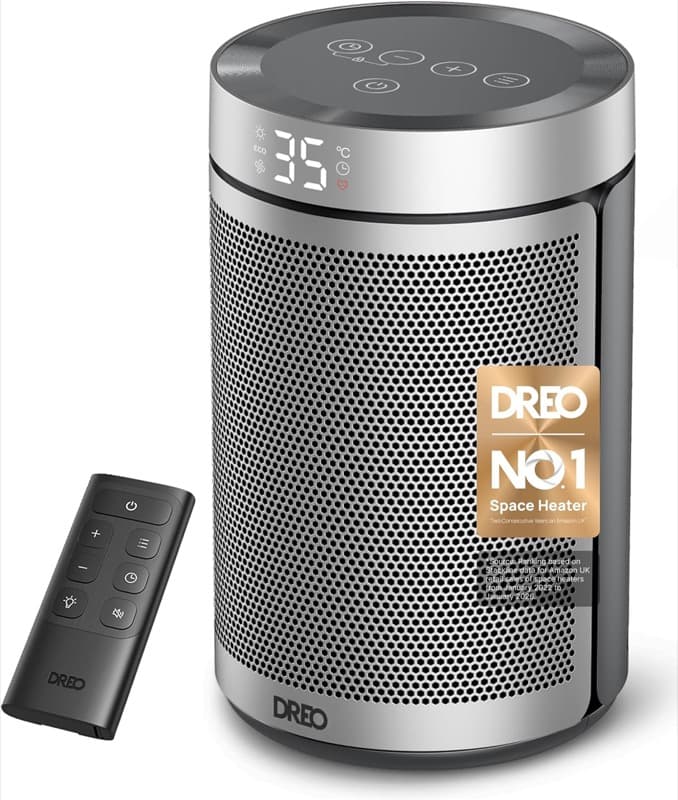
Dreo Silent 1500W Heater
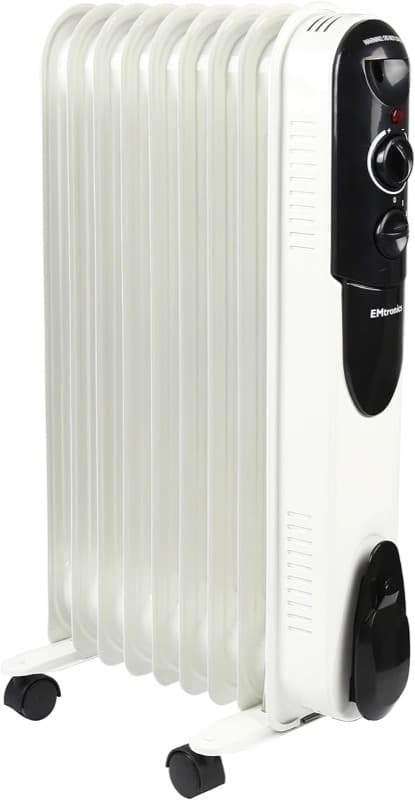
EMtronics 2kW 9-Fin Oil-Filled Radiator
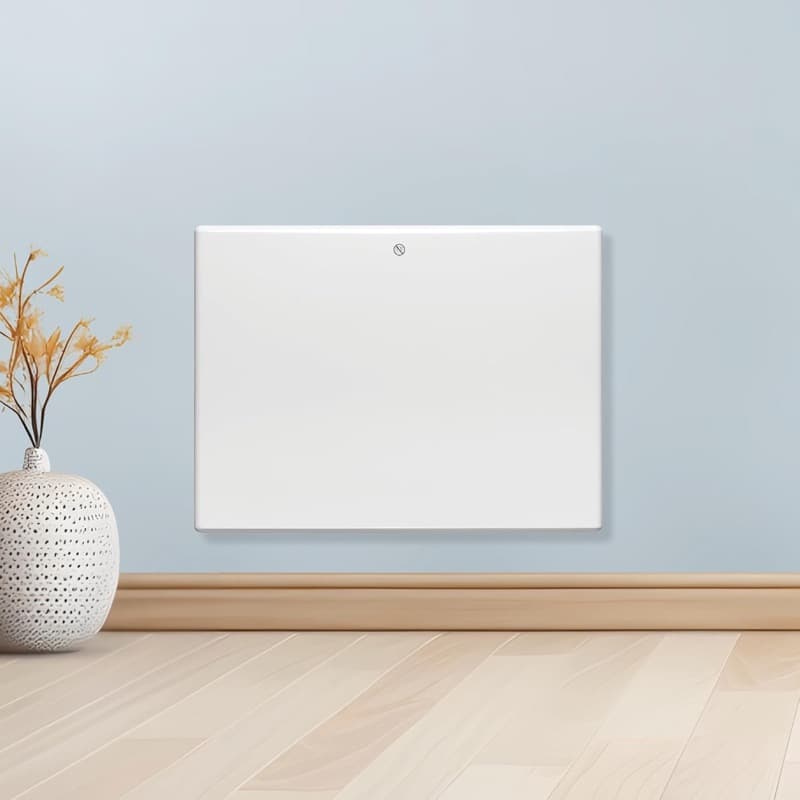
Purus 600W Electric Panel Heater
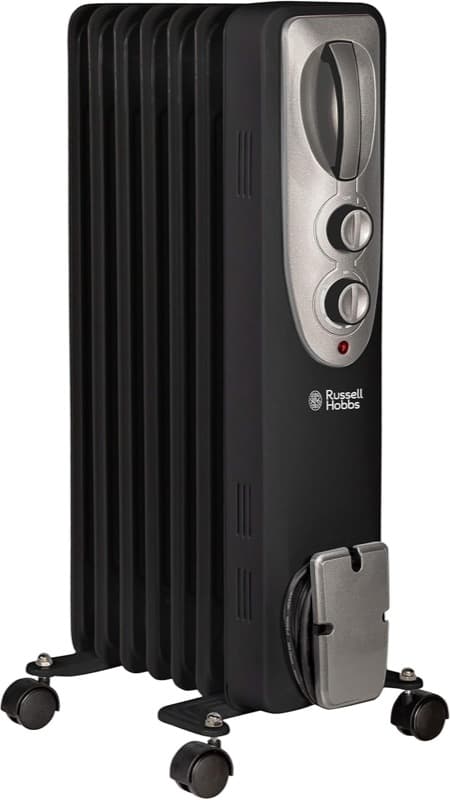
Russell Hobbs 1.5kW 7-Fin Oil-Filled Radiator
As an Amazon Associate we earn from qualifying purchases. Prices correct as of 19 September 2026, checked against Amazon every few hours.
Best Overall: Dreo 1500W Ceramic Heater (£40)
Best Overall
Dreo 1500W Ceramic Heater
£39.99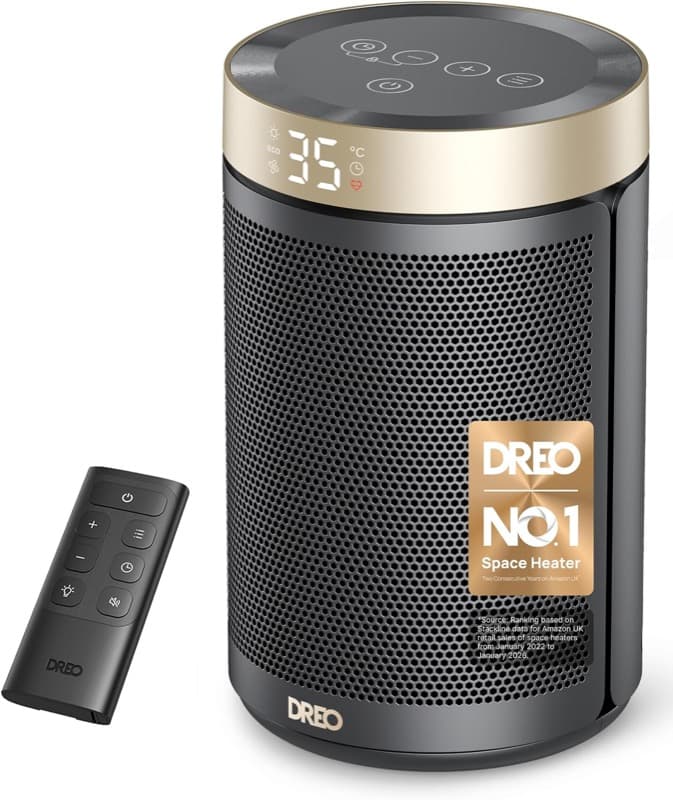
This is the heater to buy if you're only buying one. The reason isn't the heating element, which is the same commodity PTC ceramic everyone uses, it's the control. The NTC thermostat holds a set temperature properly, so the heater spends most of its life cycled off rather than running flat out. That is the difference between 39p an hour and something much less.
It's also fast. From cold, a small room is comfortable in a few minutes, which suits the way most people actually use a plug-in heater: come in, warm up, get on with the evening.
The catch is that it's a fan heater, so there's air movement and a low hum. In a living room with the telly on you won't care. In a quiet bedroom you might, which is what the Silent version is for.
Buy this if: you want one heater that does most jobs well and you don't want to think about it.
Best Budget: EMtronics 2kW 9-Fin Oil-Filled (£33)
Best Budget
EMtronics 2kW 9-Fin Oil-Filled Radiator
£32.99Thirty-three pounds for a silent heater with three power settings and a variable thermostat is a genuinely good deal. Oil-filled radiators have no fan, so there's nothing to hear at all, and the oil keeps giving out heat for a while after the element cuts off.
Use the settings. The temptation is to leave it on 2kW, which costs 53p an hour, when the 800W or 1,200W setting would hold most rooms perfectly well at 21p or 32p. Over a winter that difference is worth more than the heater cost.
What you give up at this price is a timer, so it can't pre-heat a room before you get in, and it's slow: expect fifteen to twenty minutes before it feels like anything is happening.
Buy this if: you want silent background heat in a bedroom or study and you're happy to switch it on and off yourself.
Best for Large Rooms: Devola 2.5kW 11-Fin Oil-Filled (£100)
Best for Large Rooms
Devola 2.5kW 11-Fin Oil-Filled Radiator
£99.99If you've got a big or draughty room, this is the sensible way to throw 2.5kW at it: with a 24-hour timer and a digital display, so it isn't running when you're not there. The three settings (1,000W, 1,500W, 2,500W) are the point. Most of the time you'll run it on low at 26p an hour and only reach for full power on genuinely cold nights.
It's Good Housekeeping Institute approved for 2026 and has a child lock, which matters if you've got small children and a hot radiator in a family room.
Buy this if: you have one big room to heat and want to time it rather than babysit it.
Best Smart Control: Ballu 2kW WiFi Panel (£127)
Best Smart Control
Ballu 2kW Smart WiFi Panel Heater
£127.49Three times the price of our overall pick, and the heat is identical. You're buying two things: silence, because it's fanless natural convection with no moving parts at all, and scheduling.
Scheduling is the only feature on this page that reliably saves money. A heater that comes on twenty minutes before you get home and goes off when you leave never wastes an hour heating an empty room, and wasted hours are where the money goes. If you'll actually use the app, it pays back. If you'll set it once and forget it, buy the Dreo and put the £87 towards draught proofing.
Buy this if: you want a permanent, silent heater in a room you use on a predictable schedule.
Best Low-Wattage: Purus 600W Panel Heater (£59)
Best Low-Wattage
Purus 600W Electric Panel Heater
£59.49The heater nobody thinks to buy, and often the right one. At 600W it costs 16p an hour flat out, less than a third of a 2kW heater. For a small bedroom, a home office, a hallway or a bathroom that is plenty.
The trick is to use it differently. Rather than blasting a cold room, set it to 18°C and leave it: it ticks along, the room never gets properly cold, and you never need the big expensive blast. It's IP24 rated, so it's safe in a bathroom, and it wall mounts.
Buy this if: you have a small room you want kept gently warm rather than rescued from cold.
Cheapest to Run: Dimplex 80W Tube Heater (£32)
Cheapest to Run
Dimplex 80W Tubular Heater
£31.99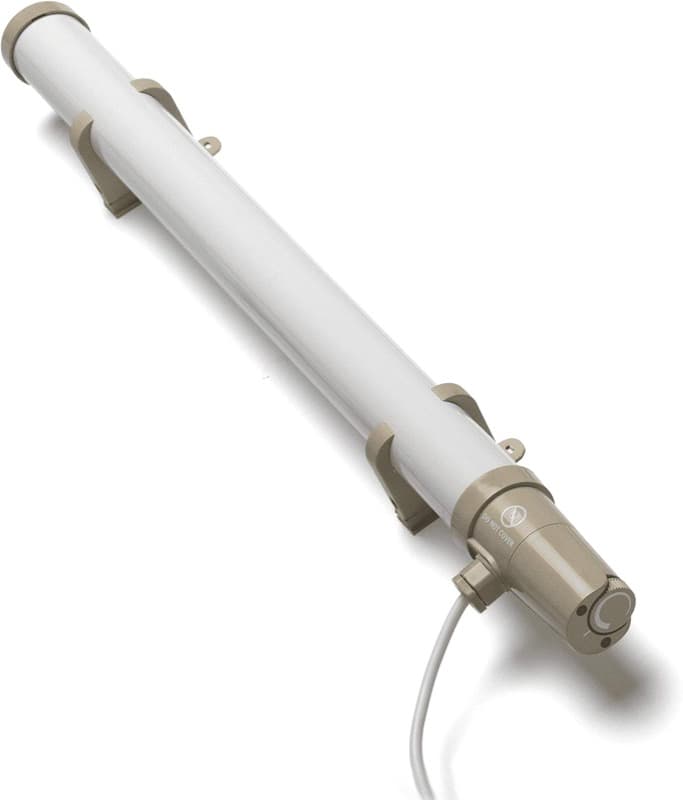
Two pence an hour. It will not heat a room you sit in, and it isn't supposed to. This is for keeping a conservatory, garage, porch, boot room or cupboard above freezing, and for stopping the damp and mould that follow cold surfaces.
If your actual problem is a cold corner that goes mouldy every winter, this is the £32 answer, and a 2kW heater is the £300-a-winter wrong answer. Pair it with a dehumidifier if damp is the real issue.
Buy this if: you need frost protection or damp control, not comfort heating.
The One That Actually Saves Money: Bedsure Heated Throw (£40)
The One That Actually Saves Money
Bedsure 120W Electric Heated Throw
£39.99Three pence an hour. A 2kW heater is 53p. That is not a small difference, it's a factor of about sixteen, and for the specific job of keeping you warm on the sofa of an evening the throw does it better: you feel warm in seconds rather than waiting twenty minutes for the air to catch up.
Run it five hours a night for four months and it costs about £19. The 2kW heater doing the same shift costs about £316.
The honest limitation is that the room stays cold. You can't wander about, and anyone else in the room isn't covered. But if you're sat still watching television, which is when most people put the heater on, it's the best value purchase on this page and it isn't close.
Buy this if: you're mostly sitting still when you feel cold. Which, if you're honest, is most evenings.
What NOT to Buy
- Anything sold as an "eco" or "energy saving" electric heater at a premium price. There is no efficiency to be had. If the premium buys a thermostat, a timer and app control, fine. If it buys the word "eco" on the box, you're paying for nothing.
- Halogen heaters for indoor use. They're cheap and they feel warm instantly because they're radiant, but they're usually 2kW+ with crude controls, the elements fail, and they're a burn and fire risk around children and pets. If you want radiant heat, an infrared panel with a thermostat is the grown-up version.
- A heater bought instead of draught proofing. Sealing a draughty door and window costs £30 to £50 and cuts what any heater has to do, permanently. Do that first. Our draught proofing guide covers what's worth buying.
- More wattage than the room needs. A 2.5kW heater in a 12 m² bedroom will not warm it faster in any way you notice, it'll just cost 66p an hour whenever the element is on.
- Any heater on an extension lead. A 2.5kW heater pulls about 11 amps continuously. Cheap extension leads and multi-way adapters are a well-known cause of heater fires. Straight into the wall socket, every time.
- Electric heaters as a permanent whole-house solution. If you're heating three rooms electrically all winter, you're paying roughly three times what gas would cost for the same warmth. That's a fabric and heating system problem, not a shopping problem.
How to Actually Cut the Bill
In rough order of how much they save per pound spent:
- Heat the person first. A £40 heated throw at 3p an hour instead of a heater at 53p, whenever you're sitting still.
- Never heat an empty room. A timer, a smart plug or app control. This is the single biggest source of waste and it costs almost nothing to fix. Our smart plug guide covers cheap ways to schedule a dumb heater, though note that a plug can't control a heater's own thermostat.
- Drop the wattage. Use the low setting and give it longer. Most rooms hold temperature on a third of peak output.
- Draught proof. £30 to £50, one afternoon, permanent.
- Close the curtains at dusk. Free. Thermal curtains do measurably better than thin ones.
- Shut the door. Heating one room only works if the heat stays in it.
A Note on Standing Charges
None of the figures on this page include your standing charge, which is 54.83p a day for electricity under the current cap. That's deliberate: you pay it whether or not you switch a heater on, so it doesn't change which heater is cheaper. It does mean your actual bill is about £16 a month higher than any running-cost calculation suggests, heater or no heater.
Frequently Asked Questions
The Heaters We'd Actually Buy
Prices and stock come straight from Amazon. Remember the rule: the cheapest heater to run is the lowest wattage that does your job, not the one with 'eco' on the box.
Dreo 1500W Ceramic Heater
£39.99The thermostat is the reason to buy it: it cycles off once the room is warm instead of running flat out, which is where the saving actually comes from.
EMtronics 2kW 9-Fin Oil-Filled Radiator
£32.99The cheapest heater we would leave running in a bedroom. Use the 800W setting and it costs 21p an hour rather than 53p.
Bedsure 120W Electric Heated Throw
£39.99About a sixteenth of the running cost of a 2kW heater. For an evening sat still it does the same job for pennies.
Purus 600W Electric Panel Heater
£59.49A third of the running cost of a 2kW heater. Set it to 18°C and leave it: background heat beats expensive blasts.
Ballu 2kW Smart WiFi Panel Heater
£127.49Scheduling is the only feature that reliably cuts a heating bill. A heater that never runs in an empty room pays for the premium.
Dimplex 80W Tubular Heater
£31.99The cheapest thing here to run. It will not heat a room you sit in, but for frost and damp in a cold outbuilding it is the right tool.
As an Amazon Associate we earn from qualifying purchases. Prices and stock are checked against Amazon every few hours and may have changed since.
